Many organizations view compliance as a routine task, managed with checklists, regular audits, and lots of paperwork. However, they mostly confirm that rules were followed in the past instead of spotting new risks as they appear. Understanding this limitation opens the door to a better way forward.
When regulations change quickly, businesses that respond slowly risk compliance gaps, disruptions, or costly penalties. Being proactive about compliance risk management can help you avoid problems before they arise. Rather than depending solely on manual processes and checklists, modern compliance platforms tap into daily operational data to uncover valuable insights.
This article outlines how Jadian rises to meet compliance and risk challenges with innovative solutions.
What Is Compliance Risk Management?
Compliance risk management means making sure a business follows all the laws, regulations, and internal rules that apply to it. It also explains what could happen if these rules are not followed.
These rules go beyond simply steering clear of penalties. At their core, they shield the organization from disruptions, safeguard its reputation, and preserve the trust it has worked hard to earn.
In practice, this involves:
- Reviewing how work is done
- Finding any gaps
- Taking steps to lower the risk of breaking the rules
Defining Compliance Risk in Modern Organizations
In business today, compliance risk is the possibility that a company does not follow legal or regulatory rules. This risk is not only about breaking rules. It can also mean missing reports, weak internal controls, or using outdated processes that do not keep up with changing standards.
The pace of change makes things even harder. Regulations change quickly, and organizations have to keep up while running smoothly. For this reason, you can’t check compliance risk only once in a while. It requires ongoing attention and clear oversight.
Why Traditional Checklist-Based Compliance Is No Longer Enough
For a long time, teams managed compliance with basic checklists. They would go through the requirements, mark them as done, and continue. While this method worked when things were steady, it often does not meet today’s needs.
The problem with checklists is that they are rigid and do not keep up with real-time changes. They can also overlook new risks, which means issues might go unnoticed until they become bigger problems.
Because of this, many organizations now use more flexible methods based on data and risk assessment tools. Rather than relying just on regular reviews, they use systems that monitor compliance all the time. This approach gives them a clearer and more current picture of risks.
In short, compliance is now about more than just completing tasks. It is now about understanding risks as they happen and responding before they grow.
With that, let us dive in more deeply to understand compliance risk today.
Understanding Compliance Risk in Today’s Business Environment?
The fast pace and global connections of today’s business world affect how companies handle compliance risk. Most businesses face more than one set of rules and often work across different regions and industries, each with its own standards. As a result, staying compliant is now a continuous process instead of a one-time job.
The next sections will look at the current state of compliance risk in today’s business world.
Increasing Regulatory Complexity Across Industries
Regulations are getting more detailed and frequent in almost every industry. Companies now face tougher standards and they must constantly stay compliant. This is particularly true for manufacturing, healthcare, finance, and logistics.
The challenge grows when rules shift from time to time. Sudden updates demand quick adaptation, all while daily operations continue. The pressure spreads across the entire organization, not just the compliance team.
The Cost of Non-Compliance and Operational Blind Spots
Missing compliance gaps can lead to serious problems. You might face more than just fines or penalties. Delays in operations, damage to your reputation, and losing customer trust are also possible.
One challenge is that these problems often start small. Missing an update, skipping a requirement, or missing an issue in one area can grow into bigger problems later. These are known as operational blind spots, and without a solid system in place, they can be difficult to spot.
Compliance rules are becoming more complex, so traditional periodic methods are no longer enough. Today, organizations need better visibility, quicker responses, and a more unified way to manage risk. Because of this, risk and compliance solutions have become essential.
How Compliance Is Evolving Into Predictive Intelligence
Compliance is no longer just about keeping records of past events. It is becoming more proactive, helping organizations anticipate what could happen next and get ready for it ahead of time. This shift is changing how teams handle oversight, make decisions, and manage risks.
Modern risk and compliance solutions are driving this change. They combine data, monitoring, and analysis to help teams act more quickly and make better decisions.
Here is how compliance is shifting into predictive intelligence.
The Shift From Static Reporting to Real-Time Insights
For years, compliance reporting relied on static information. Teams collected data, put together reports, and reviewed them later. This process helped with documentation, but often, problems were only found after they had already happened.
Now, organizations are shifting to real-time insights. Rather than waiting for monthly or quarterly reports, they can see events as they happen. This helps them respond quickly and make changes before small problems become bigger risks.
Risk assessment tools often make this shift possible. They regularly collect and organize data, which helps teams see their compliance status more clearly and stay up to date.
What Makes a Compliance System “Intelligent”
An intelligent compliance system does more than just store information. It looks for patterns, points out unusual activity, and supports decision-making by using data rather than relying only on manual checks.
This technology does not take the place of human judgment. Instead, it makes it stronger. Teams can spend less time looking for problems and more time focusing on what matters most, as highlighted by the system.
Today, this type of intelligence is an important part of compliance risk management. It helps organizations shift from reacting to problems to using data to guide their oversight.
How Data Is Used to Anticipate Risks Before They Happen
One big change in compliance today is how organizations use data. Now, rather than only looking at past events, they also examine future data to find patterns that might reveal new risks.
If small problems keep appearing in a process, it might mean that a bigger issue is beginning to develop. By spotting these patterns early, teams can act before things get out of hand.
Modern risk and compliance tools turn raw data into useful insights. This helps organizations find risks early instead of waiting to react after problems happen.
Today, compliance is about more than keeping records. Attention is now on anticipating risks before they arise. By using data and embracing intelligent systems, organizations can navigate uncertainty with newfound assurance.
How Jadian Turns Compliance Into a Risk Prediction System
As compliance relies more on data, organizations need systems that go beyond simply tracking requirements. They need tools that help them understand these needs as they happen. Jadian offers a more connected and proactive way with its compliance and risk management software.
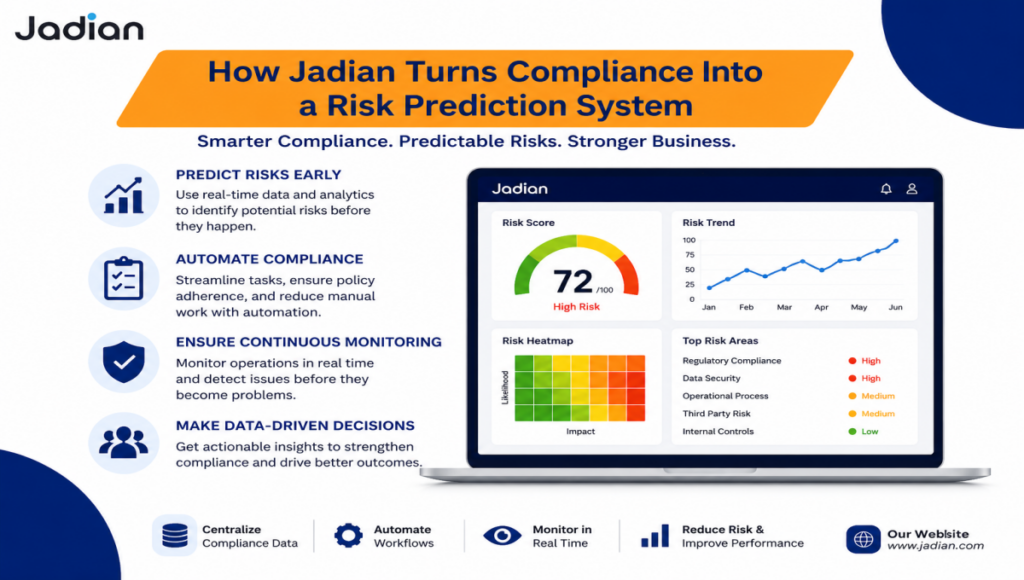
It brings all your compliance tasks together in one place. This helps you find risks early and respond with confidence. Here’s how it works:
Centralizing Compliance Data for Better Visibility
A major challenge in compliance is managing information that is scattered. When data is split between teams, tools, or locations, it is hard to see the full picture.
The software helps by gathering all compliance data in one place. Teams can easily find the most recent information without looking in multiple locations. With everything in a single view, organizations can spot risks and make better decisions.
That is why compliance management software is essential. It streamlines the collection and review of data, ensuring every step is reliable and consistent.
Using Automation to Identify Patterns and Red Flags
Over time, compliance problems can arise if manual checks overlook small, repeated actions.
The platform uses automation to spot these patterns early. Instead of just depending on scheduled checks, it keeps an eye on data all the time and finds any unusual activity or possible problems.
This allows teams to reduce time spent on routine monitoring and concentrate on critical decision-making.
Real-Time Monitoring for Early Risk Detection
Relying on reports or scheduled audits can delay response times. Issues may already have disrupted operations by the time they are documented.
Real-time monitoring lets teams spot events as they occur. This allows them to catch risks early and act before small issues become bigger problems. Having this constant visibility is a key benefit of advanced compliance management software, especially when things change quickly.
Connecting Field Operations With Enterprise Compliance Systems
Compliance is not only a job for management. This problem can happen during daily fieldwork. When these areas are not connected, important details can be missed.
The software connects field operations with enterprise compliance systems so nothing important is missed. It also makes it easy to send data from the field to the main office. This way, leaders have a clearer and more current view of what is happening across the organization.
Jadian recommends a more proactive approach to compliance. Instead of just tracking and reporting, the focus is on visibility, early detection, and a steady understanding of risk.
How to Conduct an Effective Risk Assessment Through Jadian
A risk assessment can be straightforward when it is well-organized and consistent. The main aim is to spot risks, judge how serious they are, and choose the right actions. Jadian’s compliance and risk management software helps teams keep their work clear and easy to manage.
Here’s a straightforward guide to help you complete a risk assessment.
Step 1: Mapping Regulatory Requirements
Start by figuring out which rules and standards your organization needs to follow. These could include industry regulations, company policies, or other compliance requirements.
Jadian puts all these requirements in one place, so teams do not have to look through different documents or systems. When everything is organized, it is easier to see what needs attention and find any gaps.
Step 2: Identifying and Categorizing Risks
After you list the requirements, begin looking for possible risks. Risks might come from processes, operations, systems, or mistakes people make.
Once you find the risks, group them into categories. This approach helps you notice patterns and concentrate on the most important tasks. Having a clear system also helps teams find small issues early, before they become bigger problems.
Step 3: Assigning Risk Levels and Priorities
Risks can vary in how much they affect your business. Some are minor, but others might have a big impact on your operations or compliance.
Now, look at each risk to decide how likely it is and how much it could affect your business. The software helps your team sort and understand these risk levels. This approach helps you see which risks need your immediate attention. It also points out which ones you can simply keep an eye on for the time being.
Step 4: Continuous Tracking and Updates Through Automation
Risk assessment is something you need to keep doing. As your business grows, rules shift, or new issues come up, the risks you face can change in ways you might not see coming.
This is why it’s important to keep a close watch on risks. Jadian’s automated workflow updates risk data right away, so teams don’t have to spend time on manual checks and can easily see their compliance status.
When organizations go beyond scheduled reviews, they can stay ahead and react quickly to changes. This method makes risk management more consistent, clear, and simple, helping teams make better decisions.
Key Benefits of a Strong Compliance Risk Strategy Using Compliance Software
A solid compliance risk strategy keeps organizations prepared, organized, and confident when dealing with regulations. The right compliance management software makes it easier to turn complicated rules into clear, practical steps.
Here are some key benefits organizations often see.
Improved Decision-Making Through Data-Driven Insights
Making good decisions requires accurate information. If compliance data is scattered or out of date, it is difficult to see what is actually going on in the organization.
Compliance software gathers all your data in one place, making it easier for teams to spot risks, trends, and performance. This allows them to catch issues early and respond confidently, rather than guessing.
Over time, this change helps organizations shift from reacting to problems to making better, forward-looking plans. For deeper insights, organizations often leverage data analytics in internal audit.
Reduced Operational and Regulatory Risk Exposure
One of the main goals of a compliance strategy is to reduce risk. This includes avoiding regulatory penalties or violations and preventing problems that could disrupt daily operations.
Risk assessment tools let organizations spot weaknesses early and fix them before they become bigger issues. Seeing these risks early lets teams act quickly to prevent non-compliance or disruptions.
This means risks are found sooner and handled more effectively.
Faster Audit Preparation and Reporting
Audits can be time-consuming, especially when information is stored in different systems or updated manually. Collecting documents and verifying data often becomes a major effort.
Compliance and risk management software helps keep information organized and easy to find. It also makes it faster to create reports because the right documents are already linked to the right processes.
This makes audit preparation easier and helps teams respond to requests quickly and accurately.
Greater Efficiency Through Automation and Integration
Manual processes can make compliance slower and increase the chance of mistakes. Automation takes care of repetitive tasks like data entry, tracking updates, and sending alerts quickly and accurately.
Integration connects systems and teams, so information can move more easily between departments. This helps avoid duplicate work and improves how teams work together.
When automation and integration work together, compliance becomes more efficient and dependable. This helps teams focus on important work instead of getting caught up in routine administrative tasks.
When organizations have a good compliance risk strategy and the right tools, they can stay organized, respond quickly, and keep up with regulations.
Final Thoughts
Compliance has evolved beyond ticking boxes. It is about recognizing risks and empowering people to make smarter choices. As regulations change, businesses need a connected and proactive approach that goes beyond checking boxes or doing occasional reviews.
This is why managing compliance risks matters so much today. When organizations bring together data, processes, and real-time insights, they can find problems before they happen instead of reacting later. Teams can work together with a better view of risk and compliance, rather than staying in separate groups.
The real goal is not just meeting standards. It is to create a system that can adapt, respond, and get better over time. With the right approach, compliance feels less like a burden and more like a steady, reliable part of daily business.
FAQs
What is compliance risk management?
Compliance risk management means finding, evaluating, and addressing risks that come from not following laws, rules, or company policies. This process helps organizations stay compliant and reduce the risk of financial or operational losses.
How does Jadian help with compliance risk management?
Jadian helps you manage all your compliance activities in one place, handles routine work, and provides real-time insights. Your team can find risks earlier, track corrective actions, and use data to prevent compliance problems.
Why is traditional checklist-based compliance not enough?
Traditional methods often focus on past compliance rather than new risks. This approach can make organizations more likely to face regulatory changes, operational problems, or expensive penalties.
In what ways can risk assessment tools contribute to improving compliance?
Risk assessment tools assess operational data to identify potential issues and determine the likelihood of occurrence and potential impact; these tools also assist in prioritization efforts. These types of tools enable companies to operate compliantly and provide additional value to their existing data.
Can compliance software support organizational development and growth?
Compliance software supports the identification of trends, follow-up with respect to completed corrective actions, and provides actionable information. Organizations benefit from the ability to improve their processes, reduce repeat issues, and strengthen compliance over time using this type of software.
Is Jadian suitable for large and growing organizations?
Yes, Jadian can grow with your business and change to meet your needs. It lets you do complicated tasks in one system across multiple departments or locations, which makes it easier to find risks.