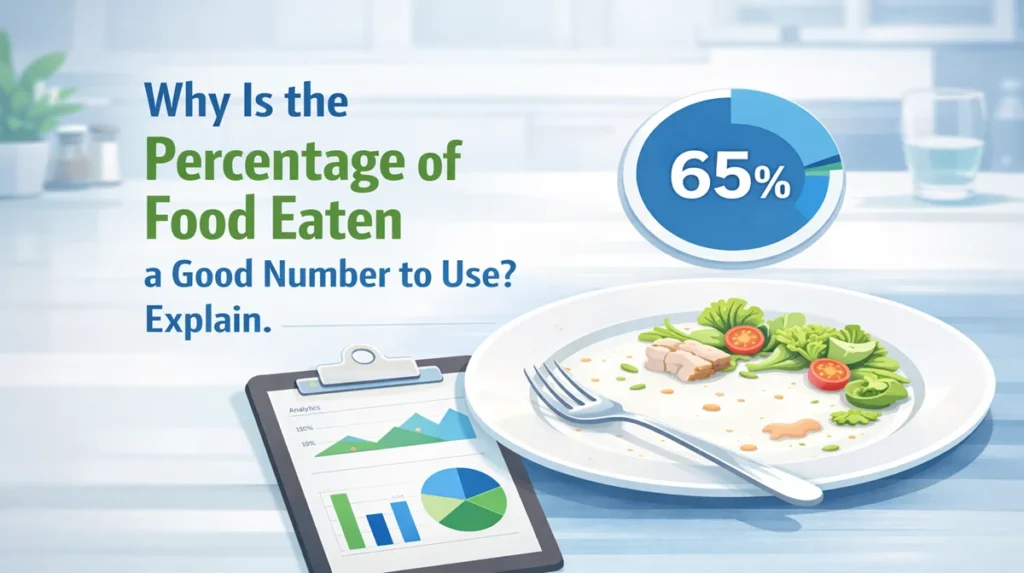
One of the easiest ways to gauge how much food people actually eat compared to what was served is to look at the percentage of food consumed. It reduces messy, real-world eating to a straightforward statistic that is simple to monitor, compare, and enhance. In this blog we will check the answer to the question “Why is the percentage of food eaten a good number to use? Explain.“
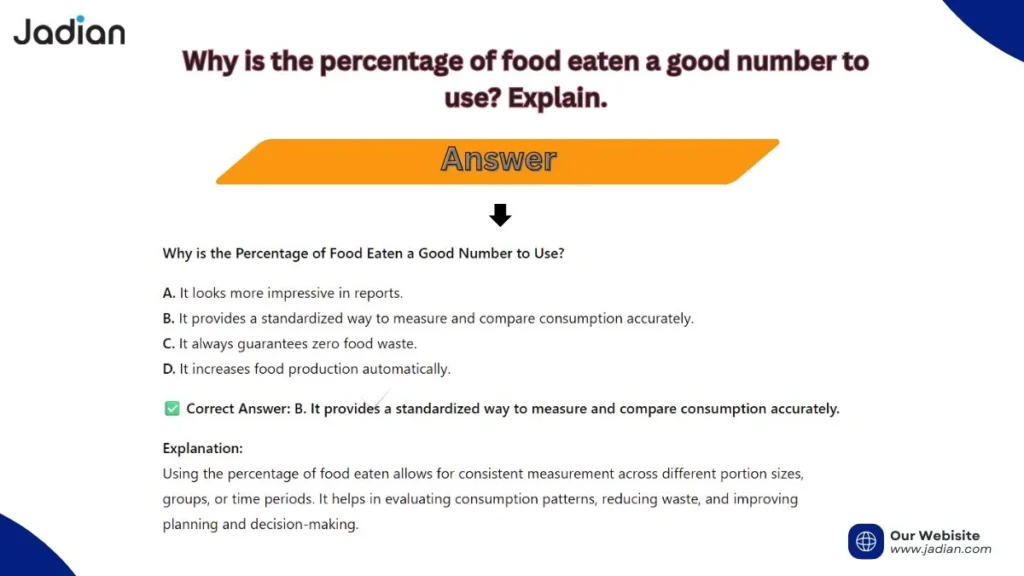
Why is the percentage of food eaten a good number to use? Explain.
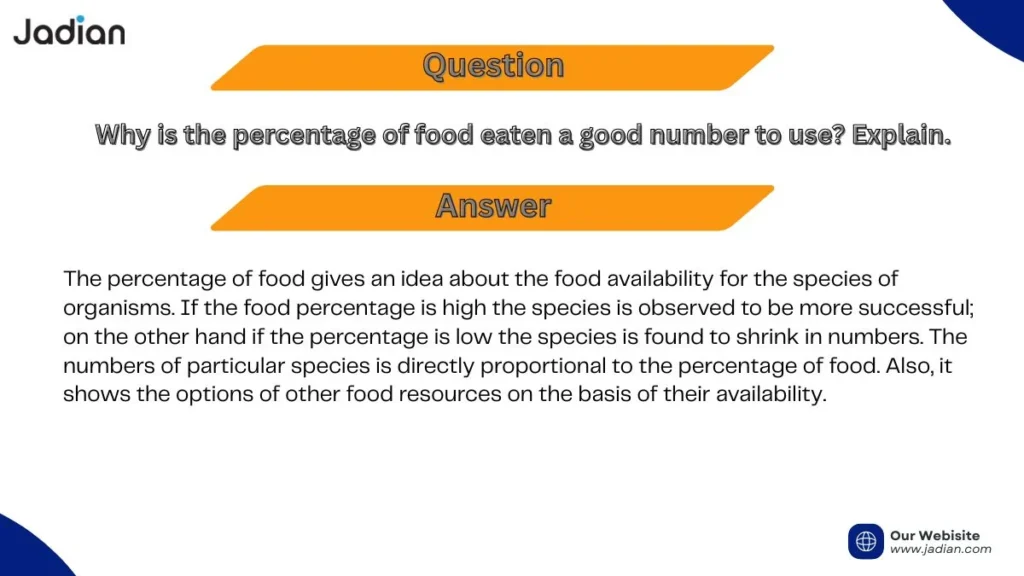
Answer : The percentage of food gives an idea about the food availability for the species of organisms. If the food percentage is high the species is observed to be more successful; on the other hand if the percentage is low the species is found to shrink in numbers. The numbers of particular species is directly proportional to the percentage of food. Also, it shows the options of other food resources on the basis of their availability.
Whether you manage a kitchen, a school canteen, a hospital, or a food business, this metric helps you reduce waste, control costs, and spot problems early. It also supports better food safety routines when used alongside checks and records in a Food Safety Management System.
What does “percentage of food eaten” really mean?
This measure contrasts the amount of food that was served with the amount that was actually consumed. It is easy to read at a glance because it is typically written as a percentage.
One easy way to think about it is:
- 100% eaten indicates that all of the food was eaten.
- 60% consumed indicates that a lot was left over.
- 30% consumed frequently indicates inadequate acceptance, improper serving sizes, or problems with quality.
In many operations, this number is collected through plate-waste checks, tray audits, or meal observations. It can also come from returned food tracking.
How do you accurately measure the percentage of food eaten?
Understanding the concept is one thing. Measuring it correctly is what makes the number meaningful.
The percentage of food consumed is only useful if the information is accurate and consistent. Results can be deceptive and lead to bad operational decisions if there isn’t a clear way to get them.
Step 1: Set the Serving Baseline
You need to say what was served before you can measure what was eaten. Standardized size limits are very important. Your percentage comparisons will be wrong if one shift serves 200 grams of pasta and another serves 250 grams.
Use: standard portion scoops or ladles
- Weighed portions for high-risk or clinical settings
- Guides for staff on how to plate clearly
At this point, consistency makes sure that “80% eaten” means the same thing no matter where or when it is.
Step 2: Pick a way to measure
Different places use different ways to track things.
Some common ways are:
1. The Weigh-Back Method (Most Accurate)
Weigh the food before serving it, and weigh the plate waste after serving.
Formula: (Served weight − leftover weight) ÷ served weight × 100
This is a common way to do things in hospitals, research labs, and big organizations where nutrition accuracy is important.
2. The Visual Estimation Method (the most useful)
Staff use standard visual categories to guess how much is being used:
- 0% eaten
- 25% eaten
- 50% eaten
- 75% eaten
- 100% eaten
With the right training for staff, this method can be surprisingly reliable and take a lot less time.
3. Tracking Tray Audits or Returns
A lot of schools and catering businesses do this. Staff keep track of how many trays come back mostly full and how many come back mostly empty. It doesn’t give exact results, but it quickly shows patterns.
Step 3: Add Codes of Reason
A percentage alone tells you what happened. Reason codes tell you why.
Examples:
- Portion too large
- Taste preference
- Texture issue
- Food too cold
- Late delivery
- Patient unwell
- Menu fatigue
When you add reason tracking to the metric, it becomes more than just an observation.
Step 4: Keep an eye on trends, not just daily numbers.
A bad day doesn’t mean you’ve failed. Over time, trends are more important.
Look for:
- Consistent drops in specific menu items
- Shift-based differences
- Seasonal variation
- Declines after recipe changes
- Improvements after corrective actions
When integrated into a Food Safety Management System, these trends can be aligned with temperature logs, holding times, and sanitation records to see whether operational controls affect meal acceptance.
Step 5: Standardize Reporting
To make the number meaningful across teams:
- Define how often it’s measured (daily, weekly, monthly)
- Define who records it
- Define how it is reviewed
- Set internal alert thresholds (e.g., investigate below 60%)
Clear accountability turns this from “interesting data” into a continuous improvement tool.
Why is the percentage better than just measuring grams or calories?
A percentage instantly adds context. Grams and calories matter, but they often confuse people when portion sizes differ.
For example:
- “150 grams eaten” could be good or bad.
- “75% of the meal eaten” immediately shows strong consumption.
Percentages also make it easier to compare:
- Different menu items
- Different sites or branches
- Different days or seasons
- Different groups (adults vs children, patients vs staff)
That comparability is why this number is widely used in health, catering, and sustainability programs.
How does this metric help food service operations make better decisions?
When food is consistently uneaten, it usually means something is off. The percentage of food eaten turns that “something feels wrong” into evidence you can act on.
It helps teams decide:
- Which dishes should stay on the menu
- Which recipes need improvement
- Whether portions are too large or too small
- Whether service timing affects meal acceptance
- Whether plating, packaging, or holding methods reduce quality
Over time, it supports smarter purchasing and production planning, because the kitchen learns what guests truly finish.
How can it reduce food waste and improve sustainability?
Food waste is expensive and adds to landfill volume and emissions. A high “served but not eaten” rate is often the first sign that waste is happening at scale.
Tracking the percentage of food eaten can lead to changes like:
- Offering two portion sizes.
- Improving menu rotation based on acceptance.
- Adjusting batch cooking to reduce overproduction.
- Improving holding and reheating practices so food quality stays consistent.
- Donating safe, untouched surplus when allowed by local rules.
Even small improvements can create big cost savings over months.
Why is it useful in hospitals, care homes, and clinical nutrition?
In healthcare settings, low meal consumption can signal malnutrition risk. A simple percentage helps caregivers notice patterns fast.
Common thresholds used in practice:
- Regularly below 50% can be a warning sign.
- A sudden drop from normal can signal pain, nausea, swallowing difficulty, depression, or poor food quality.
Because different patients receive different portion sizes, the percentage stays meaningful across varied diets.
What does “low percentage eaten” tell you about food quality and safety?
A low percentage does not automatically mean “unsafe food,” but it can reveal conditions that increase risk if ignored.
An example of this is that low consumption may occur due to:
- Late food was sent out and was chilled.
- Food was stored excessively and withered.
- Smell or touch is altered because of wrong holding.
- Spills or contamination were tolerated in packaging.
- The confidence of the staff was reduced because of poor hygiene.
In food safety, these signals matter. If meals are repeatedly returned, it is worth checking:
- Holding temperatures
- Time-out-of-control limits
- Cooling and reheating logs
- Cleaning schedules
- Allergen control steps
This is where a Food Safety Management System helps connect the “result” (uneaten food) to the “process” (how food was prepared, held, and served).
How can you use the metric inside a Food Safety Management System?
This metric fits well as a supporting KPI. It is not a substitute for HACCP checks, but it introduces transparency into operational reality.
You can use it to:
- Identify repetitive problems with particular menu items following hot holding.
- Determine whether some of the shifts have timing challenges.
- Measured improvement in acceptance of corrective actions.
- Real service outcomes support internal audits.
Example: simple tracking table (weekly)
| Item / Meal | Avg. % Eaten | Common reason for leftovers | Action |
| Chicken rice lunch | 82% | Portion too large | Offer a smaller portion option |
| Pasta dinner | 55% | Dry texture after holding | Review holding time and moisture control |
| Vegetable sides | 48% | Low preference | Adjust seasoning and presentation |
Where does food safety software (like Jadian) help in this process?
Food safety software assists teams to be quicker and record in a superior way. It brings routine checks, corrective actions, and compliance records into one place.
With Jadian Food Safety Software, teams can support this metric by:
- Digitizing temperature checks for cooking, holding, and delivery
- Logging, cleaning, and sanitation schedules are consistently
- Managing corrective actions when limits are missed
- Storing inspection-ready records for audits
- Standardizing SOPs across sites so results are comparable
- Improving traceability when complaints or returns happen
When the percentage of food eaten drops, Jadian can help you review the related records quickly. That makes it easier to confirm whether the issue is recipe acceptance, timing, or a process control problem.
What are the limits of using “percentage eaten”?
This metric is powerful, but it should not be used alone. It can be influenced by factors that are not about food quality or safety.
Common limitations:
- Appetite varies by person and context.
- Some diets restrict intake (medical or religious).
- Portion sizes might be inconsistent.
- People may share food or discard it before measurement.
- Cultural preferences can affect acceptance.
The best approach is to pair it with:
- Portion size controls
- Waste reason codes (why leftovers happened)
- Temperature and time logs
- Guest or patient feedback
How do you improve the percentage of food eaten without raising food safety risk?
Improving consumption should never mean relaxing safety rules. It should mean making food more acceptable while staying compliant.
Safe improvement ideas:
- Right-size portions to reduce forced waste.
- Improve timing so hot food arrives hot.
- Protect food during service to reduce contamination concerns.
- Standardize recipes so taste is consistent across shifts.
- Strengthen hygiene culture so guests trust the food.
Software-supported routines make these improvements easier to sustain.
Why is this number worth tracking?
The percentage of food eaten is simple, but it is not superficial. It connects real outcomes to daily decisions about portions, menu design, timing, and process control. When paired with a strong Food Safety Management System and tools like Jadian Food Safety Software, it becomes even more useful for compliance, consistency, and continuous improvement.
FAQ
Why is the Percentage of Food Eaten a Good Number to Use? Explain.
Answer : The percentage of food gives an idea about the food availability for the species of organisms. If the food percentage is high the species is observed to be more successful; on the other hand if the percentage is low the species is found to shrink in numbers. The numbers of particular species is directly proportional to the percentage of food. Also, it shows the options of other food resources on the basis of their availability.
What is cross-contamination?
Cross-contamination is the spread of harmful germs or allergens from one food, surface, or tool to another. It commonly happens when raw foods touch ready-to-eat foods, or when the same gloves, boards, or knives are used without proper cleaning.
What should food workers use to protect ready-to-eat food from contamination?
Food workers should use barriers and clean tools to protect ready-to-eat food. This includes single-use gloves (when appropriate), deli tissue, tongs, spatulas, and other utensils. They should also use clean, sanitized surfaces and follow handwashing rules.
A food handler must wear single-use gloves when
A food handler must wear single-use gloves when handling ready-to-eat food with bare hands would risk contamination. Gloves must be changed after touching raw food, dirty equipment, the body or face, or any non-food surface. Gloves do not replace handwashing.