

In the financial world, trust and credibility are everything. Clients prefer the experience and expertise offered by professionals. Being certified shows that you know what you are doing and follow standards. In this blog we will have answer to the question “Which Certification is Most Commonly Recognized in the Financial Industry?“.
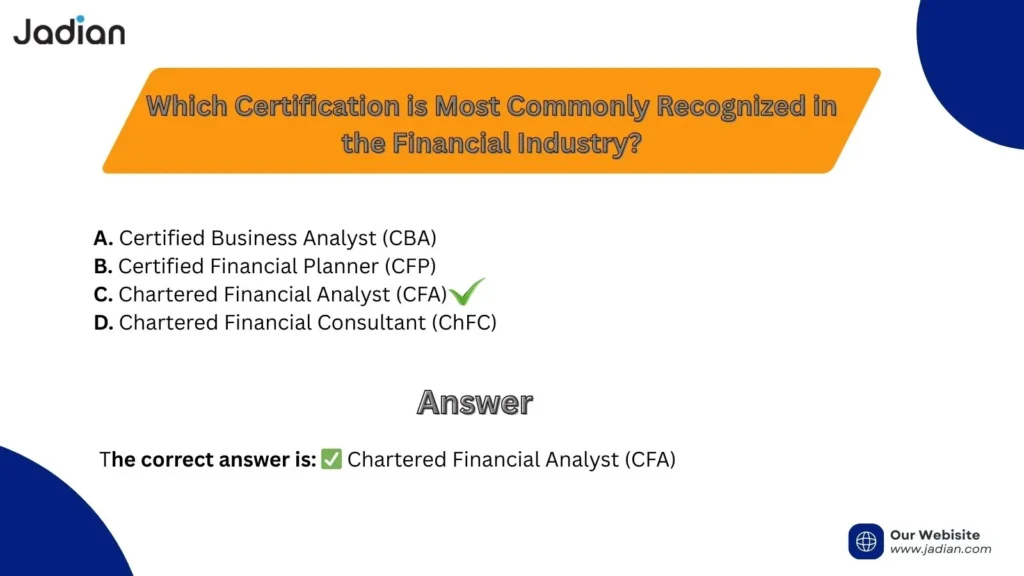
Which Certification is Most Commonly Recognized in the Financial Industry?
A. Certified Business Analyst (CBA)
B. Certified Financial Planner (CFP)
C. Chartered Financial Analyst (CFA)
D. Chartered Financial Consultant (ChFC)The correct answer is: ✅ Chartered Financial Analyst (CFA)
There are many credentials out there, but it is not always clear which certifications are the most trusted іn the industry. Some brands are known worldwide, while others are made for a specific sector or field.
The best certification management software assists businesses in maintaining the records of the certifications of employees, renewing them, and monitoring the teams that are complying with the industry standards.
In this article, we will highlight some of the most respected finance certifications and explain why they are important for both professionals and their employers.
Why Financial Certifications Matter in the Industry
Trust forms the backbone of finance. When people hand over their savings or plan for the future, they count on financial professionals to guide them wisely. Certification helps to demonstrate that professionals are knowledgeable and capable of making skills, training, and integrity decisions. It turns hope into a promise.
Financial certifications have advantages to both the individual and the company. They increase credibility and also assist organizations in complying with the standards of regulation. The reason why many businesses monitor team certifications is to facilitate a good compliance culture.
Management solutions with certification help to keep track of the credentials and update on the renewal dates, and keep the teams certified.
Here are a few more reasons why certifications matter in the financial industry:
Credibility and Professional Standards
Certifications help financial professionals show they are trustworthy. Getting a well-known certification shows they have completed challenging training. It also entails that they have passed difficult exams and are committed to keeping their skills up to date.
Clients usually feel more comfortable when they see familiar credentials next to a financial advisor’s name. This will make clients feel that their advisor is up to industry standards. For organizations, having certified employees builds a strong reputation and shows a commitment to professionalism.
Career Advancement and Employer Expectations
Certifications can help you find new opportunities in many financial jobs. Employers tend to seek applicants who have renowned credentials. These demonstrate to you that you possess the correct knowledge and actual expertise. A certification can assist you in being promoted, having your salary raised, or getting into a more specialized position.
Some companies even encourage or require certifications so employees can move forward in their careers. To help with this, many organizations use certification management solutions to track progress and manage records.
Global vs. Regional Recognition
Certifications do not have the same level of recognition everywhere. Some are respected worldwide, while others are mainly known in specific countries or financial fields.
Knowing this difference can help you choose the right certification. If you plan to work internationally, you might want a credential that is recognized around the world. If you plan to stay local, a region-specific certification might be more useful.
The Most Widely Recognized Financial Certifications
There are many professional credentials in the financial industry. However, only a few have a strong reputation and are recognized around the world. Employers, clients, and regulators respect these certifications because they require hard work, high ethical standards, and continued learning.
The following are some of the most well-known certifications in the financial industry.
Certified Financial Planner (CFP)
An individual working in personal financial planning is a Certified Financial Planner, or CFP. The United States awards this certificate to the CFP Board. Alternatively, organizations such as the Financial Planning Standards Board (FPSB) offer worldwide backing. The certificate is unique, as it encapsulates everything about financial planning.
To get certified, professionals must show they understand retirement planning, tax strategies, estate planning, insurance, and investment management. They also have to follow ethical rules and continue their education to keep their certification.
CFP professionals often work as financial advisors, wealth managers, retirement planners, or consultants. Because they build long-term relationships with clients, the CFP credential helps them earn trust. Companies with many advisors can use certification management tools to ensure everyone keeps up with their education and certification.
Chartered Financial Analyst (CFA)
The Chartered Financial Analyst (CFA) designation is considered one of the most respected certifications in the investment industry. The CFA Institute grants this credential, and it is valued by financial professionals worldwide.
This certification is especially valuable for roles in investment analysis, portfolio management, asset management, and institutional finance. Many investment firms, hedge funds, and financial institutions prefer candidates who have the CFA. This is because it shows strong skills in financial analysis and investment strategy.
The CFA program is known for its tough three-level exam process. Each level covers topics like financial reporting, economics, portfolio management, and ethics. Completing the program requires dedication and years of study. This is why the credential is so well respected in the industry.
Organizations that employ CFA professionals can use certification management tools to track continuing education and membership requirements, helping keep credentials current.
Certified Public Accountant (CPA)
The Certified Public Accountant (CPA) credential is recognized in accounting and corporate finance. In the United States and many other countries, CPAs are licensed professionals who must meet specific education, exam, and experience requirements.
CPAs are important in financial reporting, auditing, taxation, and ensuring companies follow regulations. Many businesses depend on CPAs to keep their financial statements accurate and legal. For this reason, some jobs in accounting firms, corporate finance, and auditing require a CPA certification.
CPAs contribute beyond traditional accounting by providing consulting, financial advising, and leadership services. Their knowledge of financial rules and reporting is valuable in many industries.
Other Important Financial Credentials to Know
Certifications such as CFP, CFA, and CPA are widely recognized, but additional reputable credentials are also available in finance. Many people also earn credentials in risk management, alternative investments, or advanced financial planning.
Since tracking multiple credentials can get complicated, many use certification management software to manage certifications, renewal dates, and education requirements.
Here are some other financial credentials you might want to know about.
Financial Risk Manager (FRM) Risk and Compliance Focus
The FRM certification, which is given by the Global Association of Risk Professionals (GARP), is highly esteemed in risk management. It is esteemed when it comes to financial compliance in banks, investment companies, as well as other financial institutions.
In a nutshell, FRM professionals determine, evaluate, and address financial risks. Risk specialists often handle market risk, credit risk, operational risk, and regulatory compliance. As financial markets become more complex, companies depend more on these experts to prevent financial issues.
To earn the FRM certification, you must pass tough exams and meet experience requirements. This portrays a high degree of expertise.
Chartered Alternative Investment Analyst (CAIA) Specialty Asset Expertise.
CAIA is a designation that concentrates on alternative investments, which is an expanding field in finance. The CAIA Association awards this certification to professionals who manage assets outside of traditional stocks and bonds.
People with a CAIA certification often work with investments such as hedge funds, private equity, real estate, infrastructure, and commodities. As more investors seek to diversify, having skills in alternative assets is becoming more important.
Since this field uses complex investment strategies, the CAIA certification shows that a professional has specialized knowledge. It also demonstrates understanding of the unique risks of alternative investments.
Chartered Financial Consultant (ChFC) – Advanced Financial Planning
The Chartered Financial Consultant (ChFC) is a well-regarded credential in financial planning. The American College of Financial Services provides this program, focusing on advanced planning strategies.
The ChFC program, similar to the CFP certification, covers retirement planning, estate planning, tax strategies, and wealth management. It also goes deeper into some subjects and adds extra coursework to help professionals build their expertise.
Financial advisors who have the ChFC designation often help clients with long-term planning and complex financial decisions.
Certified International Investment Analyst (CIIA) – Global Investment Analysis Credential
The Certified International Investment Analyst (CIIA) is a globally recognized qualification for investment professionals. It is awarded by the Association of Certified International Investment Analysts.
The certification covers investment analysis, portfolio management, and international financial markets. Because it has a global focus, it is especially helpful for professionals who work with international clients or multinational investment firms.
As with many professional credentials, you need to continue your professional development to keep the CIIA certification active.
Bottom Line
Picking the right certification in the financial industry can really shape a professional’s career and help organizations build their expertise.
Some certifications are especially well-known and respected in the financial industry because they are widely recognized and trusted. The Certified Financial Planner (CFP), Chartered Financial Analyst (CFA), and Certified Public Accountant (CPA) are highly respected. They cover important areas such as financial planning, investment analysis, and accounting.
Financial Risk Managers, Chartered Alternative Investment Analysts, Chartered Financial Consultants, and Certified International Investment Analysts each focus on specific areas. This includes risk management, alternative investments, and advanced financial planning.
These certifications enable professionals to gain client trust, prove competence, and create new opportunities. Organizations that help in employee development must adopt appropriate systems.
The certification management software assists businesses in maintaining the credentials up to date and in order. Certification management tools assist the teams in tracking certifications, administering renewal dates, and promoting continuous learning.
When training, certifications, and the right tools come together, professionals and organizations can stay competitive in the fast-changing financial industry. Jadian is the best software which can manager certifications.
FAQs
Which Certification is Most Commonly Recognized in the Financial Industry?
A. Certified Business Analyst (CBA)
B. Certified Financial Planner (CFP)
C. Chartered Financial Analyst (CFA)
D. Chartered Financial Consultant (ChFC)
The correct answer is: ✅ Chartered Financial Analyst (CFA)
Which Certification is Most Commonly Recognized in the Financial Industry?
Some of the most recognized certifications in the financial industry are the Certified Financial Planner (CFP), Chartered Financial Analyst (CFA), and Certified Public Accountant (CPA). Each one shows strong skills in a specific area, such as financial planning, investment analysis, or accounting. These certifications are respected by employers, regulators, and clients because earning them requires rigorous training, passing exams, and ongoing education.
What is the main purpose of completing a certification program?
Getting a certification shows that you are knowledgeable, trustworthy, and interested in industry standards. Having a certification enables financial professionals to receive client and employer trust. It is also able to create additional career opportunities. The certification programs impart valuable knowledge in financial planning, investment management, risk analysis, and compliance.
Which certification is most commonly recognized in the financial industry?
No single certification covers all areas of finance, but the CFA, CFP, and CPA are some of the most well-known. The best choice depends on what you want to do in your career. For example, the CFA is respected in investment management, the CFP is common in financial planning, and the CPA is important for accounting and financial reporting roles.
How do financial certifications help advance a career?
Earning a financial certification can lead to better jobs, higher pay, and more respect at work. Many employers value certifications because they show you are committed to learning and meeting high standards.
How long does it typically take to earn a financial certification?
The time needed to earn a certification depends on your choice. Some take a few months, while others, like the CFA program, require several years to pass multiple exams and gain work experience.
Are financial certifications required to work in the finance industry?
Not every finance job requires certification, but earning one can help you stand out and strengthen your reputation. For example, public accounting roles often require a CPA license for certain tasks.