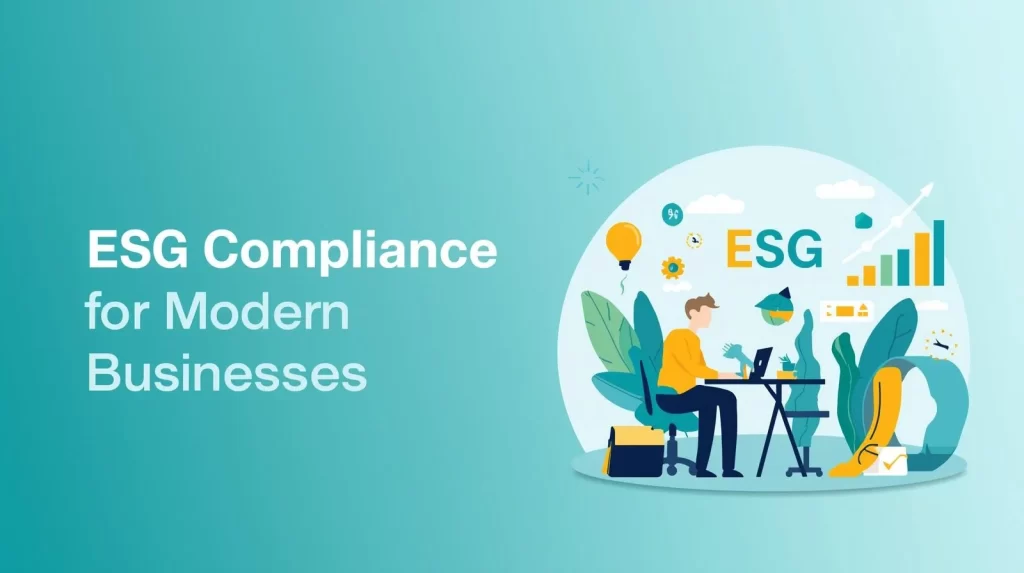
ESG compliance is not a choice anymore, it is a business requirement. Global companies are required to conform to the environmental, social and governance requirements to please the regulators, the investors and the consumers who are insisting on transparency.
Knowledge on ESG compliance is useful in penalties, attracting improved financing and creating competitive advantages. This guide describes the meaning of ESG compliance, the most important regulations and the starting point.
What Is ESG Compliance?
ESG compliance refers to adherence to the laws and regulations of environmental impact, social responsibility, and corporate governance. Companies need to monitor, report and enhance performance on these three pillars.
The environmental pillar includes waste management, energy efficiency and carbon emissions. Organizations calculate the carbon footprint and minimize emission of greenhouse gases. Sustainability should be applied in all the operations.
The social pillar also deals with labour rights, safety in the workplace, and diversity. It encompasses community and human rights. The companies should be fair to the employees and practice ethical supply chains.
The pillar of governance is concerned with corporate leadership and board control. It addresses executive compensation, anti-corruption policies, and financial transparency. Good governance is one that covers ethical decisions at all levels.
The compliance with ESG is becoming obligatory in the global context. Companies are now mandated by governments to disclose sustainability and supply chain due diligence processes in detail.
What Is the Value of ESG Compliance to Your Business?
The compliance of ESG has direct implications on your access to capital, relationship with your supply chain and competitiveness of your market. ESG factors are being incorporated in investment decisions by investors who manage more than 40 trillion funds currently.
Risks arising in regulating are increasing at a high rate. Failure to comply will result in fines and lawsuits and market access. The Corporate Sustainability Due Diligence Directive of the EU imposes a 2% fine to the global turnover of the companies through proper compliance systems.
The demands of the consumers have changed radically. Studies indicate that 78 percent of consumers in the world absorb sustainable products. Large retailers make suppliers adhere to ESG criteria prior to procurement agreements.
Good ESG practices ensure superior financing. Banks consider ESG-compliant companies as less risky investments. They provide good terms of loans and access to more green bonds.
The operation efficiencies are achieved through ESG practices. Businesses that save energy and minimize wastage save money. They also enhance resistance to lack of resources.
ESG Compliance vs ESG Reporting vs ESG Frameworks
These three are complementary yet each has a different value in your sustainability plan. Knowing the difference between them will enable you to develop a successful program.
What Is ESG Compliance?
ESG compliance is the compliance with the legal requirements and regulations. It is a process of conforming to certain laws such as the Corporate Sustainability Reporting Directive by the EU Union. The SB 253 climate disclosure provisions of California are also included in compliance.
When rules govern your business, then, it is non-negotiable. Failure attracts legal punishment and fines. The responsibilities are related to the size of the company, industry, and place.
What Is ESG Reporting?
ESG reporting reports the environmental, social and governance performance to the stakeholders. It reports sustainability activities and developments with the annual reports. You are allowed to make use of special sustainability documents.
According to the report, it may be either compulsory or optional. Compulsory reporting is in adherence to regulatory laws such as the CSRD. Voluntary reporting makes known frameworks to fulfill investor expectations.
Clear reporting develops trust among the stakeholders. It shows responsibility and monitors the progress. Quality reporting needs precise information and verification by the third parties.
What Are ESG Frameworks?
ESG frameworks are a set of guidelines used to measure the performance of sustainability. They set standard measures and reporting standards. This offers uniformity in organizations.
Some of the key frameworks are Global Reporting Initiative (GRI) and Sustainability Accounting Standards Board (SASB). Other important ones include the Task Force on Climate-related financial disclosures (TCFD) and International Sustainability Standards Board (ISSB). Their areas of focus are different.
Frameworks assist in organising your ESG program. They determine material problems in your industry. They also match disclosures with the expectations of investors.
How Do They Work Together?
Frameworks regulate what you are reporting, reporting achieves compliance, and compliance saves your business against a regulatory risk. This combined strategy will provide holistic ESG management.
Begin with the identification of relevant compliance requirements. Choosing frameworks that are congruent with the needs of the stakeholders. Develop reporting systems that are transparent to capture the necessary data.
Top ESG Regulatory Requirements and Standards
The modern international ESG standards are growing at an unremitting pace, with multifaceted compliance environments. Regions do not share priorities or mechanisms of enforcement.
What are the key EU ESG Regulations?
The EU is a leader in the holistic ESG laws. Its structure addresses corporate disclosures, supply chain responsibility, and sustainable finance.
- Corporate Sustainability Reporting Directive (CSRD) means that large companies should issue comprehensive sustainability reports. It requires disclosures on the basis of European Sustainability Reporting Standards (ESRS). It needs to be guaranteed by the third party.
The CSRD is relevant to EU companies having more than 250 employees. The companies whose revenue or assets are EUR40 million or EUR20 million are obliged to comply. Companies based in non-EU countries which have substantial operations in the EU are also eligible. Its implementation extends up to 2028.
- Corporate Sustainability Due Diligence Directive (CSDDD) is a requirement of human rights and environmental due diligence. Firms will have to detect, avoid, and reduce negative effects. This includes business relations and operations.
The CSDDD imposes legal responsibility on collapsing companies because of the failure to undertake due diligence. Companies need to be sustainable in corporate strategy. It needs to have complaint mechanisms of the affected stakeholders.
- EU Taxonomy Regulation establishes economic activities that are eco-friendly. It creates standards on six environmental goals. These are climate change mitigation, adaptation, as well as a circular economy.
Companies that are interested in green financing should exhibit taxonomy consistency. It is used by financial institutions to categorize sustainable investments. It serves to prevent greenwashing of the ESG products.
- EU Deforestation Regulation (EUDR) does not allow the importation of commodities that are associated with deforestation. It deals with cattle, cocoa, coffee and palm oil. There are also rubber, wood products and soy products. Firms have to demonstrate that products are not deforestation-free.
What are the most important US ESG Regulations?
The US ESG regulation is not unified. Disclosure of securities is a concern of the federal requirements. At the state level, there are laws that deal with climate reporting and transparency in supply chains.
- SEC Climate Disclosure Rule (which is on hold) would entail climate-related risks disclosures. Greenhouse gas emissions would be reported by the public companies. Most companies make preparations to meet future needs despite the uncertainty.
- The California law SB 253 ( Climate Corporate Data Accountability Act) requires full emissions disclosure. The scope 1, 2, and 3 emissions have to be reported by the companies with revenue exceeding $1 billion. It is the most restrictive state-level climate law.
- SB 261 in California compels climate risk reporting. Firms that have revenues exceeding 500 million are obligated. It is in line with TCFD recommendations.
- Dodd-Frank Act Conflict Minerals Rule demands sourcing disclosures. The US listed companies are required to disclose tin, tungsten, tantalum and gold. These should be monitored between war torn areas.
What are the UK and Canada ESG Regulations?
The UK Modern Slavery Act sets one slavery and trafficking statement every year. Firms whose revenue is over PS36 million are obliged to do so. Statements should outline measures undertaken to have clean supply chains.
The Act is relevant to both the UK firms and foreign organizations. The companies are required to reveal the organizational structure and due diligence practices. There is a need for risk assessments and measures of effectiveness.
Fighting against forced labour and child labour in Supply Chains Bill S-211 in Canada demands forced labour risk reporting. It is applicable to corporations with particular volumes of revenues.
What are the Key International ESG Reporting Standards?
IFRS S1 and S2 standards were developed by the International Sustainability Standards Board (ISSB). These establish an international benchmark of sustainability reporting. S1 deals with financial disclosures which are related to sustainability on the whole. S2 deals with climate-based needs.
GRI will offer universal reporting standards on sustainability. GRI is concerned with reporting of impacts. It assists organizations in expressing economic, environmental and societal impacts.
Industry-specific standards are provided by Sustainability Accounting Standards Board (SASB). SASB provides financially material sustainability issues on 77 industries. Businesses concentrate on those matters that affect the financial performance.
Task Force on Climate-related Financial Disclosures (TCFD) sets disclosure guidelines on climate risks. It encompasses governance, strategy and risk management. TCFD guidelines are mentioned in many regulations across the globe.
How Do We Become ESG Compliant: Checklist and Practical Steps
It takes proper planning, accountability, and effective data systems to become ESG compliant. A systematic path is essential since it allows you to achieve the needs and develop authentic abilities.
Step 1: What Do You Think of Your Current ESG Position?
Start with an in-depth materiality evaluation. Determine the most important ESG questions to stakeholders. Interview employees, customers, investors and community members.
Carry out a gap analysis with applicable regulations. Check on the review requirement in your jurisdiction and your industry. Record the existing practices and determine gaps.
Compare with the peers in the industry. Study the competitor approach to ESG compliance. Determine best practice and differentiation opportunities.
Checklist items:
- Full materiality evaluation with important parties
- Write relevant ESG policies and systems
- Gap analysis of existing and desired practices
- Compare ESG performance with industry
- Determine risk zones that have to be addressed at once
Step 2: What Do You Do to Establish an ESG Governance Structure?
Have distinct responsibility in ESG compliance. Hire an ESG Compliance Lead or Chief Sustainability Officer. Make sure that such a role is authoritative and resourceful.
Form cross-functional ESG committees. Have legal, finance, operations, and procurement representatives. Include the human resource and communications. Frequent meetings provide co-ordination.
Incorporate ESG in board supervision. Form board level ESG committees or delegate tasks to current committees. Connect executive compensation to ESG performance factors.
Checklist items:
- Hire an executive ESG Compliance Lead
- Establish a multifunctional ESG steering committee
- Assign duties and roles on ESG activities
- Institute ESG oversight systems at the board level
- Connect ESG performance to executive compensation
Step 3: How Do You Come Up with ESG Policies and Procedures?
Develop holistic ESG policies on all material issues. Discuss environmental management and labor practice. Add human rights, supply chain responsibility, and anti-corruption. Conform policies to regulatory demands.
Introduce definite implementation procedures. Emissions tracking and supply chain audit document processes. Add diversity programs and whistle blowing. Make procedures realistic and implementable.
Disseminate policies within the organization. Train all employees. Provide policies on internal portals. Test and certify in order to ensure.
Checklist items:
- Write overall ESG policies on all material areas
- Develop standard operating procedures to implement
- Build employee training on ESG policies
- Develop supplier code of conduct that is consistent with regulations
- Institute whistleblower and grievance
Step 4: What Do You Do to Construct Data Collection Systems?
Install ESG data management software. Spreadsheets cannot support the complexity of reporting today as there are manuals. Collection is facilitated through technology platforms and made more accurate.
Create data collection procedures throughout the operations. Find information owners of every measure. Develop routine reporting schedules. Make certain that there are stable ways of computing emissions and garbage.
Expand information gathering to your supply chain. Demand supplier ESG data. Incorporate emissions, labor practices, and certifications. Adopt standardized questionnaires and third party tests.
Checklist items:
- Select and adopt ESG data management platform
- Determine the data owners of every ESG metric
- Set data collection schedules and protocols
- Design data quality assurance procedures
- Implement supplier ESG data systems
Step 5: What Do You Mean by Supply Chain Due Diligence?
Trace your supply chain past the tier 1 suppliers. Realize the source of materials. Determine the possible ESG risks within the sourcing regions. Plot relationships using mapping tools.
Carry out ESG risk evaluation on suppliers. Enhance the environmental practices and labor conditions. Check the records and standards of governance. Focus on the spend/risk level assessment.
Carry out on-site inspections of the risky suppliers. Make sure that you adhere to your supplier code. Use independent auditors. Deal with non-conformance by using correctional action courses.
Checklist items:
- Full mapping of tier 2 and above of the supply chain
- Perform ESG risk evaluation of all the major suppliers
- Undertake on-site checks on high risk suppliers
- Establish correction action strategies on suppliers who do not comply
- Implement supplier capacity-building and programs
Step 6: What is your ESG Performance Measurement and Reporting?
Make a calculation of your starting ESG measures. Determine the performance of all material topics. Include scope 1, 2, and 3 emissions. Monitor waste production, water use, and diversity.
Establish achievable improvement objectives. Set very specific, time-related objectives. Conform to science based targets and regulatory demands. Make sure that goals are not too high or too low.
Presentation of ESG reports in accordance with chosen frameworks. Disclosure of structure to satisfy legal requirements. Faith communicates effectively to various stakeholders. Add qualitative explanations and quantitative measures.
Checklist items:
- Computations of baseline ESG performance metrics
- Establish precise, quantifiable goals of ESG improvement
- Choose the right reporting structures and standards
- Issue detailed eco-social responsibility reports
- Receive third party confirmation of reported data
Step 7: What Do You Do to Engage Stakeholders?
Issue your ESG reports in the right ways. Publish reports on your Web site. Turn in regulatory filings promptly. Marketing emphasizes research in the form of investor relations.
Get investors involved in ESG performance. Take part in the assessment of ESG ratings. Answer shareholder surveys. Conduct ESG roadshows. Open communication develops trust.
Communicate with employees and communities. Internal communications update the employees. Social responsibility is shown through community engagement.
Checklist items:
- Publication of ESG-reports on company web page
- Give necessary regulatory filings in time
- Answer ESG rating agency evaluations
- Carry out investor ESG road shows and presentations
- Communicate with employees internally via ESG
Step 8: What Are the Ways of Monitoring and Improving?
Institute constant surveillance measures. Monitor the ESG measures on a weekly, or even daily, basis. Issues are identified very fast through real time monitoring.
Carry out frequent compliance audits. Audit compliance with ESG policies and procedures. Conduct internal audits in order to spot weaknesses.
Revise your ESG program due to changes in regulations. Keep a check on the regulation trends in your jurisdiction. Change policies and reporting practices to suit new requirements.
Checklist items:
- Introduce ESG performance monitoring
- Carry out internal quarterly ESG compliance audits
- Monitor regulatory developments in jurisdictions where a firm is operating
- Revise ESG policies and procedures on an as-need basis
- Monitor ESG targets on a yearly basis
What Are Major ESG Compliance Problems?
Challenges encountered by most of the organizations in their attempt to implement the ESG compliance programs are similar. Knowledge of such problems will enable you to come up with effective solutions.
Issue: What to Do with Missing Data?
Gathering credible ESG data is a challenge to many companies. This is more so true in the case of scope 3 emissions. The data is usually in fragmented systems.
Remedy: Adopt centralized ESG data management systems. Develop ownership and collection guidelines of the data. Invest in supplier interactions to enhance supply chain information.
Fiscal: What Can You Do to Defeat Resource Constraints?
ESG compliance takes a lot of time, skills as well as money. Small organizations do not usually have sustainability teams. There might be a lack of specialized knowledge.
Solution: Focus on materiality-based compliance efforts. Outsource specialised consultant knowledge. Partner with other industry players in order to share resources.
Difficulty: How Do You Keep up with the Regulations?
Regulations of ESG are changing at a fast pace in various jurisdictions. It is complicated and time consuming to monitor changes. The study of implications of your business is an ongoing task.
Resolution: Pay for regulatory monitoring services. Participate in ESG industry associations. Create malleability in your ESG program.
Issue: What Can You Do to Make Suppliers Compliant?
The compliance with ESG in the global supply chains is a challenge. A large number of suppliers do not have means to satisfy. The knowledge might be restricted.
Solution: Formulate transparent expectations of suppliers by the use of codes of conduct. Offer capacity-building and training. Apply the tiered strategies that ensure focus on high risk suppliers.
Dilemma: What To Do So As Not To Greenwash?
Greenwashing claims are a result of making unsubstantiated ESG claims. The regulators are raising the questioning of environmental marketing claims.
Solution: Introduce effective verification measures on all claims on ESG. Get third party validation of data reported. Communicate what has been proven. Share restrictions in an open manner.
What Does ESG Best Practice Meaning Long-Term Success?
The top organizations have ESG as a part of the core business strategy and not just as part of compliance. These are the best practices that make ESG leaders and laggards different.
Integrate ESG into company strategy: Incorporate ESG into the planning and capital budgeting. Incorporate it in risk management. Make sure that sustainability objectives are consistent with business objectives.
Be a leader: Get the CEO and board members on board. Frequent communication by the leader is an indication of significance within the organization.
Invest in technology: The use of modern ESG programs that are automated to collect the data. It enhances reporting and precision. Investment in technology has paid down in terms of efficiency and lower risks.
Form supplier alliances: Work together with suppliers to improve ESG. Avoid punitive approaches. Combining efforts in solving problems results in more sustainable supply chains.
Be open and frank: Share the good news and the bad news. Authenticity is preferred to perfection by stakeholders. Openness creates credibility and trust.
Pay attention to constant improvement: ESG compliance is not a project. Put in place procedures of continued monitoring. Integrate learning and improvement of your program.
Frequently Asked Questions:
What does ESG compliance mean?
ESG compliance refers to acting according to the laws and standards that regulate the influence of business on the environment, treating people, and ethical governance. It involves quantifying, reporting as well as refining performance in these aspects.
What is the reason why I need to know whether my company should be ESG compliant?
Regulating checks in your places of operation depending on the size of the company, revenue, industry, and the public listing. Seek legal advice and establish relevant requirements. Voluntary compliance by many companies is also aimed at addressing the expectations of stakeholders.
What are the leading ESG reporting standards?
The main ones are GRI (Global Reporting Initiative), SASB (Sustainability Accounting Standards Board), TCFD (Task Force on Climate-related Financial Disclosures), and ISSB (International Sustainability Standards Board). All of them have various areas of emphasis and disclosures.
What is the time required to achieve ESG compliance?
First compliance normally consumes 12-24 months based on where you are starting, the size of your company and the regulations. The development of effective ESG programs is a process that has to be monitored and improved.
Which are the punitive measures of ESG non-compliance?
The penalties are dependent on jurisdiction, but may include high penalties (up to 2% of global revenue under EU CSDDD) in terms of fines, legal responsibility, loss of market, divestment of investors, and reputation.
Is it possible to make small businesses ESG compliant?
Yes, but the requirements tend to increase with the size of the company. Material issues can be utilized by small businesses, the simplified reporting structure can be used, and the industry resources can be exploited. There are a lot of regulations that exempt smaller companies.
What is the distinction between ESG compliance and sustainability?
ESG compliance is geared towards addressing a given regulatory and reporting requirements. Sustainability is a wider theme that includes the general effect of the company on the environment and society. One of the elements of a holistic sustainability strategy is compliance.
What is the cost of compliance on ESG?
The operational costs depend greatly on the size of the company, its complexity, and its present condition. The first investments are software, consulting, data systems, and training of the staff. Continuous expenses are monitoring, reporting and auditing. Compliance saves operation costs through numerous companies that experience cost savings.
Should ESG compliance be in place among private companies?
Yes, all the more, bigger private enterprises. EU and California laws would be applicable to the use of private companies at certain levels. Investors, lenders, and corporate customers also impose ESG-related requirements on the private companies.
What does an ESG compliance checklist mean?
An ESG compliance checklist presents necessary activities such as, but not limited to, carrying out materiality assessment, governance framework, policy development, data systems, supply chain due diligence, performance measurement and regulation of performance reporting based on relevant frameworks.