Legally, the employer/business owner is responsible. Operationally, it is executed by a designated Safety or HACCP team, often with input from department supervisors and front-line staff. In the food manufacturing and industrial operations, safety isn’t just a regulatory hoop to jump through, it is the bedrock of your business and a core pillar of any effective food safety management system. Imagining that your facility is immune to risks is perhaps the most expensive and dangerous assumption a leader can make. The uncomfortable truth? Every workplace harbors hazards.
From the silent, invisible threat of pathogens in a cooling tunnel to the obvious physical danger of a forklift in a busy warehouse, risks are everywhere. If left unchecked, they don’t just cause downtime; they ruin reputations, drain bank accounts through lawsuits, and, most tragically, change lives forever.
So, the question here is: Who is responsible for conducting a hazard assessment? Whether it falls on the executive leadership, safety management, or the operational staff, the answer is not as simple as you think it is. In a strict food safety management system, identifying who bears this responsibility is important, as it draws a clear line of accountability for potential errors.
In this guide, we’ll provide an in-depth examination of a hazard assessment process. The following sections explore the rules you need to follow, the steps to get the job done, and the role of modern technology, like Jadian, in establishing a clear blueprint for an organization that fosters a culture of safety.
What Exactly is a Hazard Assessment? Beyond the Basics
At its core, a hazard assessment is a detective story where you are the investigator. It is a systematic, documented process designed to uncover potential sources of harm before they turn into headlines. But it’s not just about “spotting danger.” It’s about understanding the relationship between the hazard, the thing that can cause harm, and the risk, the chance that it actually will cause harm.
In the context of a Food Safety Management System (FSMS), we categorize these hazards into three distinct, lethal families:
1. Biological Hazards
These are often called the “invisible killers” because they are tiny or even microscopic. They are also resilient and can multiply fast if conditions are right. In a food safety management system, we are concerned with pathogens, these are microorganisms that cause sickness. Unlike other types of hazards, biological hazards can grow and spread after the product leaves your line if the temperature or packaging is not perfect.
- Examples: Salmonella lurking in raw poultry, Listeria hiding in a floor drain, or mold growing in a ventilation duct.
- The Assessment Challenge: You can’t see them with the naked eye. Assessment here requires swabbing, lab testing, and analyzing temperature logs.
2. Chemical Hazards
These types of hazards are dangerous because they can happen at any stage, making them a major concern for food safety management systems. They can come from the farm (pesticides), the factories (cleaners), or even the food itself (allergens). In modern food safety, allergens are often seen as the most critical chemical hazard due to immediate, life-threatening reactions they can cause in consumers.
- Examples: Excessive pesticide residue on produce, unrinsed sanitizer in a vat, or machine grease dripping into a dough mixer.
- The Assessment Challenge: This requires strict inventory control and reviewing Safety Data Sheets (SDS).
3. Physical Hazards
Lastly are Physical Hazards, these are tangible objects that can cause physical injury to a consumer. Unlike the biological and chemical hazards, physical hazards are one of the most common consumer complaints and can cause massive reputational damage. They often originate from the facility environment itself or the materials.
- Examples: Metal shavings from a grinder, shards of glass from a broken light fixture, or hard plastic from a cracked pallet.
- The Assessment Challenge: This requires keen observation and the use of tools like X-ray machines and metal detectors, often monitored as Critical Control Points (CCPs) within a food safety management system.
The “Risk Matrix” Logic
A professional assessment doesn’t just list these issues; it scores them. You have to ask two questions for every hazard:
- Severity: If this goes wrong, does someone get a papercut, or do we recall a million units?
- Likelihood: Is this a “once in a century” event, or does it happen every Tuesday?
| Risk Level | Description | Action Required |
| Low | Unlikely to occur; Minor injury | Monitor periodically |
| Medium | Could happen; Moderate injury or lost | Implement controls within a set time frame |
| High | Likely to happen; Serious injury or recall | Stop working immediately and fix it. |
Who Holds the Reins? A Breakdown of Responsibility
When we ask “who is responsible for conducting a hazard assessment?,” we are really asking about three different things: Accountability, Execution, and Participation. Understanding the difference between these considerations is the only way to ensure that a hazard assessment isn’t just a piece of paper, but a living safety shield.
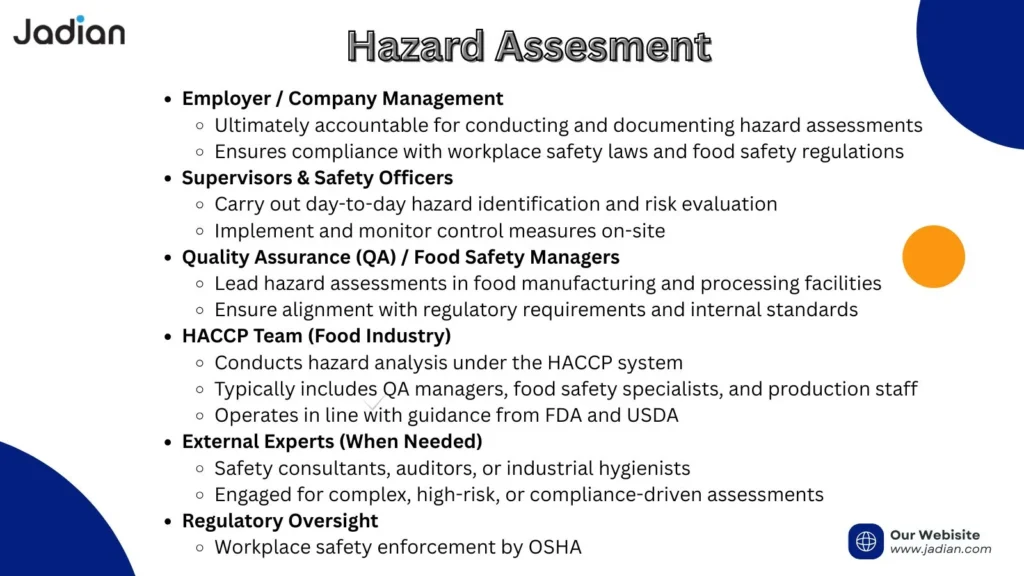
1. The Employer / Business Owner (The Ultimate Accountability)
Legally and ethically, the “buck stops here” or simply they hold all accountability and responsibility. Under OSHA regulations, local labor laws, and global standards like ISO 45001 or ISO 22000, the employer has a non-transferable “duty of care.” This means that while they can delegate the tasks of safety, they cannot delegate the liability.
- The Role: They don’t need to hold the clipboard, but they must sign the checks. They are responsible for approving the budget for safety gear, repairs, and training. Their primary responsibility is resource allocation.
- The Consequence: Ignorance is not a legal defense. If an assessment is skipped to “save money” and an accident occurs, the employer faces the stiffest penalties, including criminal negligence charges in severe cases.
2. The Safety Manager / HACCP Team Lead (The Architect)
If the employer or owner provides the resources , the safety managers provide the blueprint. They are the “Architect” of hazard assessment programs. They are the ones that translate the vague legal requirements into concrete daily actions.
- The Role: They schedule the assessments, choose the method (like a checklist or software tool), and ensure the team is trained. They act as the bridge between the boardroom and the breakroom.
- The Expertise: They need to be fluent in “regulatory” speak (FDA, USDA, OSHA) and translate it into “operational” english for the staff.
3. The Supervisors and Department Heads (The Enforcers)
These are the linchpins or the vital persons of the operation. These are the people who live in the reality of the daily grind. They often balance the often conflicting goals of speed and safety
- The Role: they are the enforcers of the assessment’s findings. They ensure that the corrective actions identified in the assessment actually happen. If the assessment says “fix the guard on Line 4,” the supervisor ensures maintenance gets it done.
- The Insight: They know the “production pressure.” They know when their team is tired or rushing, which is when hazards spike. Their input is crucial for assessing situational risks that aren’t always present.
4. The Front-Line Workers (The Eyes and Ears)
This is the most underutilized resource in corporate safety. Despite not actually writing the report, their participation is what makes the report accurate.
- The Role: They are the sensors of the organization. They are the ones who interact with the hazards for 8-10 hours a day. They are the ones who personally know the machinery they work on.
- The Value: A manager might walk past a machine and think it looks fine. The operator knows that it vibrates strangely when it hits high speed. That insider knowledge is gold for a hazard assessment. c
5. External Auditors and Consultants (The Reality Check)
Sometimes, you are too close to the problem to see it. This group provides the verification.
- The Role: To come in with fresh, unbiased eyes and tear your process apart to find the weak spots before a regulator does.
- The Perspective: They can bring industry best practices to your floor, spotting hazards that your team has become blind because they see them everyday.
The Step-by-Step Anatomy of a Perfect Hazard Assessment
You can’t just wander around the facility floor looking for trouble and hope you catch everything. That is a recipe for missing the subtle, dangerous risks that cause the biggest problems. What you need is a detailed and anti-hazard plan.
Professionals use the HIRA framework: Hazard Identification and Risk Assessment. It turns a troubled and messy process into a systematic and scientific one. Here is how to execute it, step-by-step.
Step 1: Pre-Assessment Preparation
Before you step on the floor, gather your data. Look at your incident logs (where have people gotten hurt before?), your maintenance records (what keeps breaking?), and your customer complaints (did someone find plastic in their food?). This gives you a “hit list” of areas to focus on.
Step 2: The Physical Walkthrough
This is boots-on-the-ground time. You walk the flow of the product—from the receiving dock to the shipping bay.
- Pro Tip: Don’t just look. Listen for air leaks or grinding gears. Smell for burning belts or chemical fumes. Feel for excessive vibration.
- Ask Questions: Stop employees and ask, “What is the hardest or most annoying part of your job?” The answer usually points directly to a hazard.
Step 3: Analysis and Prioritization
You have a list of 50 hazards. You can’t fix them all today. You must use the Risk Matrix we discussed earlier to rank them.
- Immediate Fixes: A puddle of oil on the floor (slip hazard).
- Project Fixes: A loud machine that needs soundproofing (long-term hearing damage).
Step 4: Implement Controls (The Hierarchy)
This is where the magic happens. You don’t just put a “Watch Your Step” sign up and call it a day. You follow the hierarchy:
- Elimination: Remove the hazard completely. (e.g., Automate a dangerous lifting task).
- Substitution: Replace the hazard. (e.g., Switch to a non-toxic cleaning chemical).
- Engineering Controls: Isolate people from the hazard. (e.g., Install machine guards or ventilation systems).
- Administrative Controls: Change the way people work. (e.g., Rotate shifts to prevent repetitive strain).
- PPE: Protect the worker. (e.g., Steel-toed boots, hairnets, earplugs). Note: This is the least effective method!
Step 5: Review and Repeat
A hazard assessment is a snapshot in time. Tomorrow, everything could change. You must schedule follow-ups to ensure your “fixes” actually worked and didn’t create new hazards.
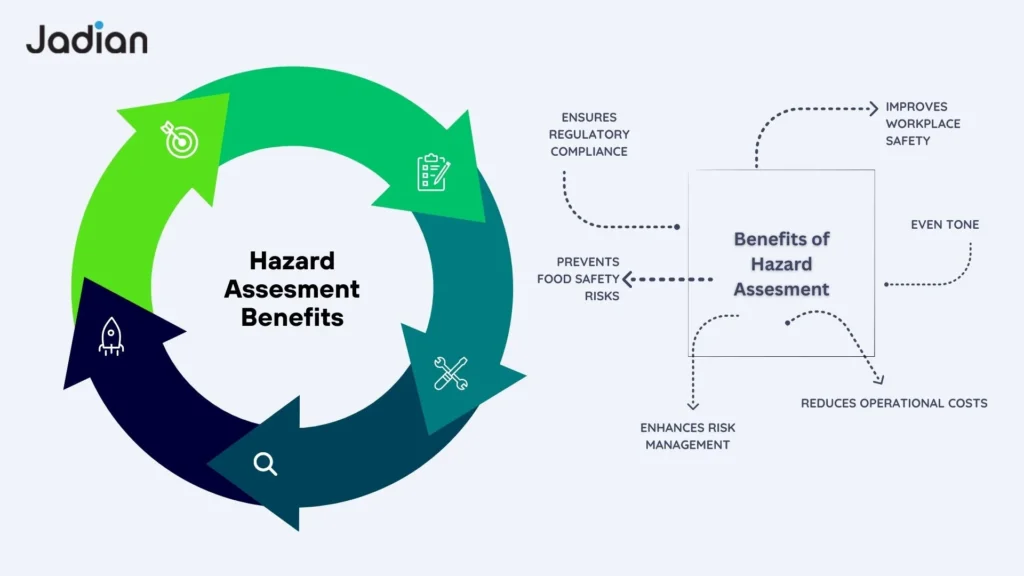
When Should You Hit the “Reset” Button?
A common failure is treating the hazard assessment like a diploma something you get once and frame on the wall. It is actually more like a car inspection; it needs to happen regularly.
The “Must-Do” Triggers:
- Annual Review: The bare minimum. Every year, do a full sweep.
- New Equipment: A new packaging machine brings new moving parts, new electrical loads, and new training gaps.
- New Ingredients: Switching from liquid eggs to powdered eggs? You just introduced an inhalation hazard (dust) that wasn’t there before.
- Staff Turnover: If 50% of your staff is new, their lack of experience is a hazard.
- Accidents or Near-Misses: If someone almost got hurt, your previous assessment missed something. Go find it.
- Regulatory Updates: If the FDA updates the Food Safety Modernization Act (FSMA), your assessment needs to reflect those new rules.
How Jadian Software Revolutionizes Hazard Assessments
Let’s be real: clipboards are where data goes to die. conducting a hazard assessment on paper is slow, prone to errors, and incredibly difficult to analyze. You end up with a stack of papers in a cabinet that no one ever looks at. This is where Jadian transforms the process from a chore into a strategic asset.
As the Best Compliance and Inspection Management Software, Jadian offers specific features designed to streamline the complex obligations of regulatory environments like food safety.
1. The “System Thinker” for HACCP
One of Jadian’s standout features is its “System Thinker” module. This tool allows you to manage the key elements of your internal compliance program, specifically integrating standards like ISO 9000 and HACCP. Instead of treating hazard analysis as a separate event, Jadian integrates it into your daily quality processes, ensuring that your Critical Control Points (CCPs) are monitored continuously.
2. Mobile-Ready Inspections (Online & Offline)
Hazards don’t happen at a desk; they happen on the production floor. Jadian’s inspection software is built for the field. It works seamlessly on laptops, tablets, and smartphones, allowing your team to record data while walking the line.
- Offline Capability: Even if your freezer storage or basement has no Wi-Fi, Jadian’s offline mobile capabilities ensure your team can still collect data, capturing photos and notes that sync once they are back online.
3. Custom Dynamic Forms
Every facility is different. Jadian allows you to generate custom, dynamic forms that fit your unique needs. You aren’t stuck with a generic checklist that doesn’t apply to your specific machinery. You can configure the system to ask the right questions at the right time, ensuring your data capture is accurate and relevant.
4. Enterprise Quality Manager (EQM)
Jadian’s web-based EQM software acts as a centralized hub. It simplifies the complex administrative requirements of tracking hazards across multiple locations. If you have three plants, you can see the risk profile of all three in one dashboard. This “Centralized Data Management” reduces costs and increases operational efficiency by letting you spot trends like a recurring mechanical failure before it causes a recall.
5. Audit Readiness
When an auditor walks in, the stress level usually goes up. With Jadian, it stays down. The software provides a user-friendly interface for recording and retrieving audit data. You can instantly pull up historical reports, proof of corrective actions, and compliance certificates, showing the auditor that you are in total control.
Part 6: Conclusion
So, who is responsible for conducting a hazard assessment? You are.
Whether you are the CEO signing the checks, the manager designing the protocol, or the worker spotting the leak, safety is a shared burden. It is the thread that holds the entire operation together. By formalizing this responsibility, adhering to a strict schedule, and leveraging powerful tools like Jadian, you move your organization from a reactive “fire-fighting” mode to a proactive “fire-prevention” culture.
Don’t wait for the accident to tell you where the hazards are. Go find them first.
FAQs – Frequently Asked Questions
Who is Responsible For Conducting a Hazard Assessment?
Legally, the employer/business owner is responsible. Operationally, it is executed by a designated Safety or HACCP team, often with input from department supervisors and front-line staff.
What is the difference between a Hazard and a Risk?
A hazard is something that can cause harm (e.g., a wet floor). A Risk is the chance that harm will actually occur (e.g., high risk if the floor is in a hallway, low risk if it’s in a locked closet).
When Should a Formal Hazard Assessment or Inspection be Performed?
At least annually. Additionally, perform one whenever there are changes to equipment, processes, staff, or regulations, and immediately following any accident or near-miss.
Why is the “Hierarchy of Controls” important?
It prioritizes the most effective solutions. Eliminating a hazard is infinitely better than just giving someone a helmet (PPE) and hoping for the best.
Does Jadian software work for non-food industries?
Yes. While Jadian excels in food safety (HACCP/FSMA), its flexible architecture makes it perfect for construction, manufacturing, and general health & safety (EHS) compliance across any sector.
Can a hazard assessment prevent lawsuits?
Yes. It demonstrates “due diligence.” If an accident occurs, having a documented history of assessments proves that the company was actively trying to maintain a safe environment, which is a key defense in legal situations.
What is a Job Hazard Analysis (JHA)?
A JHA is a micro-version of a hazard assessment. Instead of looking at the whole facility, it looks at one specific job (like “cleaning the fryer”) and breaks it down step-by-step to find risks. Jadian software can manage these individual JHA modules easily.