Regulatory compliance management is an organized process through which organizations detect, fulfill, monitor, and demonstrate compliance with laws, regulations, and required standards.
In this guide, you will learn about regulatory compliance management in detail, such as what compliance management is, why it is important, and what happens without it, how compliance management software can assist modern organizations; and how Jadian regulatory compliance management software can help teams control and manage compliance with knowledge and ease.
What Is Regulatory Compliance?
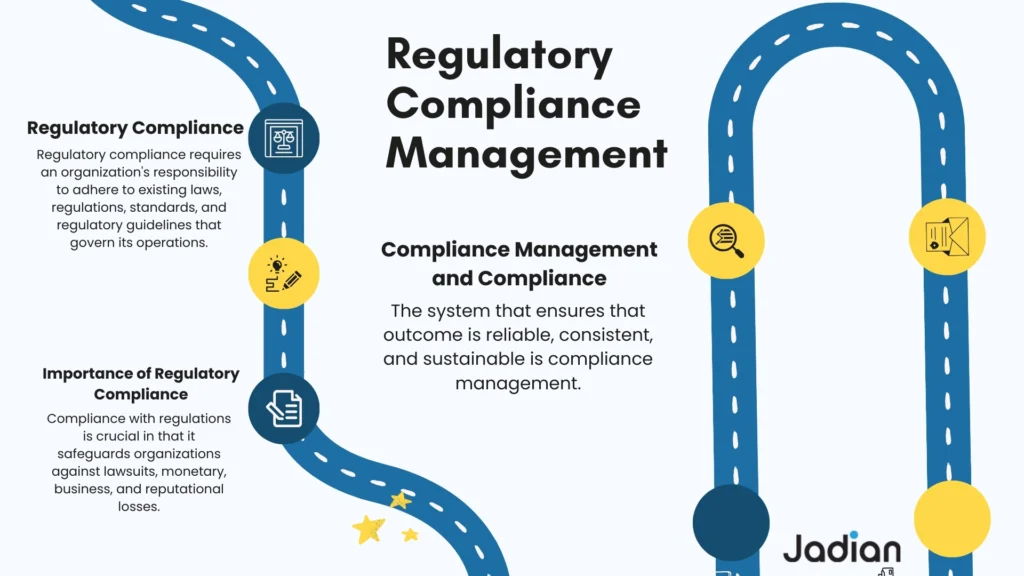
Regulatory compliance requires an organization’s responsibility to adhere to existing laws, regulations, standards, and regulatory guidelines that govern its operations.
Governments, regulators, and industry bodies create these requirements to safeguard consumers, employees, markets, and society.
Regulatory compliance cannot be reduced to merely preventing illegal behavior. It involves keeping proper records, adhering to recommended procedures, making reports punctually, training personnel, and demonstrating compliance during the audit or inspection.
What Kind of Regulations are Organizations to Comply with?
Several layers of regulation are imposed on organizations simultaneously. These may include:
- National and local laws
- Industry-specific regulations
- International standards
- Contract and licensing requirements
- Professional standards and codes of conduct
Lack of knowledge of the rules to be followed is in itself a significant compliance risk. There are many compliance failures that are not due to organizations being determined to break the rules, but rather due to uncertainties, fragmentation, or poorly written obligations.
Typical Areas that are Captured by Regulatory Compliance
It is usual that regulatory compliance requirements apply to:
- Personal data, data protection and privacy, as well as personal data collection, storage, and processing
- Accountability and financial reporting, and transparency
- Anti-money laundering (AML) and fraud prevention
- Health, safety, and labor practices in the workplace
- Environmental sustainability and environmental protection issues
- Training, education, and professional accreditation standards
- Product safety and consumer protection
All these areas have different regulatory expectations, documentation requirements, as well as enforcement mechanisms.
Is Regulatory Compliance a Single Process?
No, regulatory compliance is not a one-time job. The regulations fluctuate, the priorities on enforcing change, and the business operations.
Regulatory changes need to be kept on track, internal controls need to be revised, and compliance processes need to be documented. The compliance approach can be treated as a one-time project, and this approach is prone to gaps that are only noticed in the audit or enforcement exercise after the fact, which is too late.
What Does Regulatory Compliance Management Mean?
Regulatory compliance management is the process that organizations formalize, repeat in order to manage compliance requirements over time.
It is a shift in compliance towards a proactive and controlled business activity as opposed to reactive problem-solving.
Instead of reacting to an audit, an inspection, or an incident as a singular incident, compliance management instills regulatory requirements into daily activities. It makes responsibilities clear, processes well-documented, and compliance status transparent throughout the organization.
What is the Difference between Compliance Management and Compliance?
The result is compliance with regulatory demands.
The system that ensures that outcome is reliable, consistent, and sustainable is compliance management.
In the absence of compliance management, companies will use personal knowledge, manual reminders, and unofficial methods. This solution is not scalable and cannot withstand an increase in regulation or a change in staff.
What Do the Vital Elements of Regulatory Compliance Management Entail?
An established regulatory compliance management system usually incorporates:
- Determination of regulations that are applicable
- Regulations to internal policies and regulations translation
- Well-defined roles and responsibilities
- Awareness and training programs
- Continuous tracking and reporting
- Preparedness of audit and inspection
- Incident management and corrective measures
- Constant monitoring and enhancement
These elements are interconnected and form a closed loop. The failure in one aspect tends to compromise the whole compliance process.
Is Compliance Management a Legal Function Only?
No, compliance management is effective throughout the organization.
Although the legal and risk teams might be at the forefront of the compliance activities, it is shared throughout the operations, the HR, the IT, the finance, and the leaders.
Compliance is viewed as a common responsibility and therefore adopted as an organizational culture and not an external liability as required by regulators.
What Is the Importance of Regulatory Compliance?
Compliance with regulations is crucial in that it safeguards organizations against lawsuits, monetary, business, and reputational losses.
It also makes it trusted amongst the regulators, customers, partners, and employees.
With the rising regulatory scrutiny in the world, regulators are no longer willing to see the organization fulfill their wishes, but to show a well-organized compliance management. It is no longer just enough to say that they comply.
Financial and Security
Violation of rules may lead to:
- Huge financial fines
- Criminal cases and litigation
- Severe liability for crime
- Revocation of licenses or operation rights
In most industries, one compliance failure can run into millions and jeopardize business continuity.
Brand Value, Reputation, Trust
Failure in compliance usually draws media interest. Bad media publicity can ruin a reputation even many years later, when the problems are solved.
Companies that adhere to good compliance practices are held responsible, transparent, and trustworthy. This image affects consumer loyalty, shareholder trust, and compliance with the regulators.
Stability and Growth of Operations
Excellent compliance management decreases interference. Audits are less tense, inspections are less stressful, and changes in regulation can be introduced not in a hurry but in a systematized way.
In the case of organizations that intend to venture into new markets, compliance preparation is usually a requirement for growth.
What Does Happen When Organizations Do Not Adhere to Regulations?
A non-conformity can hardly have a single, distinct outcome.
Rather, it tends to cause a series of financial, operational, and reputational effects.
Direct Intimidation by Non-Compliance
Short-term consequences can be:
- Monetary fines and fines
- Notices or sanctions of enforcement
- Revocation or suspension of license
- Compulsory remedial courses
Such actions tend to take a lot of time and resources to solve.
Long-term and Indirect consequences
In addition to official punishment, organizations can suffer:
- Dynasty of customer and partner loss
- Stricter regulatory oversight
- Higher insurance premiums
- Late investment or growth strategies
- Low staff motivation and interest
The cost of recovering the non-compliance is usually much higher than the cost of preventing the same by organizing compliance management.
What is Malicious Compliance?
Malicious compliance is when someone is following the instructions exactly as given, but intentionally ignores the spirit or intent behind them, usually to highlight how unreasonable, unclear, or poorly thought-out the instructions are.
Key characteristics of malicious compliance
- Rules or orders are followed to the letter
- Common sense or intent is deliberately ignored
- The goal is often to expose flaws, unfairness, or absurdity
- Usually passive-aggressive, not openly rebellious
Simple example of malicious compliance
Example 1: Workplace
Manager: “No overtime is allowed under any circumstances.”
Employee: Leaves work unfinished exactly at 5 PM, causing delays.
The rule was followed, but productivity suffers.
Why Has Regulatory Compliance Become More Complex?
Globalization, digital transformation, and increased regulatory oversight have created an increased complexity in regulatory compliance.
Today, organizations have more regulations, by more authorities, as well as increased expectations of their evidence.
Major Forces of Compliance Complexity
This complexity is caused by several trends:
- It often has to be revised and amended
- International activities where the requirements are conflicting
- Cybersecurity laws and data privacy laws
- Compliance models unique to the industry
- Greater audit and inspection
- More focus on documentation and traceability
The manual operations are not able to meet these requirements.
What Is Risk Management Regulatory Compliance?
The regulatory compliance risk management is aimed at defining, evaluating and addressing the risk of non-compliance.
It changes the compliance to a proactive prevention.
Instead of relying on audits or incidents, organizations will continually assess the areas of compliance risk and deal with them promptly.
The Essential Aspects of Risk Management of Regulatory Compliance
A successful compliance risk management involves:
- Detecting relevant compliance risks
- Evaluating the probability and possible effect
- Risky areas should be prioritized
- Incorporating preventive controls
- Observing compliance performance
- Incident control and remedial measures
This will minimize unexpected events and enhance a level of organizational resilience.
Why Is Manual Compliance Management Not Effective Any More?
Paper-based compliance management is ineffective, error-prone, and not feasible in complicated regulatory settings.
Modern compliance requirements cannot be implemented with spreadsheets, emails, and shared folders.
Typical Issues of Manual Compliance
Organizations that use manual processes can experience:
- Missed regulatory updates
- Laxity of policy implementation
- Weak transparency of compliance status
- Audit preparation takes too much time
- Duplication or duplicated records
- Excessive administrative load
These issues are multiplied as regulations are intensified.
So, What Is Compliance Management Software?
The compliance management software is a digital platform that is centralized and automated, which tracks and documents compliance activities.
It substitutes the distributed tools with one source of truth.
Organizations are also using software to deal with obligations, assign duties, gather evidence, and provide reports on compliance status instead of doing so through memory, manual prompts, or software.
What Does Compliance Management Software Generally Entail?
The majority of regulatory compliance management software supports:
- Tracking of regulatory obligation
- Document management and policy management
- The allocation of tasks and notifications
- Risk assessments
- Management audit and inspection
- Tracking of incidents and corrective actions
- Dashboards and compliance reporting
Such features enhance uniformity, responsibility, and transparency.
The Relevance of Regulatory Compliance Management Software in Organizations?
Compliance management software that can be scaled is required to manage compliance at a large scale.
It has turned compliance into a reactive overhead, a process that could be controlled and audited.
Operational Benefits
The compliance management software assists organizations in:
- Cut the administrative workload
- Enhance precision and uniformity
- Follow up on compliance in real time
- Prepare for audits faster
- React to regulatory changes rapidly
Strategic Benefits
In addition to efficiency, software also makes possible:
- Enhanced leadership and supervision
- Improved visibility of compliance risk
- Informed decision-making
- Extensible compliance systems
Compliance is a strategic factor, rather than a requirement of law.
What are the Main Peculiarities of the Regulatory Compliance Management Software?
Compliance software should be effective on features, flexibility, and usability.
- Feature
- Purpose
- Regulatory tracking
- Keeps obligations current
- Policy management
- Centralizes documentation
- Task management
- Delegates and monitors duties.
- Risk assessments
- Identifies compliance gaps
- Audit management
- Simplifies inspections
- Incident tracking
- Manages breaches
- Reporting & dashboards
- Provides visibility
- Alerts & reminders
- Prevents missed deadlines
These features favor the end-to-end regulatory compliance management.
What is the Advantage of Regulatory Compliance Management Solutions?
The solutions to regulatory compliance offer assurance of compliance and business value.
Key benefits include:
- Reduced compliance costs
- Lower regulatory risk
- Improved audit outcomes
- Enhanced control of documentation
- Improved inter-team collaboration
- Greater confidence among the stakeholders
It is an issue of compliance that is institutionalized in day-to-day activities, rather than being an exception.
What is the Enhancement of Automation in Regulatory Compliance Management?
With automation, errors are minimized, consistency and speed are enhanced in compliance processes.
It minimizes the use of manual tracking and human memory.
The Areas of High Impact to be automated
Automation supports:
- Task notifications and overdues
- Policy acknowledgments
- Evidence collection
- Risk assessments
- Compliance reporting
This will enable compliance teams to focus on oversight and improvement rather than administration.
What Does Jadian Compliance Management Software Do for Regulatory Compliance?
Jadian compliance management software is a configurable, centralized system for managing regulatory compliance.
It favors institutions that have complicated dynamic compliance demands.
How Jadian Favors Compliance Teams
Jadian allows the organizations to:
- Concentrate on compliance policies and records
- Pursue regulatory requirements and timeframes
- Delegate and oversee compliance activities
- Keep audit and inspections under control
- Log accidents and remedial measures
- Produce compliance and risk reports
This brings transparency, responsibility, and trust throughout the organization.
What is Different with Jadian Regulatory Compliance Management Software?
Jadian is based on the compliance workflows in the real world and not theory.
- It is flexible and controlling
- Uniqueness Strengths of Jadian
- Intuitive user experience
- Configurable workflows
- Scalable architecture
- Good reporting/analytics
- HR and governance system integration
- Compliance with industry requirements
This facilitates easy adoption, and long-term compliance becomes sustainable.
What Industries does the Regulatory Compliance Management Software Benefit Most?
Structured compliance management is an advantage to any regulated organization.
Industries with a high level of regulations are:
- Financial services
- Healthcare
- Education and training
- Manufacturing
- Energy and utilities
- Data services and technology
- Public sector
Every business industry can enjoy customized compliance processes on a centralized platform.
What is the best way for organizations to select the appropriate Regulatory Compliance Management Software?
The selection of the appropriate solution has to be based on the alignment between software capabilities in accordance with regulatory and operational requirements.
The major selection criteria are:
- Regulatory coverage
- Ease of use
- Customization flexibility
- Reporting depth
- Integration capabilities
- Vendor expertise
- Scalability and support
An organized analysis guarantees value in the long run.
What Lies Ahead for Regulatory Compliance Management?
Compliance management is becoming digitalized, automated, and integrated in the future.
Emerging trends include:
- Increased automation
- Instant review of compliance
- AI-driven risk analysis
- Combined governance systems
- Better data protection measures
Those organizations that invest early will be in a better position to be regulated.
What Is the Relationship between the Management of Regulatory Compliance and Business Continuity and Resilience?
Regulatory compliance management is important in securing business continuity and organizational resilience.
Organizations that integrate compliance in their operations are better placed to survive interruptions, regulatory oversight, and shocks.
A significant number of compliance failures are found throughout change or stressful periods. These may be leadership changes, high growth, mergers, system migration, or a crisis. Failure to strictly manage compliance means that regulatory requirements are mostly compromised in such instances, which further exposes the organization to more risk at a time when the organization is already weak.
An effective compliance management structure will make sure that regulatory requirements are kept in view and executable even in the event of operational disruption. Policies, controls, and responsibilities are written, standardized, and do not rely on personal knowledge. This continuity enables organizations to be in regulatory conformity as it adjusts to changes in the internal or external environment.
The management software on compliance enhances resilience by maintaining institutional knowledge. Once it has been documented and automated, compliance does not vanish upon the departure of employees or a shift in roles. Rather, there is a seamless transfer of responsibility, and the compliance activities are not interrupted.
What is the Improvement of Regulatory Compliance Management in Decision-Making?
Regulatory compliance management through good compliance offers the leadership with good information on effective decision-making.
With centralized compliance data, structured, leaders have insight into the risk, performance, and regulatory exposure.
In the absence of systematic compliance management, the decisions of the leadership usually rely on incomplete or old data. The problems concerning compliance can be revealed only when they have turned into an incident or enforcement. This reactionary style constrains strategic flexibility and risk in the organization.
Compliance management software converts compliance data into actionable data. Reports and dashboards bring out trends, recurrent problems, and areas of high risk. Leaders are able to observe what obligations are being fulfilled, where there are gaps, and which areas need more resources or attention.
This visibility will aid in the making of informed choices in terms of expansion, investment, allocation of resources, and change of operation. Compliance is another concept that enables organizations to pursue growth opportunities without fear, but with confidence, when it is well understood.
Ethical Culture: How Does Regulatory Compliance Management Help?
Regulatory compliance management also supports ethical conduct through establishing expectations and responsibility.
Organizational integrity and values are closely associated with compliance.
The regulations are usually based on larger social expectations regarding equity, security, clarity, and accountability. When companies do compliance well, they portray their dedication to such values. This enhances corporate values and confidence.
Clarity, enforcement, and reporting make the employees aware of what is required of them. Employees will be willing to make complaints and use standard procedures when compliance processes are just and foreseeable.
Ethical culture can be maintained through compliance management software, which helps to have in place the organized reporting mechanisms, document the investigation, and keep track of corrective actions. This makes people less afraid of retaliation and aids in attempting responsible conduct within the organization.
What is the Effect of Regulatory Compliance Management on the Audit Results in the Long Term?
Organizations that have developed compliance management always have easier audits and inspections.
When compliance is not managed on an ad hoc basis, the results of the audit are better.
Compliance activities may be monitored throughout the year, making audits such an exercise of validation rather than disruptive. Factors are easily identified, and the duties are well defined and documented.
The software used in compliance management is very important in enhancing the performance of audits. It keeps audit trails, traces the past activities, and can give systemized answers to the auditor’s request. With time, the numbers of recurring audit findings reduce as systemic problems are solved.
This maturity will minimize regulatory friction and generate credibility among the auditors and regulators. Companies with a high compliance profile usually have less obtrusive regulation.
What Does Regulatory Compliance Management Do to Adapt to Organizational Change?
Organizations are dynamic, and compliance management should keep up with the change.
Change is absorbed, and the regulatory compliance management offers the structure to absorb change without augmenting risk.
Drastic changes like restructuring, digitalising, changing of leadership, or migration of systems can break the compliance processes. Roles are redefined, records are misplaced, and unofficial knowledge is lost.
A compliance management system with centralization maintains continuity. Roles and responsibilities are reassignable, workflows can be revised, and controls can be modified without the loss of visibility or accountability. This flexibility maintains adherence even during the organizational change.
Read More >> Top 10 Best Compliance Management Software Tools for 2026
Frequently Asked Questions (FAQs)
What does regulatory compliance management mean?
It is the organized procedure of providing continual compliance with laws and regulations.
What is the value of regulatory compliance?
It safeguards companies against legal, financial, and reputational risk.
What is regulatory compliance management software?
It is a software that consolidates and automates compliance activities.
What is the result of compliance software in risk reduction?
It enhances transparency, responsibility, and uniformity.
What does Jadian do to facilitate regulatory compliance?
Jadian offers the tools to monitor obligations, audits, risk, and compliance tasks.
Final Thoughts
The management of regulatory compliance is no longer a choice.
Since regulations are becoming more complex, it is necessary that organizations embrace structured and technology-based strategies.
Such software as Jadian is a regulatory compliance management software through which an organization can manage and minimize risk, enhance efficiency, and maintain trust.
Compliance can become a source of long-term success- not a regulatory imperative when it is managed in an effective way.