
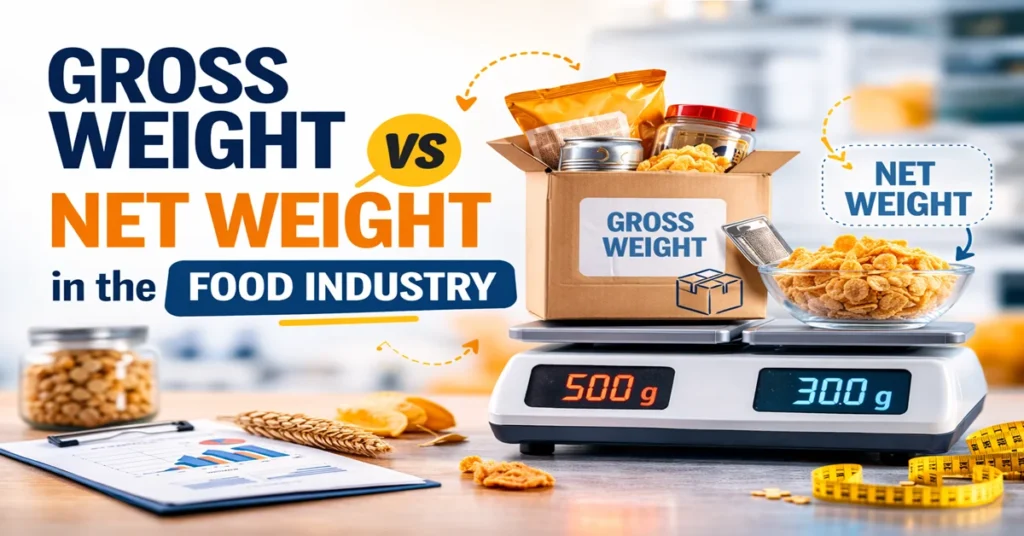
In the food industry, weight measurements are very important. When product weights are maintained, it results in easier packaging, labeling, shipping, and inventory. They are also known to keep your business in compliance and gain customer confidence.
People in the food industry should be aware of gross weight vs net weight. This guide covers what each term means, how to figure them out, and why they matter in the food industry.
No matter if you work in food manufacturing, packaging, or distribution, understanding these terms will help your operations run smoothly.
What Is Net Weight?
Net weight’s meaning is simple to understand. The weight shown on a food package is usually its net weight, which is the weight of the food only. It does not include the package or wrapping.
As an illustration, in case a bag of chips shows a net weight of 200 grams, that only includes the chips. Bags, seals, and other wrappings are not provided. Net weight shows the actual weight of the food given.
This measurement is important in the food industry because it clearly shows how much of the product you are really buying.
Why Net Weight Matters in Food Manufacturing
Knowing the net weight is important for food manufacturers since it impacts many steps in making and selling products. Here are some of the reasons why it matters in the industry:
- Product pricing and portion control
Food companies usually set prices based on how much food is in each package. Measuring net weight helps manufacturers keep portions the same in every unit. This helps ensure fairness for customers and keeps the quality of products consistent.
- Accurate labeling for consumers
Consumers examine the packaging information to determine the quantity of food that they are purchasing. The correct net weight should be listed on the labels. This way, shoppers can compare the products and select the one that best suits them.
- Compliance with food labeling regulations
Food safety and regulatory bodies tend to compel companies to display the net weight on the products. Ensuring that these measurements are correct makes sure that businesses remain in line. Consequently, they can face fines or even a recall of their products if they fail to do so.
Examples of Net Weight in Food Products
Most packaged foods list the net weight on their labels. Some common examples include:
- Packaged snacks
Looking at a pack of crackers or potato chips, you will find that there is a net weight, say 150 grams. This informs you only of the weight of the snack inside.
- Frozen foods
Frozen meals, vegetables, and seafood also list the net weight on the package. This lets you know exactly how much food you’re buying.
- Canned or bottled goods
Canned soup, bottled sauces, and jams list the net weight too. This number tells you how much food or liquid is inside, not counting the container.
Once you know what net weight means, reading food labels becomes easier. It helps both businesses and customers make sure they get the right amount of product.
What Is Gross Weight?
The gross weight is the weight of the product as a whole. This covers food weight and packaging containers, and shipping medium.
Let’s say a carton of cookies is being delivered to a grocery store. The gross weight is made up of the cookies, the plastic package, the cardboard box, and any other material used. In simple words, gross weight is the total weight of the product in the process of going through the supply chain.
This measurement helps businesses because they need to know the total weight they are handling, storing, or moving.
Why Gross Weight Is Important in the Food Industry
Most people look at only the net weight when reading a label. Gross weight is also significant in the food industry for a number of reasons.
Here are a few reasons why it’s important:
- Logistics and shipping calculations
Shipments’ calculations are based on the actual gross weight to perform logistics and shipping. Since transport companies pay per total weight, having the gross weight allows business to estimate their costs and plan the deliveries more effectively.
- Warehouse handling and storage planning
To handle products, warehouse workers have to be aware of the weight of every shipment that they have to store and transport. Such knowledge aids in planning inventory by staff, loading pallets, and making sure the storage systems are capable of taking the load without any difficulties.
- Transportation safety and freight costs
Every truck, container, and piece of shipping equipment has a weight limit. Knowing the weight allowed by companies helps avoid overloading and ensures the safety of the shipments. It also makes sure that they stay within the legal boundaries.
Examples of Gross Weight in Food Logistics
The gross weight is usually applied in cases of transporting or storing massive foodstuffs. Here are a few examples:
- Pallets of packaged food products
As the packaged products are loaded onto the pallets for delivery, the packaging is added to the weight of the products. This includes the pallet as well.
- Bulk shipments of grains or seafood
For big shipments of rice, wheat, or seafood, the weight covers both the food and the containers or sacks used.
- Export shipments with cartons and pallets
In international shipping, gross weight means the total weight of everything in the shipment. This covers the products, boxes, pallets, and all packing materials. Knowing the gross weight helps carriers and customs officials understand exactly how much is being shipped.
Gross Weight vs Net Weight: Key Differences
The weight of a product is indicated in terms of gross weight as well as the net weight. The two metrics are needed in the food industry, Although they have different purposes.
What Each Weight Includes
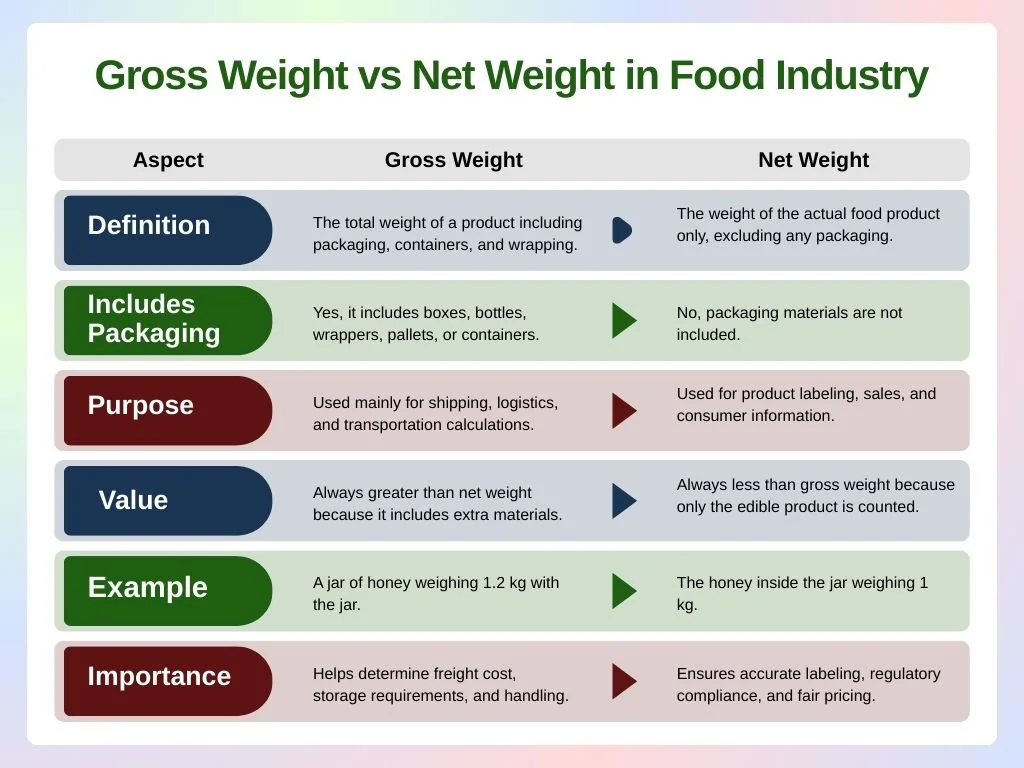
What they measure is the primary difference between the gross weight vs net weight. The net weight is only the portion of food itself, and that is sold by people. Gross weight consists of the food and all the wrappings. This includes boxes, plastic wrapping, jars, pallets, or any other material used to package the food.
Such a difference is important as various members of the food supply chain utilize different measurements. For example, food labels show net weight for shoppers, while shipping teams usually use gross weight when moving products.
How Each is Used in Operations
These two measurements are significant in day-to-day food operations. The net weight is primarily utilized in labeling, pricing, and portion control. In this way, the customers will be able to determine the precise amount of food they are purchasing.
The gross weight, on the other hand, concerns itself with transportation as well as storage and warehouse management. It assists the businesses in arranging shipping loads, inventory, and ensures that such trucks do not exceed weight provisions.
Today, a large number of companies are utilizing food safety software to record product information, including weights. This tool is used to maintain the consistency of packaging. It also ensures that labeling is more precise and the whole supply chain is more visible.
How to Calculate Gross Weight and Net Weight
These are the calculations that allow the food companies to maintain accurate labels, keep the packaging under control, and deliver the packages efficiently.
The weight of the packaging or the container, referred to as Tare weight, is what binds the two measurements.
Formula of Net weight calculation:
In order to determine the net weight, one should begin with the total weight of the product and deduct the weight of the packaging. The weight of this package is referred to as the tare weight.
Formula:
Net Weight = Gross Weight − Tare Weight
To determine the net weight of the food, one just needs to take the total weight of the product and subtract the packaging weight (tare) of the product.
Gross Weight Calculation Formula
To find the gross weight, you do the opposite. You add the packaging to the weight of the food product instead of taking it away.
Formula:
Gross Weight = Net Weight + Tare Weight
This calculation shows the total weight of the item, including both the food and its packaging.
Example Calculation in a Food Processing Scenario
Here’s a simple example from a food processing facility:
Picture a company that is packaging jars of pasta sauce.
- The gross weight of a sealed jar, including the glass jar and lid, is 900 grams.
- The empty jar and lid together weigh 200 grams. This is known as the tare weight.
Step 1: Find the net weight
Subtract the gross weight from the tare weight.
In this case, take 900 grams -200 grams.
The result is a net weight of 700 g.
Therefore, in the jar, the contents are 700 g of pasta sauce, what is on the label of the product.
Step 2: Look at the Gross Weight
When the weight of the sauce is 700 g, and that of the jar is 200 g, you can calculate the gross weight.
Gross weight = net weight and tare weight.
Here, both 700g+ 200g will make the gross weight 900g.
So, the gross weight is 900 grams.
By using these steps, food manufacturers can accurately measure both gross and net weight.
Food Industry Regulations and Labeling Requirements
The net weight on a packaged food item is actually not randomly shown on the label. It is legally mandated in a good number of countries. These regulations assist customers in getting to know precisely the amount of product they are purchasing.
Regulators tend to demand that manufacturers display the net weight on the front side or the upper section of the package. This figure only counts food that is in the food itself, not the packaging or wrapper. This will assist in maintaining a fair and transparent environment.
Hence, customers are able to compare items and are aware of what they are buying. In the case of the food businesses, this means ensuring that the weight is measured correctly and remains the same.
Compliance Requirements for Food Manufacturers
Labeling is not the only element within the food industry. Manufacturers should also maintain accurate weighing processes, maintain good records, and observe food safety regulations.
As an illustration, the companies usually have to:
- Check and adjust weighing equipment on a regular basis.
- Keep records of product measurements.
- Use standard procedures when packaging products.
- Make sure labels match what is inside the package.
Digital tools can help with these tasks. Many food companies now use food safety software to track their operations, organize records, and monitor compliance throughout production.
Platforms like Jadian help food manufacturers manage compliance easily by bringing quality, audit, and regulatory processes together in one place. Rather than tracking weight checks, labeling records, and compliance tasks by hand, teams can keep everything digital.
This helps you stay consistent and respond quickly when there are inspections or audits.
Best Practices for Accurate Weight Measurement
Getting accurate weight measurements takes clear processes and reliable systems. Food manufacturers can keep their measurements accurate and meet labeling rules by following a few simple steps.
Begin by using weighing equipment that is correctly calibrated. Checking calibration regularly keeps measurements consistent and helps prevent mistakes that might lead to incorrect labeling.
Next, use standard packaging processes to make sure each package has the right amount of product. This lowers the chance of putting in too little or too much.
Lastly, food safety management software is used by many companies to monitor such processes as they occur. Using Jadian’s tools, teams can trace quality checks, manage compliance documentation, and maintain clear records of what occurs during manufacturing.
This makes it easier to see what is going on and to show that the business is following food industry rules.
Bottom Line
Understanding gross weight versus the net weight is significant to the food industry because it is more accurate and transparent. Net weight will indicate to customers the quantity of product they obtain. Conversely, gross weight assists a business in packaging, loading, and unloading.
When food manufacturers weigh ingredients accurately, they can label products correctly, meet government requirements, and keep operations running smoothly.
Many companies use food safety software to stay current, monitor quality, and keep records. By combining precise measurements with digital tools, food operations become safer and more efficient.
FAQs
What is the difference between gross and net?
Net weight and gross weight are not similar. The net weight of a product is its weight without any packaging or containers. Gross weight refers to the total weight of the product, its wrapping, and containers, and occasionally additional shipping material.
What does net weight mean?
Net weight is the weight of food itself and not the packaging or containers, and gives you the actual amount of food you are purchasing.
What is net weight?
Net weight refers to the weight of a product without any wrapping, boxes, or coverage.
Why is it important to distinguish between net and gross weight in shipping?
Knowing the difference between net weight and gross weight matters in shipping because each one is used for a different reason. Shipping companies use gross weight to figure out freight costs, plan how to load cargo, and make sure vehicles do not go over weight limits.
What is the tare weight, and how does it relate to gross and net weight?
Tare weight means the weight of the packaging, container, or wrapping that holds a product. To get the net weight, subtract the tare weight from the gross weight. For example, if you know both the gross and tare weights, the difference is the net weight of the product.