As the population increases, food safety worldwide has become more heightened, especially now that food is traveling greater distances before it is even consumed. And here comes the food irradiation, a method that decreases the incidence of foodborne illness, extends the shelf life of foods, and ensures that food supplies remain safe.
While there is a significant body of research on food irradiation and extensive regulatory oversight, the majority of public questions about the safety of irradiated food products, their nutrient levels, and their long-term implications remain unanswered.
This article will define food irradiation, explain how it works, describe its advantages and disadvantages, and discuss what the future may hold for this increasingly important method of food safety.
What Is Food Irradiation and Why Is It Used?
Food irradiation uses low levels of ionizing radiation (UV) to inactivate pathogens on the surface or within food. This helps increase shelf-life and enhance food safety without affecting flavor, texture, or nutrient content.
The process of food irradiation involves applying ionizing radiation to food in controlled amounts to kill bacteria, parasites, and insect pests. The major global health organizations have approved this process.
Food Irradiation Definition Explained Simply
Food irradiation is a method of food processing that uses ionizing radiation at extremely high energy levels to produce safe food products with longer shelf life.
This does not cook or heat the food item, but instead provides it with sufficient energy to kill all invisible contaminants (bacteria, mold, insects).
Here’s what you should know in everyday terms:
- Ionizing radiation doesn’t stay in the food. The rays pass through the food, break apart harmful microbes, and leave without emitting radiation afterwards.
- It targets living enemies of food quality. This includes bacteria that cause food poisoning, molds that spoil food, and pests such as insects that can infest produce or grains.
- It’s a “cold” process. Compared to heat-based procedures like pasteurization or canning, it’s a method that destroys harmful organisms without increasing the food’s temperature. That way, it still preserves the taste, texture, and nutrients.
- Health authorities widely endorse it. FDA, CDC, and WHO agree that, when properly implemented, irradiation is a safe method for reducing food risks and improving food quality.
In practical terms, irradiation works much like pasteurization, but without heat. Just like heating milk stops harmful bacteria while keeping the milk drinkable, irradiation reduces bad microbes while keeping your food safe and familiar.
How Does the Food Irradiation Process Work?
Food irradiation is about making food safer by applying controlled energy beams that target and eliminate microorganisms. Keep in mind his process does not heat or cook the food. It is a method that uses ionizing radiation to treat the food.
Ionizing radiation has enough energy to penetrate through food and damage the cellular structure of bacteria, mold, insects, and parasites, so they can no longer reproduce and cause illness. As a result of applying this type of energy beam to food, the likelihood of food spoilage is reduced, and thus the risk of foodborne illness is also reduced.
What Happens Inside an Irradiation Facility?
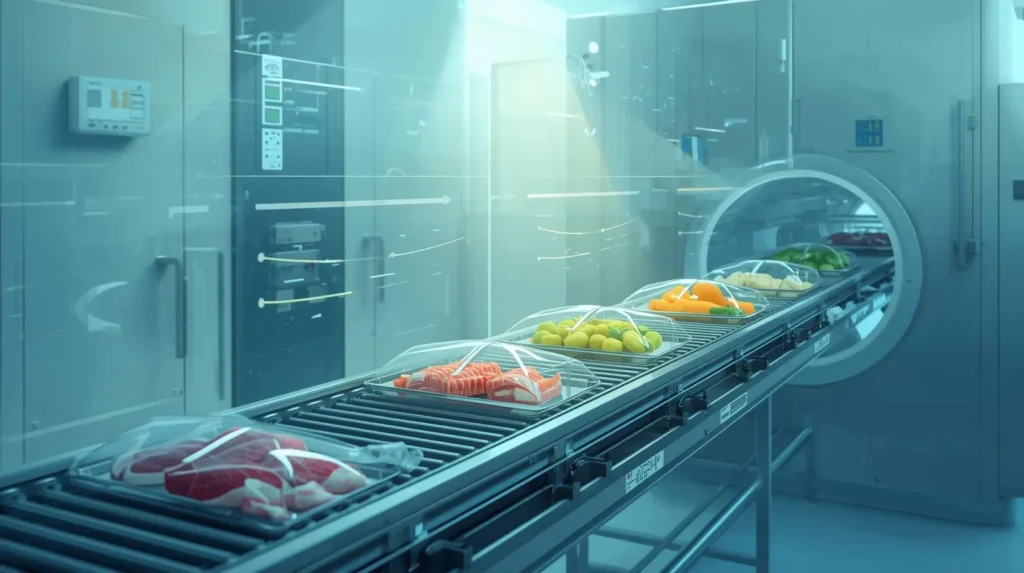
Food that will undergo irradiation is usually already packaged, then moved into a dedicated treatment room.
- The food travels on a conveyor through a shielded chamber, where the radiation source stays safely out of direct contact.
- The radiation passes through the food, delivering energy that disrupts the DNA of harmful microbes. This works much like X-rays passing through the human body — the energy moves through without leaving any radioactivity behind.
- The microscopic damage stops microbial growth. High-energy photons or electrons break chemical bonds. That way, it creates reactive molecules that prevent bacteria and other pathogens from surviving or reproducing.
After irradiation, producers can distribute the food as they would any other product. Because radiation doesn’t linger or heat the food, they can treat fresh, frozen, or packaged items without changing their temperature.
Step-by-Step: Irradiation of Food
- Workers package the food or place it on a conveyor.
- The food enters a radiation chamber.
- Radiation penetrates the food evenly.
- The process neutralizes microorganisms.
- Workers remove the food, which is then ready for distribution.
Technicians carefully monitor the entire process to ensure compliance with safety standards.
Which Foods Are Commonly Irradiated?
Producers use irradiation on food items that are more likely to carry harmful microorganisms. These foods benefit the most from longer shelf life and a lower risk of contamination.
Commonly irradiated foods include:
- Spices and dried herbs – These often carry bacteria but cannot be heat-treated without losing flavor.
- Poultry and red meat – Helps reduce the risk of bacteria like Salmonella and E. coli.
- Fresh fruits and vegetables – Extends freshness and prevents spoilage.
- Seafood – Reduces contamination from pathogens and parasites.
- Grains and legumes – Protect against insects and extend storage life.
By irradiating these foods, producers enhance food safety while preserving their taste, texture, and nutritional value.
What Are the Benefits of Food Irradiation?
Think of food irradiation as an invisible shield for your meals. It doesn’t change the taste, texture, or nutrition of your food, but it quietly works behind the scenes to make it safer, longer-lasting, and less wasteful.
Here’s what it does in practical terms:
- Knocks out harmful bacteria like Salmonella and E. coli, so your chicken, seafood, or spices are safer to eat.
- Stops pathogens from spreading while food is stored, transported, or handled.
- Keeps food fresh longer, giving fruits, vegetables, meats, and seafood more time before they spoil.
- Controls pests and parasites, protecting grains, legumes, and dried foods without chemicals.
- Reduces the need for chemical preservatives, letting your food stay natural while staying safe.
These benefits don’t just help your pantry—they make a real difference for communities too. Children, the elderly, and anyone with a weaker immune system gain an extra layer of protection every time they eat irradiated food. It’s like adding a quiet, reliable bodyguard for your meals, from farm to fork.
How Does Food Irradiation Improve Food Safety?
The number one challenge we face today in keeping our food safe is the rapid pace of our lives. Radiation of food products can help combat this issue by killing (or reducing) all types of microbial pathogens before consumption. It is essentially an “invisible shield” that protects your food from contamination by bacteria, mold, and pests.
Producers use ionizing radiation to kill and prevent bacterial and/or pest growth on their food products by disrupting the DNA of the microorganisms present within the product. The overall outcome of using radiation is to improve both the quality and safety of your food.
Here’s what it means in practical terms:
- Reduced bacterial load: Irradiation greatly lowers the presence of harmful bacteria, such as Salmonella and E. coli, making foods like poultry, seafood, and spices safer to eat.
- Lower risk of contamination: With fewer pathogens in irradiated food, the chances of spreading bacteria to other foods during storage, transport, or handling are much smaller.
Global health authorities, including the World Health Organization (WHO) and the Food and Agriculture Organization (FAO), have studied irradiation for decades and consider it a safe method for protecting food.
The U.S. Food and Drug Administration (FDA) also confirms that people can safely eat irradiated foods when producers follow proper guidelines, supporting irradiated food safety.
In short, irradiation doesn’t replace good hygiene or proper cooking, but it adds an extra layer of protection helping keep your food safe from farm to fork.
What Are the Food Irradiation Pros and Cons?
The advantages and disadvantages of food irradiation will help consumers make better decisions. The advantages have been clearly documented; however, there are also many concerns that remain.
Pros:
- Improves food safety
- Increases food shelf life
- Decreases pesticide use
- Reduces food waste
- Promotes international food commerce
Cons:
- Misconceptions about public awareness
- Costs of initial facilities
- Minimal loss of nutrients
- Availability in all areas is limited
Ultimately, it is a balance of these considerations that will eventually lead to greater overall acceptance of food irradiation.
What Are the Risks of Food Irradiation?
Although most food irradiation risks have been overestimated, there are legitimate, scientifically based risks that should be thoroughly discussed. Most commonly cited risks associated with food irradiation are based on perceptions rather than a substantial body of scientific evidence.
Some common fears about food irradiation include:
- Radiolytic compounds formed by radiation
- Degradation of nutrients
- Consumer distrust of food irradiation
- Confusion regarding the labeling of irradiated foods
Scientifically based studies demonstrate that the levels of radiolytic compounds produced as a result of food irradiation are very small and not harmful.
Is Irradiated Food Safe to Eat Long-Term?
Decades of testing confirm the safety of irradiated food. Long-term studies show that it does not increase health risks.
Key safety facts:
- Approved in over 60 countries
- Endorsed by WHO, FDA, and FAO
- Used safely for decades
Scientific consensus supports its continued use.
How Is Food Irradiation Regulated?
All levels of authority, both international and national, strictly oversee how food irradiation is done. Only approved foods are permitted, as well as strict dose limits for irradiated foods.
Examples of regulatory oversight include:
- The U.S. Food and Drug Administration (FDA)
- The International Atomic Energy Agency (IAEA)
- The Codex Alimentarius Commission
In most countries, food producers are required to clearly label products that have been treated with radiation.
Why Do Some Consumers Still Fear Food Irradiation?
The public is fearful of consuming irradiated food due to an incorrect understanding of the nature of radiation. The majority of the public associates “radiation” with either nuclear accidents or nuclear weapons.
Common misconceptions concerning food irradiation:
- Food irradiation renders food “radioactive”
- The radiation will remain in the food until it rots
- There is currently no data on the long-term health effects of consuming irradiated foods.
To alleviate consumer fears about food irradiation, education and transparent labeling of irradiated products are critical.
How Does Food Irradiation Compare to Other Food Preservation Methods?
Food irradiation complements, rather than replaces, traditional methods like freezing or pasteurization.
| Method | Heat Used | Shelf Life Extension | Chemical-Free |
|---|---|---|---|
| Freezing | Yes | Medium | Yes |
| Canning | Yes | Long | No |
| Pasteurization | Yes | Short | Yes |
| Food irradiation | No | Long | Yes |
Note that each method has a specific role, depending on the type of food.
What Is the Future Impact of Food Irradiation?
The long-term potential of food irradiation lies in its ability to provide solutions to the issues of sustainability, food security, and global commerce. Since there will be an increase in the demand for food, it will be necessary that all food preservation methods are as safe as possible.
Future uses may include:
- Reducing worldwide food waste
- Helping with disaster relief food sources
- Increasing food availability for remote communities
- Increasing bio-security
Food irradiation can help mitigate the effects of climate change on our food supply.
Can Food Irradiation Help Address Global Food Shortages?
Yes, producers utilize food irradiation to help minimize losses from pest damage and spoilage, which increases food availability in developing countries.
By increasing the shelf life of irradiated food products, producers can ship their products greater distances while maintaining a safe level of quality for consumers.
Will Food Irradiation Become More Common?
The growth of knowledge about food irradiation will most likely increase the number of users of this practice. Additionally, technological improvements have decreased the cost of using this method as well. Consumer education will play a crucial role in helping food irradiation gain acceptance.
Frequently Asked Questions (FAQ)
What is food irradiation in simple terms?
Food irradiation is a process that utilizes controlled radiation to eliminate harmful bacteria and extend the shelf life of food.
Is food irradiation safe for humans?
Yes. Decades of research and support from global health organizations confirm the safety of irradiated food.
Does irradiated food become radioactive?
No. The food does not retain radiation after treatment.
Are nutrients destroyed during food irradiation?
Not really. Some vitamins may decrease slightly, but the food keeps most of its nutritional value. In other words, you get safety without losing the good stuff.
Why is food irradiation not widely used everywhere?
The process isn’t cheap. High setup costs, limited facilities, and public misconceptions have slowed its adoption around the world. It’s safe, but not everyone has access yet.
How can consumers identify irradiated food?
Check the packaging for a label or the international Radura symbol. This mark shows the food has gone through irradiation and is safe to eat.