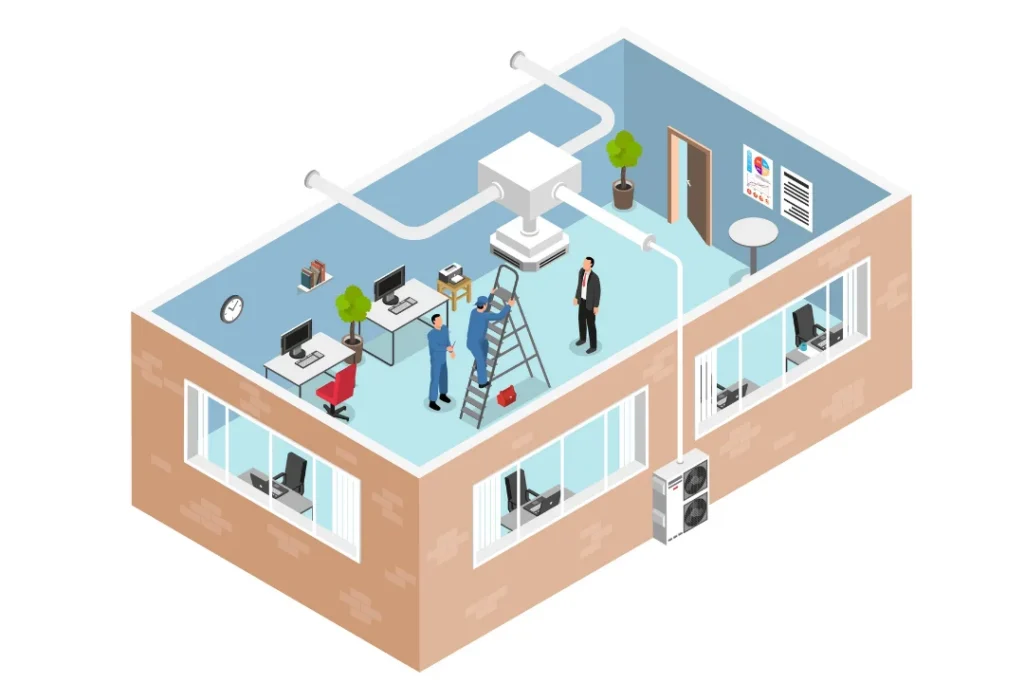
VAV stands for Variable Air Volume. In HVAC, a VAV system changes how much air (the volume) gets delivered to each area of a building, based on what that area needs.
If you have ever wondered what a VAV in HVAC is, think of it as a smart air distribution setup that can cool one room more, another room less, and save energy by not over-conditioning empty spaces.
What does VAV stand for in HVAC?
VAV stands for Variable Air Volume.
That means the system mainly controls comfort by adjusting the amount of conditioned air supplied to a zone, instead of pushing the same airflow all the time.
This is the core VAV in HVAC meaning variable airflow to match changing demand.
What is a VAV in HVAC, in plain terms?
A VAV system is usually used in commercial buildings with multiple rooms and different comfort needs. It typically has:
- One central unit that produces conditioned air
- A duct system that carries air through the building
- A VAV box in HVAC for each zone (or group of rooms)
- Thermostats or sensors that tell each zone what to do
Instead of treating the whole building the same, VAV treats it like separate comfort “neighborhoods.”
How does a VAV system work?
A VAV system works by sending conditioned air from an air-handling unit into ductwork, then using VAV boxes to control how much air each zone receives.
Here is the basic flow:
- Air Handling Unit (AHU) cools or heats air.
- The AHU pushes air into the duct system.
- Each zone has a thermostat (or sensor).
- The thermostat signals the zone’s VAV box.
- The VAV box opens or closes a damper to increase or reduce airflow.
If a zone is warmer than the setpoint, the box typically opens more to deliver more cool air. If the zone is satisfied, the box reduces airflow.
How do VAV systems handle ventilation and indoor air quality (IAQ)?
VAV systems do more than heat or cool. They also play a big role in ventilation and indoor air quality (IAQ). Ventilation means bringing in outdoor air to dilute indoor pollutants. In many commercial buildings, outdoor air is introduced at the air-handling unit (AHU), then distributed through the ducts to each zone.
Here is the key beginner concept: a VAV box can reduce airflow when a zone needs less cooling, but the building still needs enough fresh air. This is why, in the majority of VAV systems, there is a minimum airflow requirement. The box normally remains half-open even when the thermostat is set to ensure a minimum of air circulation and ventilation.
In modern-day buildings, VAV systems often work together with a building management system (BMS) to ensure a more precise regulation of air movement. A typical approach is demand-controlled ventilation (DCV), which relies on CO2 sensors to estimate the number of occupants in a room.
In the system, ventilation is enhanced as CO2 levels rise. When it is not crowded in the vicinity, it reduces outdoor air in order to conserve energy.
Controlling the air flow also helps with humidity and smells, especially in crowded places like meeting rooms, classrooms, and lobbies. But problems can happen if the setup isn’t right. When the minimum airflow is lowered too low, there will be some stuffy areas. This may consume unnecessary energy and result in drafts, as it may be set too high.
The simplest way to say it is:
- VAV controls comfort through the air flow modification.
- Ventilation rules still apply, so the system keeps a safe “floor” of airflow.
- Sensors and controls can fine-tune fresh air based on real building use.
What is a VAV box in HVAC?
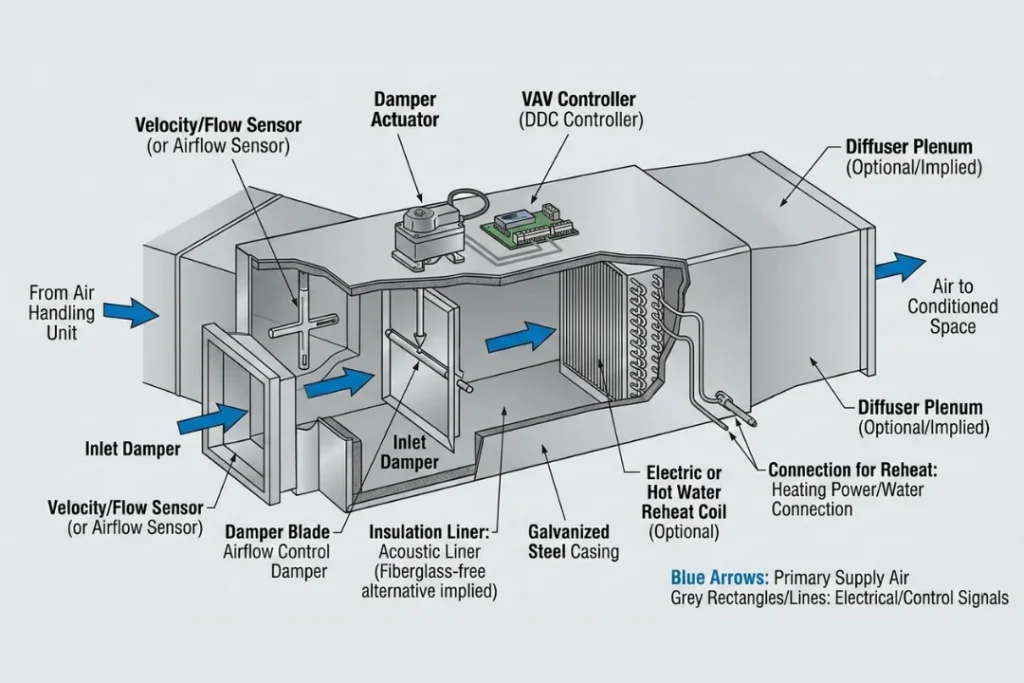
A VAV box is the zone-level device that controls airflow into a space. It usually sits in the ceiling plenum or mechanical space above the rooms it serves.
Most VAV boxes come with:
- A damper that opens and closes to change the flow of air
- An actuator is a motor that moves the damper.
- A sensor that measures the actual CFM of the airflow
- A controller is the “brain” that gets signals from the thermostat and BMS.
Some VAV boxes come with a reheat coil that can help warm the air in that zone when it needs to be.
What are VAV controls, and why do they matter?
The sensors, controllers, and logic in VAV controls keep each zone stable and comfortable. Good controls stop problems like complaints about being too hot or too cold, noise, and wasted energy.
Some common control inputs are:
- Thermostat for zone temperature
- The temperature of the air coming from the AHU
- Airflow (CFM feedback in the box)
- Occupancy sensors (optional)
- Optional CO₂ sensors for controlling ventilation
Some common control outputs are:
- Position of the damper (0–100%)
- Reheat valve position (if there is a reheat)
- Commands for fan speed (in some designs)
A Building Management System (BMS) connects to VAV controls in many buildings so that the whole HVAC system can be watched and adjusted from one place.
What are the main types of VAV in HVAC?
There are different kinds of VAV in HVAC, and each one is best for a different type of building. The big differences are whether the box only cools, whether it can reheat, and whether it keeps airflow stable.
1) What is a VAV box with only one duct?
The most common type is a single-duct VAV box. It demands air from one supply duct and changes the flow of air into the zone.
This is often used for areas that only need to be cooled or areas that will be heated in a different way.
2) What is a box that reheats VAV?
A VAV reheat box can cool a zone by slowing down the flow of air, and it can also heat a zone by warming the air with a hot-water coil or electric heater.
This is common in buildings where some areas may need to be heated even when the main system is cooling.
3) What is a VAV system with two ducts?
A dual-duct VAV system has two ducts going to the zone:
- One duct brings in cold air.
- One duct brings in warm air.
The VAV terminal chooses or mixes air from those ducts to meet the needs of the zone. It can keep the temperature very stable, but it usually costs more and has more ducts.
4) What is a VAV box that runs on fans?
A VAV box with fans has a small fan that assists in circulating air, and a fan-powered VAV box is often more comfortable at low air flow.
There are two common styles:
- Series fan-powered VAV: fan runs continuously, airflow is steadier
- Parallel fan-powered VAV: fan turns on when needed, often during heating
These are common where low airflow could otherwise cause poor mixing or comfort complaints.
VAV vs CAV: What is the difference?
VAV changes the volume of air. CAV (Constant Air Volume) keeps airflow constant and changes temperature more than airflow.
Here is a simple comparison:
| Feature | VAV Systems | CAV Systems |
|---|---|---|
| Airflow | Varies by zone demand | Constant all the time |
| Zone control | Strong (per zone) | Limited unless extra controls exist |
| Energy use | Often lower | Often higher |
| Complexity | Higher | Lower |
| Best for | Buildings with mixed needs | Spaces with steady, uniform loads |
If your goal is to explain “what is a VAV in HVAC” to a beginner, this is the key message: VAV matches airflow to demand, zone by zone.
Where are VAV systems commonly used?
VAV is most common in commercial and institutional buildings, especially those with many rooms and changing occupancy.
Typical examples:
- Office buildings
- Hotels
- Hospitals (with special design requirements)
- Schools and universities
- Shopping malls and mixed-use buildings
Homes usually do not use classic VAV boxes. Residential zoning exists, but it often uses different equipment and control methods.
Why are VAV systems considered energy efficient?
VAV systems save energy because they avoid pushing maximum airflow to every zone all the time.
Energy savings often come from:
- Lower fan energy when zones need less air
- Less overcooling of empty or low-load areas
- Better zoning, which reduces “comfort battles.”
- Integration with occupancy schedules and sensors
In many real buildings, fan energy is a major operating cost. Reducing unnecessary airflow can create meaningful savings.
What is “minimum airflow” in VAV, and why is it so important?
Minimum airflow is the lowest airflow a VAV box is allowed to deliver when the zone does not need much cooling. In simple terms, even when a room is close to the set temperature, the VAV box usually cannot shut completely. It must keep a small amount of air moving for ventilation, air quality, and stable comfort.
This matters because VAV systems are designed to save energy by reducing airflow. However, when the minimum airflow is adjusted incorrectly, you may lose comfort and efficiency.
If the minimum airflow is set too high, the zone may get overcooled. The system then has to reheat the air to avoid discomfort.
This is a common source of energy waste, especially in buildings with many interior zones that do not need much cooling. High minimums also increase fan energy because the air handler must push more air than necessary.
If minimum airflow is set too low, the room can feel stale, stuffy, or uneven. Air may not mix well, which causes hot and cold spots. Very low airflow can also create control instability. The room temperature drifts, then the box opens aggressively, then closes again.
Minimum airflow settings often relate to:
- Ventilation needs (fresh air requirements)
- Occupancy (how many people use the space)
- Diffuser performance (air throw and mixing at low CFM)
- Heating method (reheat boxes may need a stable minimum)
A beginner-friendly way to think about it is: minimum airflow is the system’s “idle speed.” Set it right, and the zone stays comfortable without wasting energy. Set it wrong, and you get complaints, noise, and higher bills.
What are the downsides of VAV systems?
VAV systems are not perfect. The tradeoff for efficiency and control is more complexity.
Common concerns include:
- Higher first cost (more devices and controls)
- More commissioning work
- More things to maintain (actuators, sensors, controllers)
- Comfort issues if the minimum airflow is set too low
- Noise issues if ducts and terminals are poorly sized
Most VAV problems are not “because VAV is bad.” They are usually setup, design, or maintenance problems.
What should beginners know about design and installation?
Getting VAV right is about details. A good VAV system is sized, zoned, and controlled carefully.
What is zoning, and how should zones be chosen?
Zoning means dividing the building into areas that should be controlled together.
Good zones usually share:
- Similar sun exposure
- Similar occupancy patterns
- Similar equipment heat loads
- Similar schedules
Bad zoning can cause constant complaints, even if the equipment is high quality.
Why does duct design matter so much with VAV?
VAV relies on stable pressure and predictable airflow. Poor duct layout can cause:
- Some zones are getting too much air
- Other zones are starving for air
- Excess noise at diffusers
- Unstable temperature control
Good ductwork design and balancing are essential.
Where should thermostats be placed?
Thermostats should read the real room temperature. Avoid placing them:
- In direct sunlight
- Near exterior doors
- Near heat-producing equipment
- Directly under the supply air blasts
Bad thermostat placement leads to bad control decisions.
What does commissioning mean for VAV systems?
Commissioning is the process of verifying that the system actually performs as designed. For VAV, this matters because airflow control has many moving parts.
Commissioning often includes:
- Confirming sensor calibration
- Verifying airflow readings and damper response
- Setting minimum and maximum airflow per zone
- Testing reheat operation (if present)
- Checking schedules and control sequences in the BMS
- Balancing air distribution at diffusers
A VAV system can look “installed” but still perform poorly without proper commissioning.
What are common VAV maintenance issues?
Most VAV maintenance is about keeping sensors, dampers, and controls working accurately.
Common issues:
- Sticky or failed damper actuators
- Dirty airflow sensors or tubing
- Control loop tuning problems
- Reheat valve failures (reheat boxes)
- Filters and coil issues at the AHU (upstream, but affects all zones)
A practical maintenance plan usually includes periodic inspection of terminals and trend review in the BMS.
What are common VAV problems, and how do you troubleshoot them?
Even a well-designed VAV system can run into problems over time. The good news is that most issues are predictable, and troubleshooting usually comes down to airflow, sensors, or controls.
A common complaint is “this room is always too hot or too cold.” First, verify thermostat placement and accuracy. A thermostat near sunlight, a supply diffuser, or heat-producing equipment can misread the zone. Next, check the VAV box damper. If the actuator is failing, the damper may not open or close to the commanded position.
Another frequent issue is poor airflow. If a zone feels stuffy or weak, confirm the box is receiving enough duct static pressure. Low pressure upstream can make multiple VAV boxes under-deliver. Also, check the minimum airflow settings. If the minimum is set too low, air mixing gets worse, and the zone can feel uncomfortable even when “on.”
You may also hear noise at diffusers. This often points to high velocity from an undersized duct, poorly selected diffuser, or a VAV box hunting (rapidly adjusting). Noise can also happen when the box is near wide open due to high load, but the duct system is not balanced.
For reheat VAV boxes, watch for zones that heat when they should cool. A stuck reheat valve, incorrect control sequence, or wiring issue can cause simultaneous heating and cooling. That wastes energy and creates comfort swings.
A practical troubleshooting order is:
- Confirm zone temperature and setpoint.
- Check the airflow command vs the actual airflow.
- Inspect the damper and actuator operation.
- Verify sensor calibration and control sequence.
- Re-test and rebalance if needed.
Quick recap: What is a VAV in HVAC?
A VAV system is an HVAC air distribution approach that adjusts airflow to each zone based on demand. VAV stands for variable air volume. Each zone typically has a VAV box, a thermostat, and controls that open or close a damper to deliver the right amount of air.
FAQ
What is a VAV in HVAC?
A VAV is a Variable Air Volume system that changes the amount of conditioned air delivered to each zone to maintain comfort efficiently.
What does VAV stand for in HVAC?
VAV stands for Variable Air Volume.
What does the VAV in HVAC mean?
It means the HVAC system controls comfort mainly by varying airflow volume, usually zone by zone.
What is a VAV box in HVAC?
It means that the HVAC system controls comfort mostly by changing the amount of air that flows through each zone.
What does a VAV box do in HVAC?
A VAV box is a terminal unit in the duct system that uses a damper, actuator, and controls to control the flow of air into a zone.
What are the types of VAV in HVAC?
Some common types are single-duct VAV, VAV reheat, dual-duct VAV, and fan-powered VAV boxes that work in series or parallel.
Is VAV better than CAV?
VAV is often more energy efficient and offers better zone comfort, but it costs more and requires better design and commissioning than CAV.
Do VAV systems only apply to commercial buildings?
Most classic VAV systems are used in commercial buildings, especially multi-zone buildings with changing occupancy and loads.
Can a VAV system provide heating, or is it only for cooling?
Yes. Many VAV systems can heat, usually through a VAV reheat box that warms the air before it enters the zone. Some buildings also use fan-powered VAV boxes to improve heating performance at low airflow.
How can you tell if a VAV box isn’t working?
Some common signs are that one zone stays too hot or too cold, the airflow feels weak or inconsistent, there are clicking or humming sounds coming from the ceiling, or the temperatures go up and down. A technician usually checks the movement of the damper, the readings from the airflow sensor, the operation of the actuator, and the control signals.