
For business leaders and HR professionals, navigating federal cybersecurity rules feels daunting. The primary guidance is NIST Special Publication 800-53. This document is key to protecting sensitive government data and offers a full list of security controls. In this blog we will get breif and correct answer to the question “What Guidance Identifies Federal Information Security Controls?“
The guidance identifies federal information security controls is THE PRIVACY ACT OF 1974.
Any organization working with the U.S. government needs to understand this guidance. It affects how you handle contracts and keep information safe. Compliance is not optional. It is a mandatory requirement for federal partnerships.
If you ignore these controls, you could lose valuable government contracts or face legal trouble. You risk losing lucrative government contracts and facing legal penalties. Proactively implementing these controls builds trust and secures your business’s future.
What is the Core Guidance for Federal Information Security?
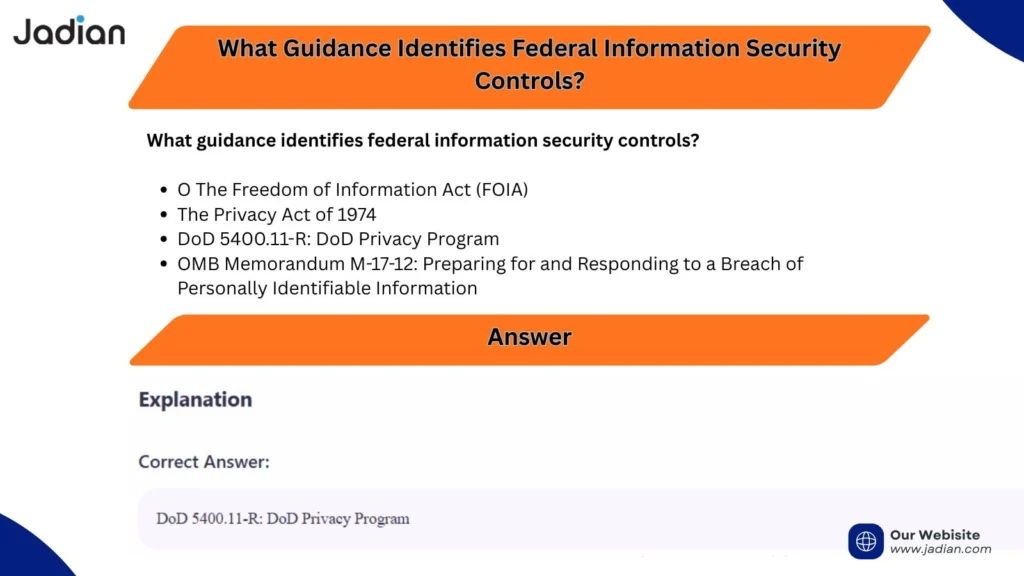
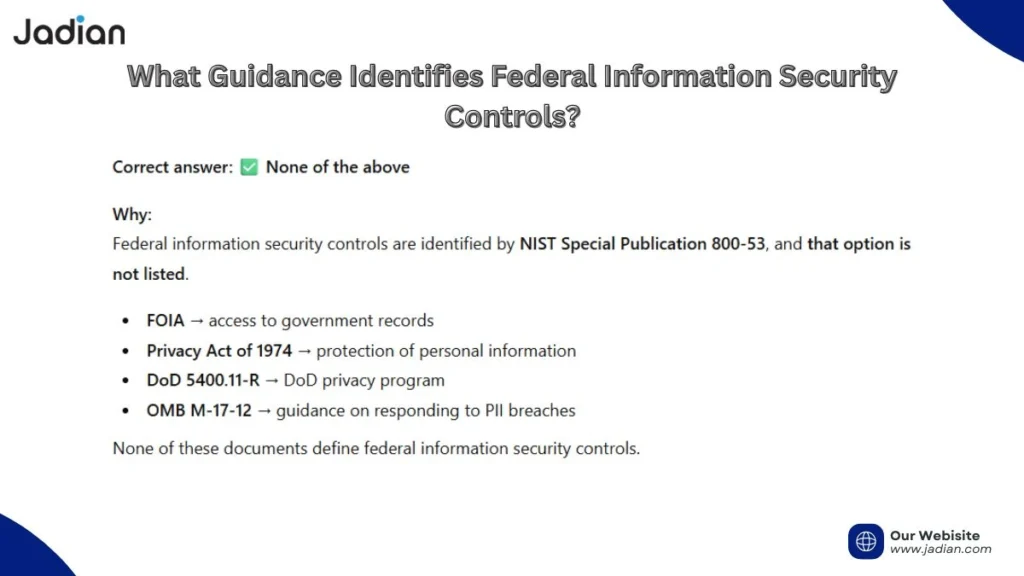
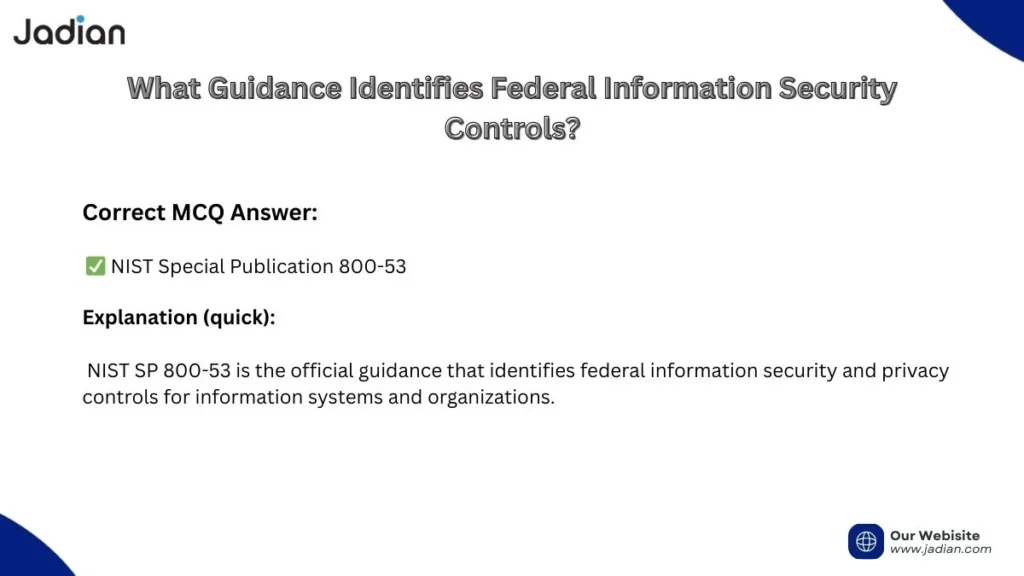
The definitive answer is the NIST SP 800-53 framework. Published by the National Institute of Standards and Technology, it identifies security controls. Its full title is “Security and Privacy Controls for Information Systems and Organizations.” This publication is the federal standard.
It offers a flexible and customizable set of safeguards. Organizations use it to manage diverse security and privacy risks. It is designed to protect operations, assets, and individuals from various threats.
The framework is regularly updated to address new cyber threats. This ensures the guidance remains relevant and robust. Adopting it means your security practices evolve with the landscape.
Why is NIST SP 800-53 So Critical for Compliance?
This guidance is mandated by the Federal Information Security Modernization Act (FISMA). FISMA requires all federal agencies to implement information security programs. NIST SP 800-53 provides the specific controls to meet that legal requirement.
For private companies, compliance becomes law through federal contracts. Your business must follow these rules when handling federal information. It is a key criterion for doing business with the government.
The controls cover more than just IT. They address management, operational, and technical safeguards. This holistic approach protects the entire organizational ecosystem.
How is This Federal Guidance Structured and Organized?
The NIST SP 800-53 standard divides security controls into 20 control groups, which they refer to as control families. Each family group relates security objectives together. Examples include Access Control, Audit and Accountability, and Risk Assessment.
This setup lets organizations handle security in smaller, manageable parts. You can focus on the most important families based on your risk assessment. It gives you a clear plan for putting controls in place.
Within each family, controls are further classified by type. The classes are Technical, Operational, and Management. This ensures all aspects of security are addressed systematically.
What Other Key Frameworks Support Federal Information Security?
NIST 800-53 functions as the primary standard, while other documents deliver vital background information. The NIST Risk Management Framework (RMF) serves as an essential supporting document. It provides a six-step process for selecting and implementing the controls.
The RMF turns the control catalog into an actionable lifecycle. Steps include categorizing systems, selecting controls, and continuous monitoring. It is the engine that drives effective security management.
Federal Information Processing Standards (FIPS) are also crucial. For example, FIPS 199 defines how to categorize information systems. This categorization directly dictates which controls you must implement.
How Can Organizations Implement These Complex Controls Efficiently?
Manual implementation is complex and prone to error. This is where specialized best compliance software becomes indispensable. The right platform transforms this challenge into a manageable process.
Tracking hundreds of controls across documents is overwhelming. It leads to gaps, failed audits, and unnecessary risk. Automation is the modern solution for reliable compliance.
Jadian software helps to manage compliance in this case by centralizing all requirements. It maps controls directly to your organizational processes and evidence. The system establishes an authentic central reference point that confirms your security status.
The platform guides your team through each step of the NIST RMF. It automates evidence collection, assessment workflows, and audit reporting. This significantly reduces the administrative burden on your staff.
With Jadian, you can continuously monitor your control status. Real-time dashboards show your compliance health in real time. This allows for proactive management instead of last-minute scrambles before an audit.
Read More >> Top 10 Compliance Management Software
What Are the Common Challenges in Managing Federal Information Security Controls?
Organizations frequently struggle to understand their complex needs. The requirements contain specialized language elements that create challenges because they require multiple licensing agreements. The absence of a defined strategy creates confusion for the entire team.
The organization faces its second major obstacle when it needs to provide ongoing proof of activities. Auditors require proof that controls are functioning over time. Manually maintaining this evidence is a full-time, error-prone task.
Staying updated with framework changes is also difficult. NIST regularly updates SP 800-53 to counter new threats. Falling behind on revisions leaves your systems vulnerable.
How Does Practical Implementation Look for a Business?
The theory of federal security controls is one thing. Putting them into daily practice is another. Business leaders find it difficult to implement because they must complete multiple tasks. We will create a straightforward plan that leads to specific results.
A practical implementation is a phased, managed project. It transforms written guidance into operational reality. This process protects your data and your federal business interests.
The goal is to build security into your business rhythm. The audit process must be handled through regular operations instead of requiring emergency audits. Businesses need to develop their operations by incorporating compliance as an element to be implemented directly at their operational centers.
Step One: Define and Categorize
You must begin by identifying the federal systems that need assessment. The system requires FIPS 199 for its impact assessment according to those predetermined categories. The scoping process defines the NIST 800-53 baseline controls, which you must implement.
Step Two: Conduct a Gap Analysis
The next step involves executing a comprehensive gap analysis process. The assessment evaluates your current security practices to determine their effectiveness against established security standards. The assessment process identifies your successful areas while showing which parts need urgent improvement.
Step Three: Execute a Plan of Action
You need to create an execution plan that details all required actions to fulfill project objectives. The gap assessment report requires your team to develop a plan that specifies actions needed to resolve all identified gaps. The process includes assigning responsibility to team members while establishing project milestones and determining required project resources.
Why is Continuous Monitoring a Game-Changer for Compliance?
Compliance is not a one-time project before an audit. It is an ongoing cycle of assessment and improvement. Continuous monitoring is the practice that makes this sustainable.
It involves regularly checking that controls are working correctly. This means automated checks, log reviews, and periodic testing. Problems are found and fixed quickly, not months later.
Jadian software helps to manage compliance in this case by automating monitoring tasks. It can track user access, system configurations, and policy adherence. The system alerts you immediately if a control falls out of compliance.
Conclusion: Turning Guidance into Confident Action
Understanding what guidance identifies federal information security controls is the first step. The real goal is effective and sustainable implementation. NIST SP 800-53 provides the “what,” but you need a strategy for the “how.”
The process of moving from theoretical knowledge to practical application needs appropriate tools together with the correct methodology. A manual process creates risk and drains resources. The current solution requires organizations to adopt structured methods that use technology for their operations.
The Jadian software solution establishes the necessary compliance framework requirements that organizations can utilize for their regulatory needs. The system enables your team to achieve federal information security controls through successful implementation. You can secure your contracts, protect your data, and focus on growing your business.
FAQs: Your Federal Security Controls Questions Answered
1. What Guidance Identifies Federal Information Security Controls?
NIST Special Publication 800-53 is the primary guidance. It provides a comprehensive catalog of security and privacy controls. All Federal agencies and contractors must comply with it.
2. Is NIST 800-53 only for federal agencies?
No, it is also mandatory for private sector organizations. This includes contractors, subcontractors, and service providers. They must use it when handling federal information systems.
3. What is the difference between NIST 800-53 and the NIST Cybersecurity Framework (CSF)?
NIST 800-53 is a control catalog for federal systems. The CSF is a voluntary, risk-based framework for all organizations. The CSF is broader, while 800-53 is more specific and mandatory for government work.
4. How often does NIST 800-53 change?
NIST updates the document at regular intervals, which usually occur every few years. The updates reflect emerging threats and developing technologies and include user comments. Organizations must stay informed about the latest revision.
5. Where does FISMA fit into this?
The Federal Information Security Modernization Act (FISMA) is the law. It requires agencies to protect their information. NIST 800-53 provides the specific controls to comply with FISMA.
6. Can software really manage all these controls?
Yes, dedicated compliance software like Jadian centralizes the process. The system allows users to create control maps, which they can use to track between implementation and monitoring until the final report stage. This approach reduces system complexity while ensuring complete control over all aspects.