It is important for every business to understand non compliance and compliance if the business wants to avoid penalties and keep its operations running smoothly. Compliance is the term used to describe following laws, regulations, and standards that apply to your industry, whereas non-compliance denotes the scenario in which your business does not meet the requirements.
No matter if you own a new small company or a large organization, being compliant will always protect your company from the legal side of the game and will not only that but also enhance the relationship with the clients, partners and regulators. On the contrary, non-compliance will be a cause of the downfall of the company through the payment of fines, lawsuits, and loss of reputation.
With this guide, you won’t miss out on anything important for understanding non compliance and compliance. We will define these terms, tell you the reasons of their importance and cover the ways of saving your company from severe penalties.
What Does Compliance Mean in Business?
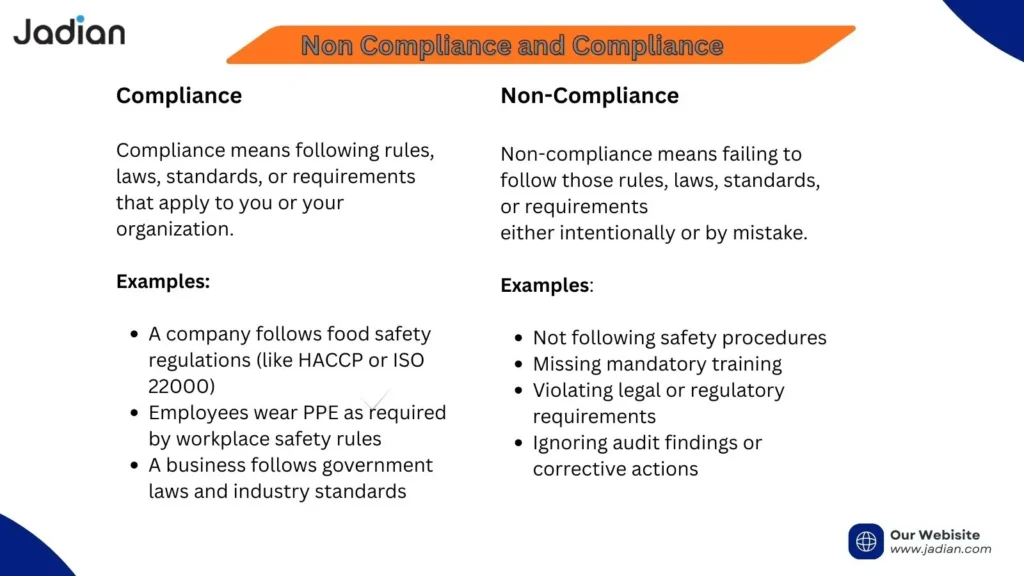
Compliance is basically the procedure of adhering to all applicable laws, regulations, standards, and internal policies that outline the operation of your business. It includes taking to account the requirements imposed by regulators, standard-setting bodies, and even your own internal procedures.
When your business is compliant, you are in the legal Territory. You act according to the norms set for your industry like ISO standards, safety guidelines, data protection laws, and quality assurance systems. Compliance is not only about staying on the safe side but also about establishing a solid ground for sustainable development.
Different regulatory needs exist across different industries:
- Health Care: Medical gadget standards, patient data privacy, and HIPAA rules
- Manufacturing: ISO 9001 quality standards, rules for safety at work, and compliance with environmental laws
- Finance: rules for reporting money, laws against moving money, and rules protecting consumers
- Technology: Cybersecurity standards like ISO 27001 and data protection rules like GDPR and CCPA
- Food Industry: rules for food safety, HACCP, and cleanliness
Managing compliance entails a number of crucial elements. To start, it is important to recognize the laws that are relevant to your company. Then, you will have to establish procedures and safeguards in order to fulfill these requirements. Finally, it is important to record everything correctly for the purpose of audits and reviews.
Compliance management software assists companies in following the necessary requirements, handling their documentation, and performing compliance duties automatically. Such tools minimize manual mistakes and offer transparency in compliance situations throughout the whole organization. They also streamline the process of preparing for audits and getting quick responses to changing regulations.
What Is Noncompliance?
Noncompliance is a term used to describe the situation where a business fails to comply with the laws, regulations, standards, or its own internal rules that are applicable to it. It means not adhering to the rules that apply to your industry or operations either on purpose or inadvertently.
Non compliance and compliance are two sides of the same coin. Compliance means that all the requirements are fulfilled, whereas non-compliance indicates the presence of gaps, failures, or even violations in your adherence to those standards. The extent of these failures could vary from minor documentation errors to even serious legal violations.
Different kinds of non-compliance can be found in the everyday operations of a business:
- Auditing with documents not complete or missing
- Not changing processes when there are changes in regulations
- Not following safety rules or neglecting maintenance of equipment
- Not conducting employee training or not giving certifications that are required
- Not taking sufficient data security measures
- Not keeping records properly
- Not reporting incidents or violations
- Not having the necessary licenses or permits while operating
The main distinction between compliance and noncompliance is not merely obeying the regulations. It is having the proper measures to continually satisfy the requirements. A single error might not be designated as non-compliance if there are effective remedy procedures. On the other hand, persistent faults or a lack of systems will definitely lead to non-compliance.
There are several types of non-compliance that can be classified:
- Critical non-compliance: This entails committing serious violations that could create risks right away to health, safety, or legal reputation. They need immediate withdrawal of measures and may lead to stopping the business.
- Major non-compliance: This situation would result in a considerable failure that could cause very serious consequences if not dealt with quickly. While operations may continue, nevertheless, they need priority attention.
- Minor non-compliance: Issues of a lower severity, such as documentation gaps or inconsistencies in following proper procedures, fall under this category. Although these are not dangerous immediately, it is still advisable to rectify them to avoid the situation getting worse.
- Being aware of and recognizing the differences among these types of non-compliance, corrective actions can be prioritized and resources allocated efficiently.
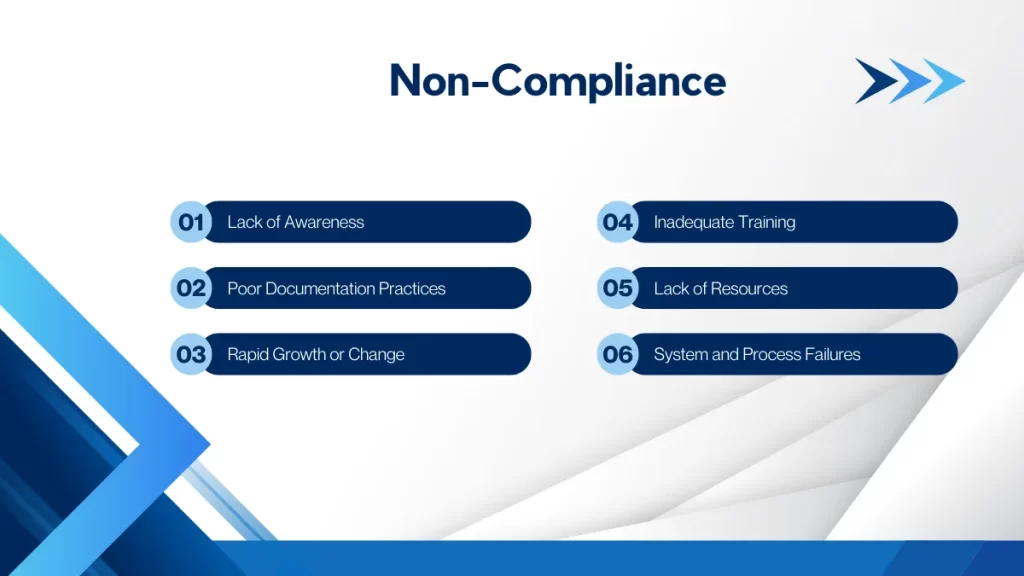
How Does Non-Compliance Happen?
Non-compliance is not something that occurs all of a sudden. It usually comes into existence slowly through a series of organizational weaknesses, process breakdowns, and alterations in external demands. Knowing the way non-compliance develops will make it easier for you to implement preventive measures.
Lack of Awareness
A lot of companies get non-compliant merely because they are unaware of the regulations they are subject to. This is very likely when businesses make a move into new territories or introduce new products. There are different prerequisites for different places, and what is within the compliance limits in one place may be a breach of rules in the other.
Inadequate Training
Workers in your company will not follow the rules if they do not know what is expected. Poorly trained employees cause errors that lead to non-compliance, and this often occurs with the newcomers who have not been thoroughly educated on the compliance rules. Even with proper training, people can still interpret and respond to rules differently, often shaped by their underlying personality types and how they approach structure, responsibility, and decision-making.
Poor Documentation Practices
Proof is a conformance thing. It means you have to submit reports that you are observing rules, doing inspections that are required, and keeping the right records according to the regulations. When documentation is outdated, for instance inconsistent papers or reports missing, you are not able to prove compliance even if you are actually doing everything right.
Lack of Resources
There are occasions when companies are aware of their proper actions but do not have the means to accomplish them in a good manner. Compliance needs money to be spent on implementing systems, training, hiring staff, and continuous monitoring. Organizations that provide insufficient funds for these areas are bound to end up with compliance gaps.
Rapid Growth or Change
In case of rapid business growth, the compliance systems may not be able to handle the demand. The hiring of new staff surpasses the rate of training them. The processes applied for the small team are no longer suitable for a bigger entity. The opening of new offices leads to new legal requirements.
System and Process Failures
Obsolete systems and inefficiently crafted processes become the main factors for non-compliance. If the daily operations do not have built-in compliance checks, the busy people will bypass them. If your technology is not able to monitor compliance metrics, you will not be aware of the onset of the issues.
What Are the Consequences of Non-Compliance?
Non-compliance brings its own disastrous consequences which go way more than just simple regulatory fines. Non-compliance puts your business in a long line of problems that can endanger its very survival. By being aware of these risks, you can see the reason why non compliance and compliance are still the most important issues to be taken seriously and to be given sufficient resources.
- Financial Penalties and Fines
- Legal Action and Litigation
- Operational Disruptions
- Loss of Licenses and Certifications
- Reputation Damage
- Decreased Business Opportunities
- Employee Impact
What Are the Different Types of Compliance?
Compliance is not merely a concept, but it covers a wide range of categories that vary in their application according to the industry, location, and even the business model. By knowing the various types, you can make effective compliance programs that cover all the necessary requirements.
Regulatory Compliance
Regulatory compliance means adhering to the laws and regulations set up by the government agencies. These requirements are the legal restrictions that you have to satisfy in order to do business in a particular industry or area. Non-compliance can lead to legal consequences such as fines, sanctions, and arrests.
Examples include:
- Environmental Protection Agency (EPA) regulations for emissions and waste disposal
- Occupational Safety and Health Administration (OSHA) workplace safety standards
- Food and Drug Administration (FDA) rules for pharmaceutical and food companies
- Securities and Exchange Commission (SEC) requirements for publicly traded companies
- Federal Trade Commission (FTC) consumer protection regulations
Each industry faces its own set of regulatory bodies and requirements. Healthcare has different regulators than construction. Financial services face different rules than manufacturing.
Industry Standards Compliance
Industry standards are the best practices and technical specifications created by professional organizations and standards bodies. They are not always legally required; however, they usually turn out to be de facto necessities for conducting business in certain industries.
Key industry standards include:
- ISO 9001: Quality management systems ensure that products and services are consistently of high quality
- ISO 27001: Information security management guarantees the safety of sensitive data
- ISO 14001: Environmental management systems support the company in being eco-friendly
- ISO 45001: Occupational health and safety management
- PCI DSS: Payment card security standards apply when credit card information is being processed
- HIPAA: Healthcare data privacy and security regulations in the U.S.A.
Data Protection and Privacy Compliance
Data compliance tells you how to handle, keep, process, and safeguard private data. This has grown more important as companies deal with more digital information and worries about privacy grow.
Important guidelines for safeguarding information are:
- GDPR (General Data Protection Regulation): The European Union’s all-encompassing privacy law that impacts any company that provides service to people who live in the EU.
- CCPA (California Consumer Privacy Act): California’s rule about privacy that led to other states making similar laws.
- HIPAA: In the US, private healthcare data
- PIPEDA: A Canadian privacy law for businesses
These rules require certain ways to get consent, protect data, notify people of breaches, and give people the right to view or delete their own data.
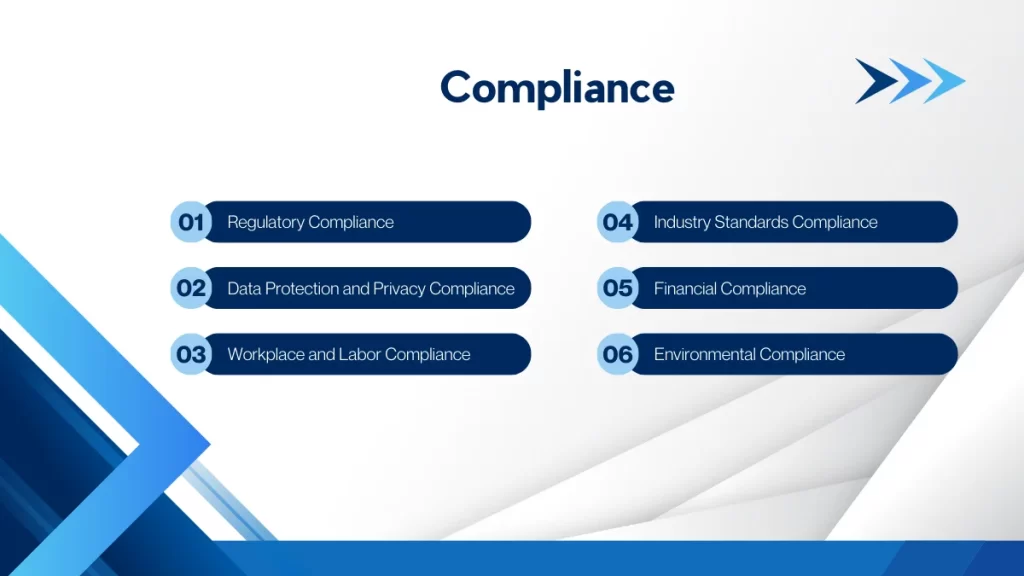
Financial Compliance
Financial compliance makes sure that reports are correct, stops scams, and keeps the budget in line. This is more relevant to businesses that are publicly traded, but it still has some effect on all organizations.
Key safety areas for finances are:
- The Sarbanes-Oxley Act (SOX): It makes sure that public companies have internal processes and report their finances accurately.
- Anti-Money Laundering (AML): Reporting suspicious actions and stopping financial crimes
- Tax Compliance: Filing, paying, and reporting taxes in accordance with the law in different areas
- Generally Accepted Accounting Principles (GAAP): standardized ways of keeping financial records
Workplace and Labor Compliance
Compliance in the workplace protects workers’ rights, makes sure everyone is treated fairly, and keeps people safe on the job. This includes pay, safety rules, making sure there is no discrimination, and perks. In many workplaces, employees may also be required to provide documentation such as a medical certificate for sick leave or health verification to meet workplace compliance requirements.
The most important areas are:
- Fair rules about pay and hours for workers
- Anti-discrimination and hiring with equal chance
- Safety at work and avoiding hazards
- Compensation for workers and the management of perks
Different states and countries have different rules, so compliance in the workplace changes a lot from place to place.
Environmental Compliance
Environmental compliance looks at how your business affects the air, water, land, and natural resources. This includes long-lasting pollution control, trash management, and sustainability practices.
Common needs are:
- Control and measurement of emissions
- Hazardous waste dealing and getting rid of it
- Water dumping permission slips and oversight
- For new projects, environmental effect studies
- Sustainability reporting and carbon footprint reporting
As climate worries grow and states demand greater long-term viability, environmental rules are growing. To protect sensitive data and meet regulations, businesses must implement strong cybersecurity practices to ensure compliance.
Following Rules for Product Safety and Quality
You need to be sure that the things you make or sell are safe and of good quality. This protects people and keeps the market trustworthy.
This basically includes:
- Product testing and approval needs
- Safety and warning information
- Remember how to recall items that don’t work correctly.
- Rules for making things and quality control
- Companies that do foreign trade must follow the rules for when things come into and leave the country.
If you want to be able to sell your product in certain places, you usually have to get a third party to test it and make sure it follows the rules. Jadian is providong the quality information about the non-compliance and compliance in thi article.
How Can You Ensure Compliance in Your Business?
1. Do a full compliance check.
Start by knowing exactly what legal rules your business has to follow. In this case, it means finding all applicable laws, rules, standards, and contracts.
Rate your current state based on these needs. For this first evaluation, you might want to hire dedicated development team and compliance experts from outside your company.. They bring knowledge and impartiality that in-house teams may not have. They also know where it’s hard for most businesses to work.
2. Make it Clear Who is Responsible for Compliance
Your company needs to have someone in charge of compliance.For small companies, this could be just one compliance worker. Compliance teams with clear jobs and duties are needed in bigger companies.
3. Make clear rules and guidelines and write them down.
Write out exactly how your business meets each compliance rule.Write down each part of your process so that anyone can always do it the same way. These written steps are used to train people and prove that an audit was done.
4. Set Up Strong Training Programs.
Every employee should be trained on legal rules that apply to their job. New employees need to be fully trained. When things change, workers who already work there need to be trained again and told about the changes.
5. Set up an internal audit and monitoring system.
Regular internal checks find compliance problems before outside regulators see them. According to risk levels, figure out how often checks should be done. It’s important to check high-risk places more often.
6. Buy software to help manage compliance.
These days, Compliance Management Software turns compliance from a burdensome thing that has to be done by hand into a process that can be handled easily. These platforms help you keep track of what you need to do, handle files, plan audits, make sure training is finished, and create reports.
Good compliance management software offers:
- Centralized place to store all legal papers
- Alerts that automatically let you know about upcoming deadlines and required tasks
- Training to track and give tasks
- Management of audits and tracking of appropriate actions
- Dashboards and reports for safety in real time
7. Build a Culture of Compliance
Following the rules can’t be left up to just one safety department. You should make sure that everyone knows how to keep up with the standards in your company. Let workers know they can report compliance issues without fear of what will happen to them.
8. Keep up with changes in the rules that govern your business.
Rules are always changing. Your compliance program needs to change to fit the situation. Regulations can change in your business and areas. Make sure someone is assigned to keep an eye on these changes.
9. Make a way to correct and prevent actions.
When there are legal problems, deal with them in a planned way. Don’t just look at the sign, look for the root cause. Take steps that fix the problem right away. Then come up with steps that will keep this problem from happening again.
10. Keep the Right Paperwork and Records
Following the rules means showing proof.Keep good records of everything you do to follow the rules, such as training records, reports from audits, results from inspections, records of correcting actions, and descriptions of how things should be done.
FAQs About Compliance and Non-Compliance
What’s the difference between complying and not complying?
Compliance means your business follows all relevant laws, rules, and guidelines. Non-compliance happens when you don’t do these things. Following the rules shows you run your business legally and properly. On the other hand, not following the rules puts you at risk legally, financially, and operationally. Understanding noncompliance and compliance helps you run your business better.
What is the business definition of noncompliance?
In business, noncompliance meaning, refers to not following laws, rules, industry standards, or company policies that you are supposed to follow. It includes things like missing paperwork, not following the rules, ignoring safety measures, or breaking the law. Intentional breaches and accidental oversights both mean non-compliance.The noncompliance meaning includes any difference between the standards that are expected and the way things actually are.
How much could my business have to pay for not following rules?
The cost of not following rules depends on the type of business and how bad the violation is. Fines given directly can be anywhere from thousands to millions of dollars. On top of the fines, costs include having to pay for repairs, lost business chances, damage to your reputation, and having your business shut down. The total effect is usually at least ten times greater than the direct penalties.
What non-compliance usually doesn’t follow?
The most common causes include a lack of awareness about requirements, inadequate employee training, poor documentation practices, insufficient resources, rapid business growth, outdated systems, and failure to track regulatory changes. Many businesses become non-compliant through oversight rather than intentional violation.
How can software for compliance control be good for my business?
Compliance management software brings all of your documents together in one place, tracks requirements and deadlines automatically, handles training and certifications, schedules audits, keeps an eye on corrective actions, and shows you what’s going on right now with dashboards. It lowers the amount of work people have to do, makes mistakes less likely, and makes sure that all parts of your company are looked after the same way. Compliance management software is especially useful for companies that have to follow a lot of different rules at the same time.
How often should we conduct compliance audits?
The number of audits depends on the rules, risks, and your business. Annual in-depth audits with quarterly reviews of high-risk areas are helpful for most companies. It may be necessary to check on important legal areas every month. Set up a risk-based audit plan that gives the right amount of oversight without wasting too many resources.
Who is responsible for compliance in a company?
Everyone is responsible for following the rules in their own job, but leaders need to keep an eye on things and make sure people have the tools they need. A lot of groups choose a compliance officer or team to keep an eye on rules, plan work, and make sure that everyone does the same thing. The executives are ultimately responsible for the company’s compliance non-compliance stance.
What steps should I take if I find evidence of noncompliance?
Take care of compliance issues right away. Find out how bad it is and what caused it. Take steps to fix the problem right away. Let the right governing agencies know if you need to. Make sure to fully document everything. Come up with protective steps so this doesn’t happen again. Get help from a lawyer for major violations.
Can compliance standards be ignored by small businesses?
No. No matter how big a business is, it has to follow the rules. Most basic law and safety rules apply to all businesses, even though some rules have size-based exceptions. It’s often worse for small businesses when they don’t follow the rules because they don’t have as many tools to deal with fines and changes in how they do business.
How do I stay updated on changing compliance requirements?
Regulatory agencies send out notifications that you can subscribe to.You can also join industry groups, go to compliance conferences and webinars, and ask compliance experts for advice. Using compliance management software with regulatory tracking tools and talking to people in your industry can also be helpful. Put someone in your company in charge of keeping an eye on things and reporting on any changes that are important. When rules that affect your business change, good compliance management software can let you know instantly.