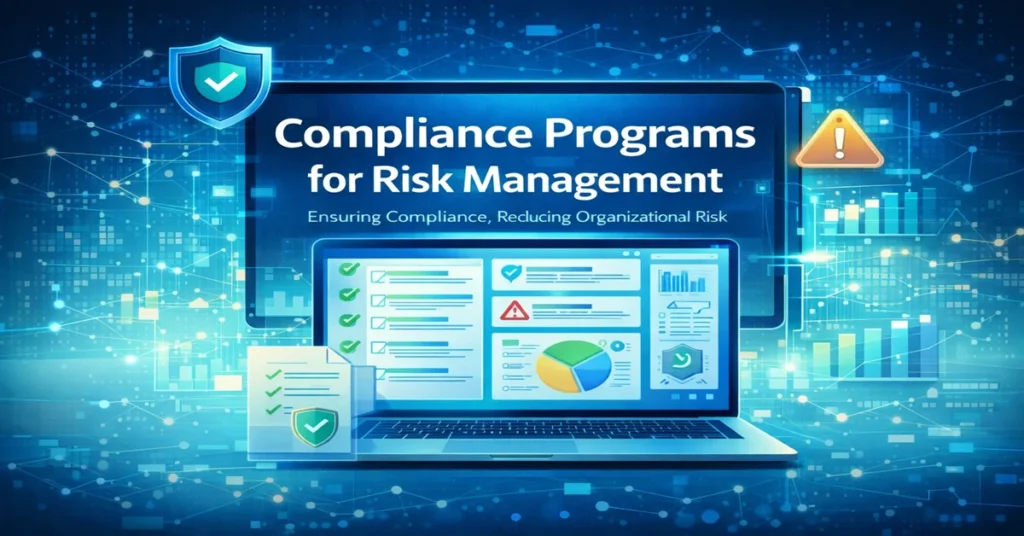
In today’s business world, rules and risks intersect closely. Every organization, regardless of size or industry, operates within a network of laws, regulations, standards, and internal policies. Compliance ensures you navigate these requirements effectively. In this blog we will get the answer to the question “A Compliance Program is Used For?“
Compliance means your business follows all applicable rules. Risk management plays an equally vital role. In business, risk management identifies potential threats that could harm your organization financially, legally, operationally, or reputationally.
Risk management lets businesses prepare, not just react. This is why compliance and risk management are connected. A compliance program is used for more than avoiding fines or passing audits. It is also essential for managing risk.
Compliance is more than checking boxes. It proactively reduces risk, builds accountability, and protects against costs.
This guide explains the role of compliance in enabling you to control and reduce risk.
What Is Compliance Risk?
Compliance risk arises when a business fails to follow laws, regulations, industry standards, or its own policies. Put simply, problems occur if organizations fail to understand, monitor, or enforce the rules effectively.
Every organization must meet certain obligations, such as data privacy laws, financial reporting rules, workplace safety standards, or industry regulations. Failing to meet these obligations exposes the business to risk. This risk constitutes compliance risk.
Why does this matter? Serious consequences can result from compliance risks. These risks are not merely theoretical. They may strike a company financially, reputation and its long-term stability. A single error may lead to investigations, fines, litigations or unnecessary publicity.
With today’s technology, news travels fast. If a company loses trust, it can be very hard to win it back.
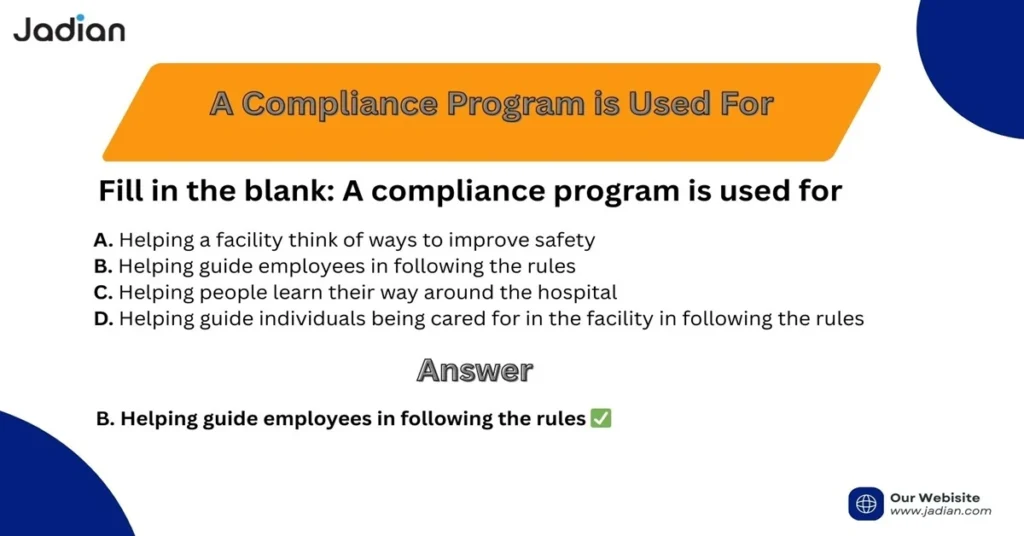
A Compliance Program is Used For?
A. Helping a facility think of ways to improve safety
B. Helping guide employees in following the rules
C. Helping people learn their way around the hospital
D. Helping guide individuals being cared for in the facility in following the rules”
The correct answer is:
B. Helping guide employees in following the rules ✅
The Role of a Compliance Program in Risk Management
A strong compliance program does more than just meet regulations. This approach helps businesses manage risk consistently. By making compliance part of everyday routines, organizations can find and solve problems early.
Here’s how it works:
Establishing a Structured Compliance Framework
A good compliance program begins with a clear framework. This makes it easier to stay organized and keep things on track.
The main parts of a compliance framework are usually:
- Policies that clearly explain what is expected
- Procedures that show how to follow those policies
- Internal controls that help stop errors, misconduct, or violations
- Training and communication so everyone knows their responsibilities
- Monitoring and reporting tools to track how well compliance is working
Without a structure, compliance efforts become scattered and reactive. A formal framework documents expectations, assigns responsibilities, and maintains steady oversight.
Compliance management software centralizes policies, provides reminders, tracks regulatory changes, and stores evidence, eliminating scattered spreadsheets.
This structure supports risk management by reducing the chance of missing something important. When organizations organize and display compliance clearly, they manage risk more effectively.
Identifying and Assessing Compliance Risks
Best compliance management software also plays a key role in identifying where risks exist.
Risk identification usually includes the following steps:
- Reviewing the relevant laws and regulations
- Carrying out internal audits and checking for any gaps
- Interviewing department heads and key stakeholders
- Keeping track of new regulations and changes in the industry
- Looking at past incidents or close calls
You don’t look for fault. Instead, you intentionally uncover vulnerabilities before regulators or external auditors do.
Once risks have been identified, evaluate them. Not all problems are equally important. There are those risks that are infrequent, but when they occur, they cause harm; those that occur frequently but with less harm are also frequent.
In making a decision where to begin, individuals consider two things which are:
- Likelihood: Probability of the occurrence of the risk.
- Impact: If the risk occurs, how much harm could it cause to finances, legal standing, or reputation?
Structured compliance management tools help simplify the process by providing features like risk scoring, dashboards, and reporting. With these tools, leadership teams can focus their resources on the areas that need them most, rather than trying to cover everything at once.
Integrating Compliance with Enterprise Risk Management (ERM)
Compliance should not work in isolation.
Good risk management implies a combination of compliance with the overall Enterprise Risk Management (ERM) model.
ERM is related to operational, financial, strategic, and reputational organizational risks. One of them is compliance risk.
When compliance and ERM teams work together, organizations see several benefits:
- Departments share risk information with each other.
- Leaders gain a clearer, organization-wide understanding of risks.
- Controls can address different types of risks at once.
- Decision-making becomes smarter and more forward-looking.
For example, a new regulation can create both compliance and operational risks. If teams do not work together, the organization might miss the bigger picture. But when compliance insights are added to ERM reports, with the help of compliance management software, they can respond more quickly.
Integration builds resilience. Instead of reacting to problems, organizations create a coordinated plan to anticipate and manage uncertainty. Compliance then shifts from a checklist task to a strategic partner for long-term stability and growth.
Key Elements of Effective Compliance Risk Management
It is a robust compliance strategy that is based on daily practice risk minimization and the compliance implemented in the daily routine, rather than on audits.
A compliance program creates risk structure, visibility, and accountability. We will consider the elements that ensure its effectiveness.
Internal Controls and Monitoring
The internal controls will allow for the avoidance of errors, misconduct, and regulatory issues. You can think of them as guardrails that keep your business running smoothly.
When creating controls, start by looking at your most significant risks. For data privacy, use system restrictions and regular reviews. For financial risks, separate duties and set approval processes.
However, simply setting up controls does not suffice. You also need to monitor them.
Continuous monitoring ensures controls work. This may include audits, alerts, reviews, and regular testing. Organizations can fix issues before regulators notice.
Regular monitoring turns compliance from reactive to proactive. Here is where real risk mitigation happens.
Training, Awareness & Culture
Even the best controls fail if employees don’t understand them.
Training is crucial but often overlooked. Employees need to know:
- What regulations apply to their role
- What policies are they expected to follow
- How to recognize and report potential issues
Regular, practical training sessions turn policies into real-world actions. They also make it clear: compliance is not only a leadership concern; it is everyone’s responsibility.
Culture is crucial beyond training. A compliant culture encourages open communication, ethics, and accountability. Employees should feel safe raising concerns. When they understand why compliance matters, not just the rules, they act responsibly.
That’s why a compliance program goes beyond simply meeting regulatory requirements. It also shapes the organization’s values and daily decisions.
Reporting and Metrics
If you don’t measure it, you can’t manage it. Tracking and reporting metrics are key to compliance risk management.
Here are some important compliance metrics to pay attention to:
- Number and severity of compliance incidents
- Time taken to resolve issues
- Audit findings and remediation progress
- Training completion rates
- Regulatory changes tracked and implemented.
These metrics reveal where your organization performs well and where risk still exists.
Clear reporting enables leaders to make better decisions. Leadership teams rely on accurate data to set priorities, improve controls, and manage new risks. Without a clear view, risks may grow unnoticed.
Reporting also helps keep everyone accountable. When compliance results are measured and shared, they become part of the bigger performance picture. Departments know what they are responsible for, and progress is easier to follow over time.
Essentially, good compliance risk management isn’t about being perfect. It’s about being consistent, open, and always looking to improve.
Technology’s Role in Compliance Risk Management
Compliance risk management can be very daunting to do manually. Technology is nowadays a necessity in compliance programs with all the unstable regulations, emerging risks, and a mountain of paperwork.
Organizations can maintain a digital tool to keep their schedule in order and prevent any possible difficulties instead of employing spreadsheets and long email chains.
When used well, technology supports human judgment instead of replacing it. It helps teams see things more clearly, find answers quickly, and avoid missing important details.
GRC Software and Automation
Governance, Risk, and Compliance (GRC) platforms let businesses manage everything together. Instead of handling policies, risk registers, audits, and reports manually, companies can use compliance management software to stay organized.
Automation eliminates errors and time wastage. As a case in point, overdue training can be automatically flagged by compliance tools, which means that there is no need to check manually. Alerts are sent live to teams in case of a control failure, as opposed to quarterly reviews.
This will minimize the stress of last-minute, reduce the number of surprises, and make the risk handling process smoother.
Data Analytics and Real-Time Insights
Modern technology makes it easier to see what is happening in an organization. With the right tools, teams can move from just reacting to compliance problems to managing risks before they happen. Data analytics lets compliance teams find patterns and trends early, so they can address issues before they become serious.
Instead of waiting for an annual audit to uncover problems, analytics tools help teams find them sooner.
Real-time dashboards give leaders a clear view of the organization’s compliance status at any time. They can quickly spot high-risk areas, overdue tasks, and new threats without searching through several reports.
When compliance management software includes analytics and reporting, it turns compliance from a back-office task into a strategic risk management tool. This helps organizations anticipate problems, respond quickly, and keep improving.
In today’s rapidly changing regulations, having this kind of insight is essential. It is essential.
Why Compliance Is Critical to Risk Management
Risk management closely goes with compliance. Compliance provides the organization, transparency and responsibility that the risk management requires. Companies that do not pay attention to compliance usually end up troublesome once they have taken place instead of getting trouble preemptively.
Here are some important points from this discussion.
First, compliance risk is a real concern and can cause major financial, legal, and reputational issues. Second, a structured compliance framework, supported by clear policies, internal controls, monitoring, and reporting, helps reduce uncertainty and improve oversight. Third, bringing compliance into broader risk management gives leaders a full view of the organization’s risks. Finally, technology helps improve visibility, efficiency, and responsiveness.
A strong compliance risk strategy starts with committed leadership. It includes regular risk assessments, ongoing training, open communication, and a focus on steady improvement. The organizations must invest in the products that monitor requirements and can react quickly to changes.
As laws change, the companies that incorporate compliance in their risk management approach are in a better position. They know how to overcome regulatory hurdles and not only manage them.
FAQs
A Compliance Program is Used For?
A. Helping a facility think of ways to improve safety
B. Helping guide employees in following the rules
C. Helping people learn their way around the hospital
D. Helping guide individuals being cared for in the facility in following the rules”
The correct answer is:
B. Helping guide employees in following the rules ✅
A compliance program is useful in ensuring that an organization adheres to laws, regulations, and internal policies and minimizes legal, financial, and reputational risks. It helps the businesses to determine the compliance requirements, controls, employee training, activities monitoring, and the fastest possible response in case of a violation occurrence.
What is the primary purpose of a compliance program?
A compliance program helps prevent, find, and fix violations of laws, regulations, or company rules. It does this by setting up clear policies, controls, monitoring, and reporting. This protects the company from fines, business interruptions, and damage to its reputation, while encouraging ethical and responsible behavior.
Does delivering value mean improving compliance adherence for a business?
Creating value through compliance starts with making sure everyone in the organization understands and follows the rules. When employees know what is expected and use the right processes, the risk of violations goes down. But compliance is about more than just following rules. It also improves efficiency, increases accountability, improves transparency, and facilitates improved decision-making.
What is the role of a compliance program in minimizing business risk?
A compliance program reduces risk in business as it determines the regulatory requirements, gaps, and controls that are put in place to avoid violations. With regular monitoring, audits, and reporting, organizations can catch problems early, before they turn into fines, lawsuits, or damage to reputation.
Who is responsible for managing compliance risk?
Compliance teams usually take the lead, but everyone shares responsibility for managing compliance risk. Leaders set expectations and oversee the process. Managers make sure procedures are followed in their departments. Policies have to be followed by the employees, and concerns voiced. A good compliance culture is based on the involvement of all people.