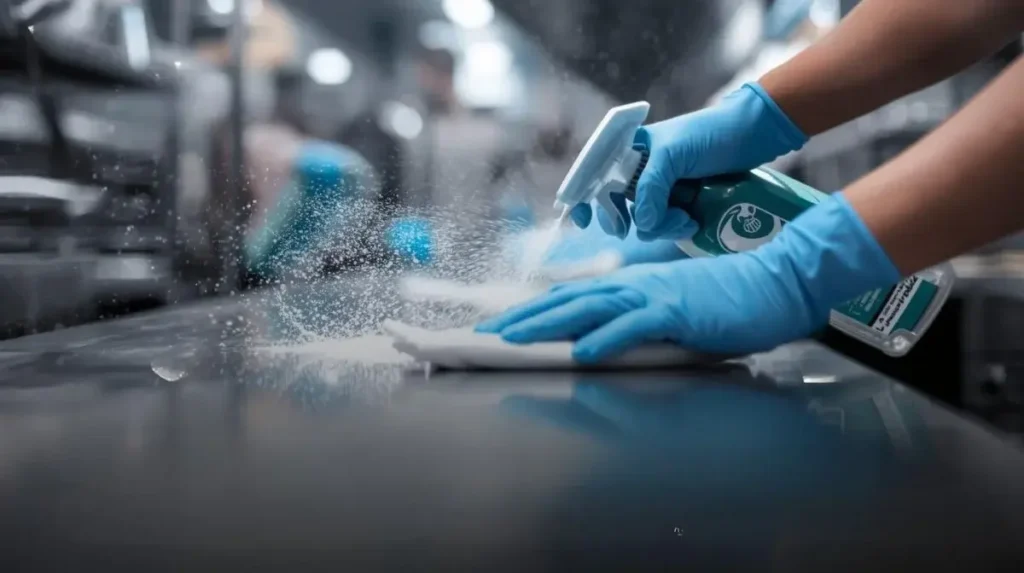
Cleaning and sanitizing food contact surfaces regularly is necessary to prevent contamination, keep your customers safe, and comply with all local, state, and federal health laws as they apply to your operation if you are involved in the handling, preparation, cooking, or serving of food.
The following information will provide an in-depth review of:
- When must food contact surfaces be cleaned and sanitized
- What three characteristics must food contact surfaces have
- Which item does not have a food contact surface
- Recommendations for maintaining high levels of food safety and sanitation
- How food safety management software can assist you in achieving compliance
Whether you operate a restaurant, commissary, catering service, cloud kitchen, or food manufacturing facility, this guide will help you create a safer, more compliant food establishment.
What Are Food Contact Surfaces?
Surfaces that make direct contact with food, including those used for preparation, cooking, holding, or serving, are considered food contact surfaces. As a significant factor in food safety, these surfaces can harbor potentially harmful bacteria if not properly cleaned and sanitized.
Examples of common surfaces that come into direct contact with food include:
• Cutting boards
• Knives and utensils
• Prep tables
• Mixer bowls
• Conveyor belts
• Storage containers for food
• Slicers and grinders
• Thermometer probe tips
Meanwhile, the bacteria that are commonly found on food contact surfaces are Salmonella, E. coli, Listeria, and Norovirus. When surfaces are not properly cleaned and sanitized, these bacteria can grow rapidly, especially in warm, moist environments.
When Must Food Contact Surfaces Be Cleaned and Sanitized?
Cleaning and sanitizing of all food-contact surfaces must take place at least after the first use of a surface, before using it for a new food product, every 4 hours if the surface will continue to be used continuously throughout that time, and as soon as there is evidence of possible contamination.
This rule applies everywhere in the commercial sector, in accordance with global food safety standards and guidelines.
1. After Each Use
After using a surface for cooking or food preparation, it should always be cleaned and sanitized before use again. Examples of how surfaces are utilized in food preparation include:
- Raw chicken is carefully chopped and sliced by hand on a sanitized wooden or plastic cutting board. To avoid cross-contamination, it must be cleaned and sanitized first before being used to cut vegetables or other foods.
- A cutting board used to prepare vegetables such as bell peppers, onions, or carrots should be cleaned before being reused for other foods.
- A mixing bowl used to prepare cake or pancake batter should be washed and sanitized before being used for another preparation task.
Hence, remember to always properly clean and sanitize a surface after each use before reusing it.
2. When Switching Between Raw and Ready-to-Eat Foods
Cross-contamination is a leading cause of foodborne illnesses. When you switch from raw to ready-to-eat foods, you need to clean and sanitize the equipment. Examples of cross-contamination are:
- Raw meat and vegetables
- Raw seafood and cooked rice
- Raw poultry and ready-to-eat salad.
3. Every 4 Hours During Continuous Use
In general, if a food contact surface has been in continuous use (e.g., a deli slicer or worktable), it should be cleaned and sanitized at least once every four hours.
Why four hours? Bacteria will multiply to dangerous levels within 4 hours when in contact with a warm food product in an ambient-temperature environment.
4. After Interruptions or Contamination
Food-contact utensils must be cleaned and sanitized whenever there is a risk that they may have become contaminated. Example:
- Utensil falls on the floor: Always clean and sanitize it if it comes into contact with the floor, as it may have picked up bacteria or other contaminants.
- Utensils handled by a worker with contaminated hands: If a utensil is touched by someone who has not properly washed their hands or whose hands may be contaminated, the utensil should be cleaned and sanitized before reuse.
- Utensils come into contact with cleaning chemicals: All utensils that accidentally come into contact with cleaning chemicals must be cleaned immediately to prevent chemical contamination, which can pose health risks.
If you’re unsure whether your utensils are clean enough, clean them anyway. Don’t take a chance with food safety; always err on the side of caution.
5. Before Starting Food Preparation
Preventive sanitation is important for cleaning all workstations before opening for business. Here is an example of a morning checklist to assist you with this task:
- Sanitize the top of your prep tables to remove any remaining bacteria or debris.
- Sanitize all your cutting boards to ensure they remain clean and safe surfaces for cutting.
- Thoroughly sanitize your knives and utensils to avoid any contamination when working with food.
- Do not forget to sanitize your food thermometer as well; this will help you to keep your food at the correct temperature and ensure that it is cooked properly.
Preventive sanitation is just as important as reactive sanitation. If you always have a clean work area, there should be less risk of food safety issues.
6. After Cleaning with Detergent
Cleaning removes visible dirt, debris, and food residue. However, cleaning alone does not eliminate harmful microorganisms. It reduces microbial numbers to safe levels. Preventive (ongoing) sanitation is equally important as reactive sanitation. A clean, consistent environment reduces the likelihood of foodborne illness.
7. At the End of Each Shift
Cleaning at the end of each day can help to reduce the risk of bacterial growth occurring during the night hours, which can attract pest(s). Following proper shutdown procedures will help maintain food safety and extend equipment life.
Cleaning vs. Sanitizing: What’s the Difference?
Cleaning removes visible dirt, food particles, and other contaminants from food-contact surfaces by washing with detergent and water; however, this is usually not enough to eliminate most bacteria on the surface. Sanitizing can be used after cleaning and utilizes heat (hot water) or an acceptable chemical to lower harmful bacteria populations to a safe level.
Therefore, cleaning makes a surface appear clean, while sanitizing ensures it is truly safe to use; both are important for food safety and sanitation procedures in the food industry.
What Three Characteristics Must Food Contact Surfaces Have?
All food-contact surfaces should be smooth, nonabsorbent, and easy to clean, so bacteria do not develop and can be properly sanitized. Let’s look at each of these three.
1. Smooth Surface
Cracks in a surface provide hiding places for food and bacteria to accumulate. These hidden spaces make it difficult to clean the surface properly and can lead to bacterial growth.
Examples of smooth materials are as follows:
- Smooth stainless steel (cutting board)
- Smooth food-grade plastic (cutting board)
- Smooth tempered glass (cutting board)
Do not use the following:
- A chipped cutting board
- A crack in a ceramic product
- Wood that is worn so much that there are deep grooves in it
It is possible to create bacterial growth areas even from very small cracks.
2. Non-Absorbent
Porous materials can retain moisture, allowing bacteria to grow within them. This trapped moisture can allow bacteria to grow and multiply inside the material.
Approved Materials (for preparation of food):
- Stainless Steel
- Food Grade Polypropylene
- Cleaned and Sealed Surfaces
Unapproved Materials (for preparation of food):
- Untreated Wood
- Cardboard
- Clothing
Materials that retain high moisture levels are at significant risk of bacterial contamination.
3. Easy to Clean and Sanitize
Effective cleaning and sanitizing of surfaces are essential for food safety. They should be durable enough to withstand cleaning chemicals, heat, and frequent use without damage.
Surfaces need to have properties that allow them to withstand:
- Chemical cleaners and sanitizers
- Heat from cleaning equipment
- Cleaning chemicals
- Frequent use (be durable)
- Exposure to moisture.
In addition, they cannot corrode easily. If cleaning chemicals can damage the surface of a piece of equipment, it leaves bacteria with many places to hide and grow.
Why These Characteristics Matter
If a surface does not meet all of the above requirements (i.e., it meets none of them), sanitation will fail.
Examples include:
- Cracks in a plastic board prevent effective cleaning or sanitization.
- Corrosion on metal will create crevices that harbor bacteria
- Rusted metal can be a breeding ground for bacteria in pits.
The porous nature of absorbent materials allows pathogens to live beneath the surface. It is why health inspectors carefully inspect the cleanliness of preparation surfaces.
Which Item Does Not Have a Food Contact Surface?
Non-food-contact surfaces are generally any item that does not come into direct contact with food or food equipment.
Some examples of non-food contact surfaces are:
- Floors
- Walls
- Ceilings
- Ceiling vents
- Trash cans (the outside of the trash can is a non-food contact surface.)
- Light fixtures
- Hand washing sinks
Although not all of the above-mentioned items are food-contact surfaces, each should be cleaned regularly for sanitary purposes.
Why This Distinction Matters
Non-food-contact surfaces are generally any item that does not come into direct contact with food or food equipment.
Some examples of non-food contact surfaces are:
- Floors
- Walls
- Ceilings
- Ceiling vents
- Trash cans (the outside of the trash can is a non-food contact surface.)
- Light fixtures
- Hand washing sinks
Although not all of the above-mentioned items are food-contact surfaces, each should be cleaned regularly for sanitary purposes.
The Role of Food Safety and Sanitation in Compliance
Sanitation and food safety practices are the most basic elements for preventing foodborne illnesses and passing Health Department inspections.
Regulations include:
- Cleaning Schedule documentation (written)
- Chemical Concentration Log documentation
- Temperature Log documentation
- Documentation for Employee Hygiene Protocols
Non-compliance can result in:
- Penalties/Fines
- Temporary Closure
- Civil Action
- Damage to Reputation
Sanitation is a moral obligation as well as a commercial obligation.
Step-by-Step Cleaning and Sanitizing Process
For maximum cleanliness and safety, follow these steps:
1. Remove any remaining food debris: Remove all food debris from the surface using a heavy-duty scraper or spatula. Make sure you have removed all remnants of food from the surface.
2. Wash with hot water and dish detergent: Wet the area with a liberal amount of hot, soapy water. Clean the surface with a soft-bristled brush or sponge in circular motions to remove grease and grime.
3. Rinse the area completely with clean water: Rinse the area with clean, cold water to remove all soap residue, which will allow all cleaning agents to be removed from the surface.
4. Use an approved sanitizer for final sanitization: Sanitize the area using a sanitizer specifically designed for use on food surfaces and approved for your use by the manufacturer. The entire surface should be covered to properly sanitize it and eliminate any additional bacteria.
5. Let the area air dry completely: Allow the surface to air dry in a well-ventilated area, without using towels or rags to wipe down the surface. Allowing the sanitizer to dry completely on its own is important to ensure it remains active and does not become ineffective when wiped away by a towel or rag.
Note: Do not wipe the sanitized surface with towels or rags, as this can contaminate the surface and ultimately compromise its cleanliness.
Approved Sanitizing Methods
Common sanitizers include chlorine (50–200 ppm), quaternary ammonium compounds, and iodine solutions. Heat sanitization can be performed with high-temperature dishwashers or by boiling-water immersion.
Also, always check that you are using the correct amount of sanitizer according to food safety code guidelines with test strips before using it for sanitation.
How Food Safety Software Improves Sanitation Compliance
Automated sanitation-tracking systems with food-safety software can reduce manual-entry errors and provide real-time tracking of sanitation and compliance.
Digital sanitation tracking systems help remove the need for paper-based sanitation logs by allowing users to track and record sanitation-related activities as follows:
- Automate cleaning reminders (schedule)
- Track sanitation intervals (4 hours)
- Record sanitizer concentration checks
- Record inspection results
- Send alerts to management if tasks are missed
The automation of sanitation tracking provides an additional level of accountability and traceability.
Why Food Safety Management Software Is a Game-Changer
The food safety management software centralizes all kitchen sanitation protocols in a single system.
The benefits are:
- Compliance can be tracked in real time
- Reports to be used as evidence for audits
- Accountability for employees
- Less paperwork
- More rapid responses to issues that arise from non-compliance.
In a commercial kitchen or restaurant with multiple locations, manual systems do not provide the same level of consistency among staff members as digital systems do.
Common Mistakes to Avoid
The most common ways in which restaurants violate safe food handling practices include:
- Cleaning food preparation surfaces but not sanitizing them.
- Using the wrong concentration of sanitizer.
- Reusing clothes for cleaning, but never sanitizing them after use.
- Allowing employees to continue using worn equipment, rather than replacing it when necessary.
- Allowing employees to clean food-contact surfaces before they have had time to sanitize (4-hour rule).
Failing to train new employees on food safety and sanitation procedures.
Food Contact Surfaces in Different Food Businesses
Restaurants
All restaurants are at high risk of cross-contamination because employees often need to change from one item to another (for example, preparing chicken, then making salad).
Food Manufacturing
To maintain a sanitary environment in which products are made, all manufacturing equipment must be disassembled and thoroughly cleaned after each use.
Catering
When catering for events such as parties or corporate meetings, mobile kitchens create opportunities for cross-contamination by providing a potential breeding ground for bacteria on countertops and utensils; therefore, sanitation guidelines must be created for kitchen staff to follow at every event.
Cloud Kitchens
Because cloud kitchens share space with multiple companies to increase efficiency, there is a greater need for documentation and tracking to ensure sanitation standards are met.
Each type of food service business must develop its own sanitation schedule tailored to its establishment’s specific needs.
Final Thoughts
Sanitation must be performed consistently on all food-contact surfaces to help prevent contamination of food products, ensure customer health and safety, and ensure compliance with regulations. Each business must know when they need to clean and sanitize their food-contact surfaces; be aware of the characteristics required of a food-contact surface; and identify which food product is NOT a food-contact surface.
Each food business can foster a culture of responsibility and safety by implementing proper sanitation procedures, educating employees on them, and using modern food safety management software.
Proper sanitation procedures are not only a means of complying with regulatory requirements, but also the basis for building trust in each food service provided.
FAQ Section
When must food contact surfaces be cleaned and sanitized? They must be cleaned and sanitized after each use, every 4 hours during continuous use, when switching from one type of food to another, and each time contamination occurs.
What three characteristics must food contact surfaces have?
The surfaces must be non-porous, easy to clean, and easy to sanitize.
Which item does not have a food contact surface?
Floors, walls, ceilings, and trash cans are not food-contact surfaces because they never come into direct contact with food.
Is cleaning the same as sanitizing?
No. Sanitizing reduces the number of harmful microorganisms to a safe level. Cleaning removes visible dirt and debris.
Why is the 4-hour rule important?
Bacteria can grow to harmful amounts in about four (4) hours when food is held at room temperature.
How can food safety software help?
This program will track cleaning schedules, sanitize and log sanitizing solutions used to ensure compliance with health regulations, and provide an easy way to prepare reports that are ready for audits.