Modern technology is transforming how businesses meet the rising demands of regulatory and auditing requirements. For these businesses, staying compliant with changing regulations has always been a challenge. However, the rise of contemporary compliance tools across various sectors has made compliance easier for businesses.
In this article, we explore the top compliance management software tools to help you find the best services that excel in automation, accuracy, and important features for 2026.
Read More >> Looking for a Goaudits Alternatives? Here Are Your Best Options
What Is Compliance Management Software?
It is a digital platform built to control, manage, and maintain compliance with laws, regulations, standards, and other external and internal policies. Compliance management software enables businesses to ensure legal compliance, maintain safety, and prepare for audits.
In essence, it does the following:
- Automates compliance tasks
It eliminates manual tasks and promotes accountability. The workflow automation of the software allows organizations to:
- Assign tasks to specific team members
- Set deadlines and reminders
- Route approvals and reviews
- Track completion in real time
- Tracks regulatory requirements
The software also helps in staying up-to-date with industry regulations, such as
- GDPR
- ISO standards
- HIPAA
- SOC 2
- PCI DSS
- Local and global data protection laws
- Maintain records for auditing
It also keeps track of evidence and documentation for proof of compliance by storing documents, files, certifications, and logs. Thus, keeping everything audit-ready.
- Eliminates operational and legal risks
A compliance management software also identifies and tracks risks. Furthermore, it connects these risks to tasks that can reduce and prevent them from arising again. Some of these risks include:
- Data breaches
- Operational gaps
- Process failures
- Policy violations
- Consolidates compliance operations
The software gathers the following necessities into a single platform:
- Regulations
- Company policies
- Standards (ISO, SOC 2, PCI, HIPAA)
- Audit controls
With this, organizations can access all requirements at a glance, and by that means eliminating the need for searching spreadsheets and scouring through emails.
Why Is 2026 A Critical Year for Compliance Technology?
The year 2026 represents a critical turning point for compliance technology. An influx of new regulations, combined with increasing cybersecurity threats and global digital expansion, will pose a challenge to businesses like never before. The rapid move toward automated compliance management in 2026 amplifies the urgency. Organizations must quickly adapt to preserve transparency, data security, and accurate documentation in a more complex regulatory environment.
Here are some of the reasons why businesses should go for compliance tools for 2026:
- New and Upcoming Global Regulations
Regulations are evolving every year. Local and international rules also grow, and by 2026, businesses will have to comply with more rules, such as:
- Regulations on data privacy
There are updates in place to GDPR and emerging Asian laws. Furthermore, the privacy standards in the U.S. will become stricter.
- Requirements on financial reports
Authorities will implement more rigorous controls for auditing and transparency purposes in the finance, accounting, and investment departments.
- Governance of AI and technology
AI and technology will have mandates for transparency in their algorithms, ethical use, and auditability of their systems.
The compliance software makes it easier to ensure that business processes are in compliance with new regulations. It also follows up the change automatically in real time, hence company policies are maintained at global standards.
- Increased Demand for Audit-ready Documentation
The regulators have shifted to require organizations to produce systematic documents as evidence of compliance. It is difficult to satisfy these demands without automation since:
- Scattered spreadsheets and emails.
- Versioning policies and procedures that vary across versions.
- Takes a long time to locate evidence during audits.
The information is automatically stored, labeled, and recorded using compliance tools. This ensures that companies are ready for audits. It also provides immediate visibility into the status of compliance.
- Industry Shifts that Affect Compliance Operations
Current operations in organizations and businesses are undergoing significant changes.
These are driven by the following factors:
- Evolution of remote and hybrid work
The emergence of remote employees in addition to onsite ones, and the accessibility of data, create more complex challenges in compliance.
- Digital transformation
Businesses now utilize cloud storage, AI tools, and IT systems, which promote operational efficiency while also increasing regulatory risks.
- Global expansion
Companies operating in different regions or locations must comply with multiple frameworks, standards, and regulations simultaneously. However, compliance software has the ability to centralize workflows, automatically monitor risks, and support cross-functional collaboration.
In turn, it enables businesses to quickly adapt to industry shifts without compromising compliance.
Key Features to Consider For a Compliance Tool
Before investing in a solution, it is imperative to evaluate the capabilities that a compliance tool provides. Here are some of the features to keep an eye on when selecting the best compliance and risk management software:
- Automation capabilities and workflow design
Modern compliance management is driven by automation. Hence, the right software should be able to streamline tasks, eliminate errors, and promote team accountability.
A software, therefore, should offer the following:
- Automated task assignments and reminders
- Configurable approval workflows
- Scheduled compliance checks
- Automatic control testing
- Alerts for deadlines, policy updates, or missing documentation
A strong workflow design ensures that the process for compliance can flow smoothly across different aspects of the company. It also prevents traffic jams that slow down audits or regulatory reporting.
- Reporting, dashboards, and audit trails
A powerful compliance software should be able to present real-time insights by means of:
- Customizable dashboards
- Scheduled and on-demand reports
- Evidence and audit log monitoring.
- Graphic supplements on the risk level and the functionality of controls.
Detailed audit information also makes organizations accountable and gain trust in an audit. The regulators would prefer the records to be clear, giving details of the employee who completed this task and at what time.
- HR, security, and IT systems integration
Seamless integration is necessary in compliance software as regulatory standards encompass multiple aspects of a business. A good compliance platform connects with:
- HR systems
This is essential for training employees, their rights of access, and onboarding/offboarding.
- Security tools
This is needed for reporting incidents, monitoring vulnerabilities, and accessing logs.
- IT systems
This is imperative for the management of data, verification of identity, and system controls.
Integration into these systems significantly reduces the duplication of data entries. It also ensures that correct information is kept consistently across multiple departments.
- Cloud vs. on-premise vs. hybrid compliance setups
The needs of a company depend on its infrastructure. Thus, depending on your company’s structure, the deployment model also varies.
For instance, cloud-based compliance tools are ideal for fast-growing teams that require lower upfront costs. It has automatic updates and scalability and users can enjoy remote access. It is well-suited for modern and digitized organizations.
On-premise compliance tools, on the other hand, provide full control of data storage. It has the ability to meet strict requirements on security and regulations. One of its downsides is its higher cost and longer setup. It is recommended for industries that require strict data restrictions, such as finance or government.
Another model is a hybrid compliance tool that combines cloud convenience with on-site control. It is a flexible choice for businesses that are transitioning from outdated systems. It also supports distributed teams while maintaining sovereignty for your data.
Selecting the correct model or setup ensures that the compliance tool fits your business’s security, accessibility, and other requirements.
Read More >> Key Things to Know About Quality Management Software
Top 10 Best Compliance Management Software Solutions for 2026
Regulatory pressure, audit demands, and volatile compliance requirements are only a few of what businesses face these days. Thus, selecting the right regulatory compliance management software is a must for convenience and necessity.
The following is a curated list of the top 10 compliance management solutions that stand out based on their features, scalability, ease of use, and proven reliability.
- JADIAN
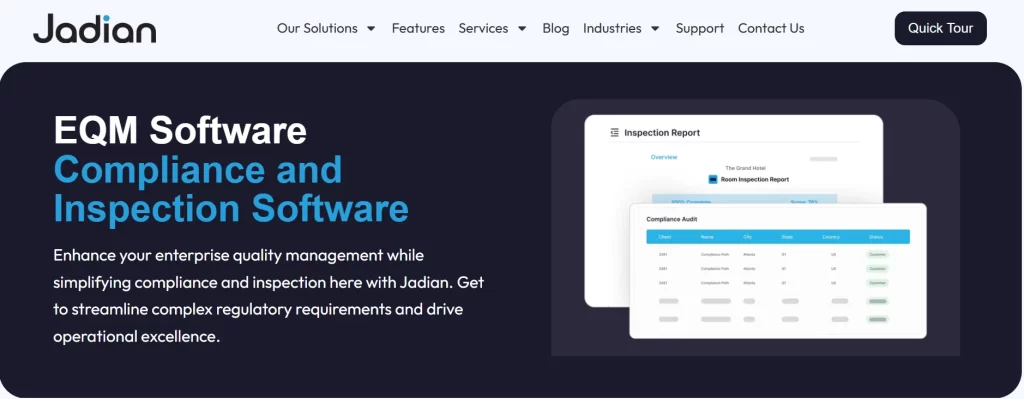
Jadian is a compliance software that helps you centralize and automate your compliance and audit workflows. Its main function is to manage obligations on compliance and regulations, including internal audits, inspections, risk assessments, and solutions.
It is a software that provides a one-stop solution for companies that need structured compliance tracking and record-keeping for audits.
It is also a flexible software that allows for customization and can easily adapt to various industries and their compliance needs.
Notable Features
Jadian provides a wide range of features for robust compliance and seamless audit management, such as:
- Centralized Compliance
Jadian allows organizations to log, control, monitor, and manage tasks for risk management and compliance across various domains.
- Customizable models
You can easily design or import both qualitative and quantitative models that are built to your company’s standards.
- Automated scheduling and tasks
Scheduling of assessments, audits, and inspections can automatically be calendarized to prevent oversight.
- Compliance, audit, and inspection workflows
The software supports inspections, audits, corrective actions, and processes for compliance. This allows you to manage standards by ISO, HACCP, and other regulations.
- Accessibility
Jadian’s modules work on desktop and mobile platforms for easy access and compliance checks anywhere.
- Data and documentation management
All data for compliance and audits is stored centrally. Thus, it is easier to access or retrieve evidence, reports, and track corrective actions.
- Flexibility and custom workflows
The platform also lets businesses customize forms, workflows, templates, and approval logic to fit the company’s internal processes and needs for compliance.
- Support for multiple use-cases and regulatory frameworks
Jadian also supports various regulatory frameworks for various cases. From quality management (ISO standards) to inspections, audits, safety, accreditation, and general compliance and risk, the software is suitable for different industries.
Who Should Use Jadian?
Jadian is recommended for organizations that:
- Has to comply with various regulatory or quality standards (ISO, HACCP, etc.)
- Operate in different sites, locations, or departments
- Need flexible and customizable compliance workflows
- Requires accessibility in different devices (remote or on-site)
- Involved in industries with strict regulatory, quality, and certification requirements (well-suited for medical fields as a healthcare compliance management software)
- Prefer to decrease manual labor
- Aim to automate compliance, risk tracking, and audit-ready documentation
- Vanta

Vanta is a platform for compliance automation that assists smaller and growing companies in automatically tracking compliance, monitoring controls, and being audit-ready with minimal manual costs. It offers businesses fast, easy, and secure services for streamlining operations.
Notable Features
Vanta’s powerful features rest on its automation prowess, which includes:
- Automated and continuous compliance monitoring
This software runs hourly automated tests in order to ensure that controls are correctly in place and are working seamlessly.
- Broad framework support
Vanta supports multiple security and compliance frameworks, such as SOC 2, ISO 27001, HIPAA, and more. It also lets organizations map controls and evidence across such frameworks to prevent duplication.
- Automated evidence collection
It makes use of different integrations, such as cloud, infrastructure, identity, and SaaS tools to automatically gather evidence for auditing instead of relying on manual uploads of data.
- Audit-ready dashboards
The software also offers dashboards and a “trust center” to ensure visibility in real-time into compliance. This is helpful for internal teams and external audits.
- Vendor risk management
Third-party risk management is also in place for risk assessments, reusing of evidence, and documentation management to extend compliance beyond internal systems.
Who Should Use Vanta?
Vanta is well-suited for the following types of businesses:
- Startups
- Scale-ups
- Small to medium businesses
- Business-seeking certifications
- Businesses onboarding clients that require compliance assurances
- Drata
Drata is another compliance tool that is focused on providing efficient compliance and risk management for growing organizations. It is designed to help these organizations reach and maintain continuous compliance instead of simple periodic audit readiness.
Notable Features
Drata offers the following features to its users:
- Automated evidence gathering and control monitoring
Drata allows users to continually monitor controls and automatically document evidence. Thus, eliminates the need for a manual audit preparation.
- Policy templates for various frameworks
It also comes with ready-made templates and a list of frameworks for compliance. This streamlines audits and compliance setups.
- Risk management and compliance dashboards
The software also provides a consolidated dashboard for risk and issue tracking. This ensures that you can track the status of your compliance and remediation in one place.
- Audit-friendly reports
The platform likewise presents businesses with audit-ready reports, documentation exports, and a “trust portal” for sharing compliance updates with external partners.
Who Should Use Drata?
This software is best for:
- Startups
- SaaS companies
- Growing firms
- Businesses that need reliable compliance assistance with minimal manual errors
- Businesses that plan to scale quickly
- Businesses that undergo frequent audits
- LogicGate Risk Cloud
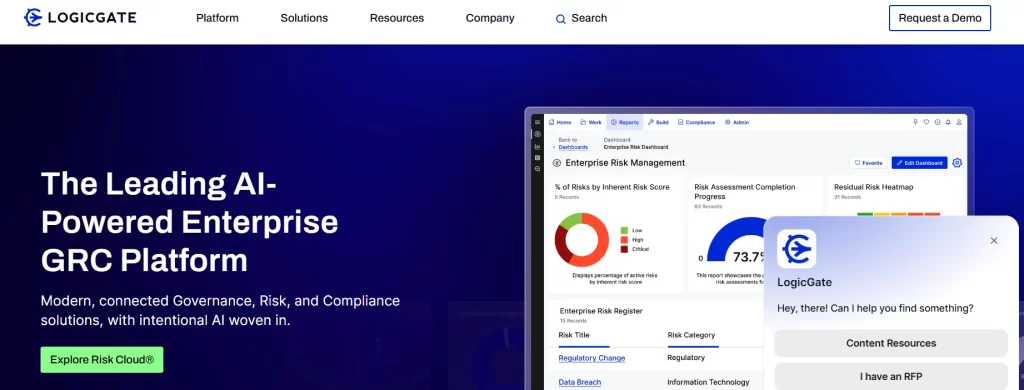
LogicGate Risk Cloud is a governance, risk, and compliance platform that offers flexibility and customizable workflows. It assists businesses in establishing compliance processes that suit their purposes without having to write much code.
Notable Features
LogicGate provides a wide array of features for ease to organizations, including:
- Low-code workflow builder
It allows the companies to custom-create compliance, risk, and audit processes without advanced technical expertise. It only needs drag-and-drop tools.
- Custom risk scoring, registers, and issue management
The platform enables risk assessments that are both qualitative and quantitative. It also tracks incidents by means of resolution.
- Flexible control mapping and framework support
Users can easily map controls covering multiple compliance management software. This platform allows businesses to tailor these controls to their policies and procedures.
- Scalable and flexible architecture
This software is suitable for both small and large enterprises. It can grow and adapt as compliance requirements evolve.
Who Should Use LogicGate Risk Cloud?
LogicGate is perfect for:
- Organizations that want flexibility
- Enterprises with complex processes
- Firms that need compliance automation without rigid templates
- Hyperproof
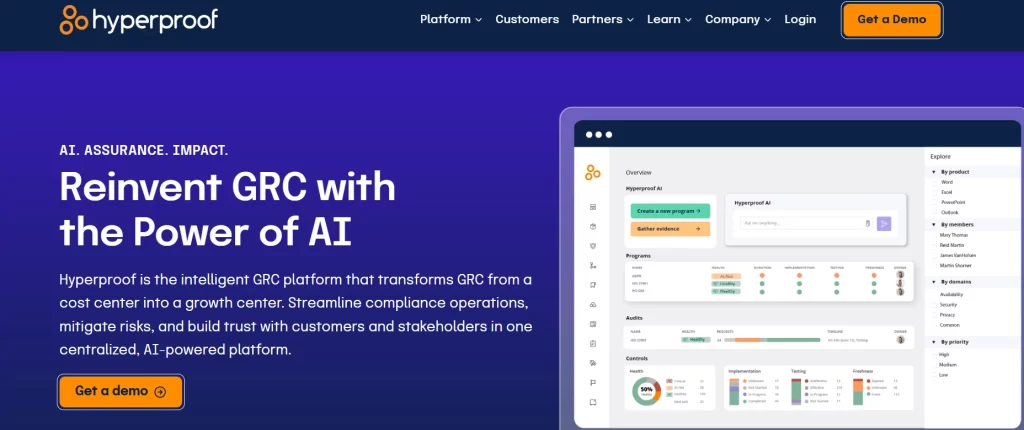
Hyperproof is a compliance and risk management software designed to efficiently ensure continuous compliance, audit readiness, and evidence collection. It is a cloud-based platform that supports different frameworks.
Notable Features
The platform offers strong features for businesses. These include:
- Multi-framework support
Hyperproof supports various frameworks for compliance. It also allows mapping controls across these frameworks to avoid duplication for every standard.
- Automated evidence collection and integrations
The platform can integrate and sync with tools such as Jira, AWS, Google Cloud, and more. With this, it can automatically gather evidence, audit logs, and documentation.
- Collaboration tools and audit workspace
It also offers organizations a centralized audit dashboard, tools for evidence tracking, and provides shared workspaces that are useful for external checks and teamwork.
- Third-party risk and program management
Hyperproof also manages vendor assessments and tracks their compliance status.
Who Should Use Hyperproof?
Hyperproof best fits:
- Teams dealing with various compliance requirements
- Companies that need continuous compliance monitoring
- Businesses that require collaborative audits
Read More >> Top 10 Food Safety Inspection Software for Restaurants: 2026 Buyer’s Guide
- OneTrust
OneTrust is a governance, risk, and compliance platform that is widely used for its emphasis on privacy, governance of data, and regulatory compliance. It assists organizations in managing data protection, third-party risk, privacy laws, and different compliance frameworks in one platform.
Notable Features
This software puts privacy as its priority. Here are some of its standout features:
- Comprehensive privacy, risk, and compliance platform
OneTrust combines your management of data privacy and compliance in various frameworks all in one suite. It also allows you access to risk assessment, vendor risk, and audit workflows in the same platform.
- Policy management
It likewise maintains a policy library that distributes policies across your teams. This software also tracks acknowledgments or attestations by such teams.
- Data mapping
As mentioned above, OneTrust also supports risk assessments of vendors, breach monitoring, and vendor questionnaires. This is essential for companies that partner with third parties.
- Flexible reporting and controls
This platform offers robust reporting and role-based access for various types of employees. It also has a multi-entry program control for complex organizations.
Who Should Use OneTrust?
OneTrust comes highly recommended for the following types of organizations:
- Enterprises
- Large businesses
- Companies with important data privacy
- Organizations that deal with security and customer data
- Businesses that are subject to privacy laws, data protection regulations, or data-sensitive compliance rules
- VComply
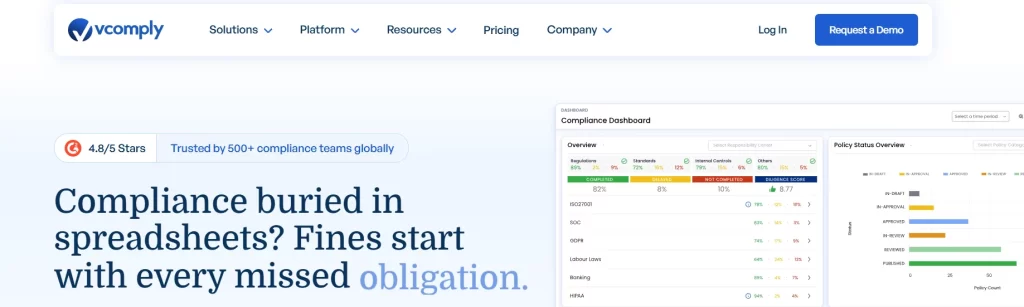
Compared to the other tools, VComply is simpler and more lightweight. It is a software that is aimed at small to mid-sized companies. It offers a seamless service that allows these companies to get rid of spreadsheets and email-based compliance workflows.
Notable Features
VComply’s charm rests on its simple yet reliable service. Some of its features include:
- Task and calendar-based compliance workflows
VComply allows teams to track compliance tasks, deadlines, and responsibilities in one system. It is an easier alternative to full GRC (governance, risk, compliance) platforms.
- Centralized tracking and dashboards
This software helps teams manage documents, status, and tasks within a single unified interface. This is much better than spreadsheets.
- Scalability
The platform is designed to scale with your company’s increasing compliance needs. It does this without the complexity or added cost of enterprise-level GRC suites.
Who Should Use VComply?
This software is perfect for:
- Small to medium companies
- Teams with limited compliance needs
- Organizations that need a straightforward tool without the added cost of GRC platforms
- NAVEX One
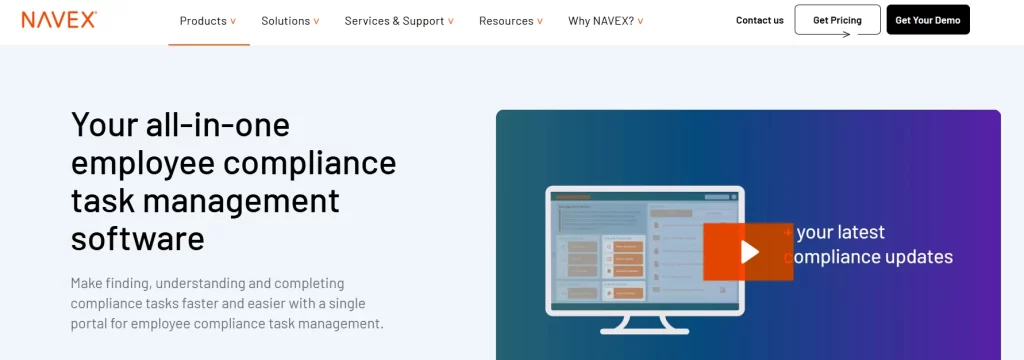
It is a cloud-based GRC suite that is designed to be a comprehensive platform that manages compliance, risks, policy, and incidents. NAVEX One offers a fused approach to compliance across different frameworks.
Notable Features
As a unified platform for compliance, it offers the following features to its users:
- Centralized Data
NAVEX One offers a central “hub” and a shared data model. It allows different departments within the company to view real-time risk and compliance data in one system.
- Incident Management
The platform has a hotline and a web intake system. This is enabled for whistleblower reports and incident management to report breaches in compliance, misconduct, or ethical issues.
- Document Control and Procedure Management
It also allows businesses to create, update, or retire policies and procedures. This way, they can manage the entire policy lifecycle in a structured way. It also has an audit-trail support that lets you track changes over time and maintain records for auditing purposes.
- Reporting, Analytics, and Data Intelligence
NAVEX One’s built-in dashboards include analytics, reporting tools, and cross-program insights. These features allow businesses to analyze and track compliance data, metrics, and performance.
Who Should Use NAVEX One?
This platform is well-suited for the following enterprises:
- Medium to large businesses
- Organizations that need a unified compliance and risk program
- Companies that deal with third parties/vendors
- Enterprises that require internal policy compliance and incident management
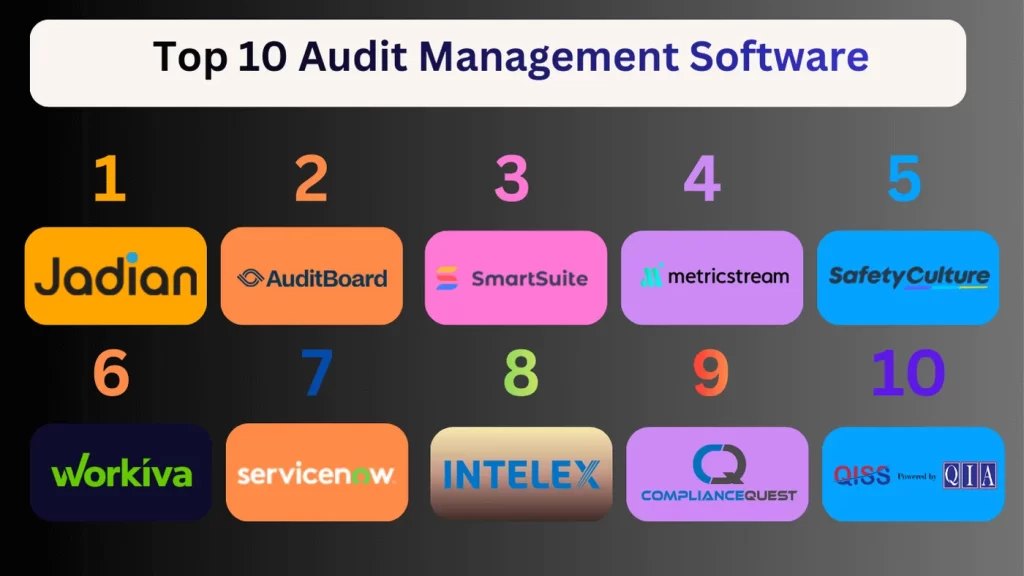
Read More >> Guide to the Top 10 Audit Management Softwares
- MetricStream
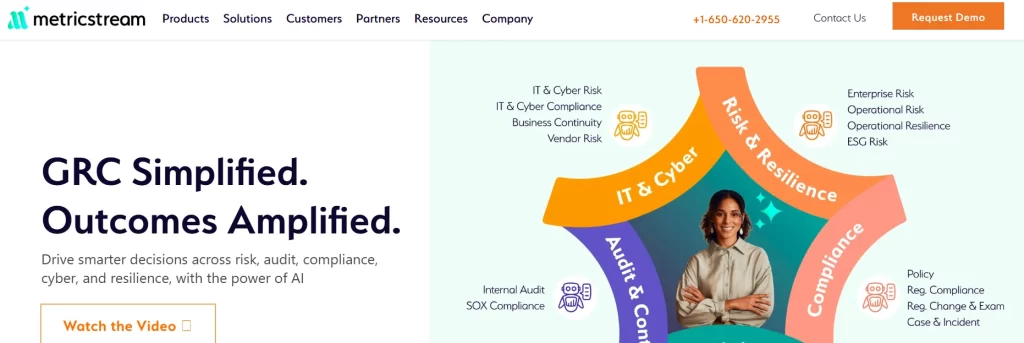
MetricStream is another one of the GRC tools that is built to support large and complex businesses. It is a full-fledged enterprise that is a go-to for organizations that need comprehensive compliance coverage. It covers multiple regulatory, operational, and risk domains.
Notable Features
MetricStream also provides a comprehensive set of detailed features, including:
- Centralized control and framework mapping
This feature lets businesses design and manage a unified control library. They can map and control each library to relevant standards and laws for compliance. This helps in ensuring consistency across different jurisdictions and regulations.
- Automated management
The platform also provides updates to policies or controls when compliance laws evolve. It can help track changes in regulations or compliance requirements automatically.
- Third to fourth party risk
MetricStream’s system does not just handle internal compliance. It also tracks risks for vendors and third parties.
- AI-powered insights
Aside from real-time analytics and dashboards, the software also makes use of AI to help forecast risk and suggest optimizations.
- Support for audit management
This feature is useful for both internal and external audits. It also helps in evidence collection and continuous compliance monitoring.
Who Should Use MetricStream?
This software is best suited for:
- Large businesses operate across different locations
- Industries with strict compliance requirements
- Organizations that need to cover governance, risk, and compliance programs
- Enterprises that need scalability, customization, and analytics control
- Sprinto

Sprinto is another modern take on compliance tools. It is a cloud-based automation platform that is designed to help fast-growing companies and SaaS-based organizations. It helps maintain compliance by supporting different standards and frameworks. This software is built for agility and automation.
Notable Features
Some of Sprinto’s notable features include the following:
- Automated compliance and evidence collection
The software supports different frameworks such as SOC 2, ISO 27001/27017, HIPAA, and GDPR. It allows companies to map controls and check compliance automatically. It also collects evidence from cloud tools to reduce manual auditing preparation.
- Up-to-date monitoring
Sprinto provides real-time monitoring continuously. It likewise solves compliance gaps and risks.
- Alerts and notifications
Compliance workflows in Sprinto are automated, and alerts are set for required actions. This minimizes manual errors and oversight.
- Support for SaaS businesses
Sprinto is designed for cloud-based operations. Thus, it can integrate with common cloud services.
- Simplified audit process
Since evidence collection and compliance is constantly tracked, audits are smoother and faster for businesses.
Who Should Use Sprinto?
Sprinto is well-recommended for the following entities:
- SaaS companies and technology firms
- Small to medium-sized businesses
- Organizations that need compliance certifications
- Enterprises that need automation with minimal manual effort
Expert Tips for Choosing the Right Software
There are many different regulatory compliance management software solutions out there. The software listed above is the best among them. Choosing the right software for you might be difficult as each of them offers advantageous features.
To help you decide, here are some expert tips to help you select the right one for your business:
- Identify your compliance frameworks first
A specific list of frameworks is the foundation for selecting the right system. You must first define which standards or regulations your business must follow. Knowing the right frameworks and their requirements will help you identify which tool best fits your regulatory environment.
It also helps ensure that the platform can map your controls and collect evidence correctly. Plus, you can avoid paying for features that are unnecessary.
- Compare feature depth vs. usability
Looking for the right balance between advanced capabilities and simplicity helps you identify whether the platform is useful for your team. A platform that offers various features but is difficult to adapt to might end up wasting your money. Search for the following features in a tool:
- Deep automation for evidence collection and control monitoring
- Intuitive dashboards and clean workflows
- Easy onboarding and minimal learning requirements
- Policy and audit templates that reduce manual setup
- Evaluate long-term scalability
It is likewise imperative that your business utilize a platform that can be used for a long time. In order to identify whether a tool has long-term scalability, consider the following:
- Support for multiple frameworks as your requirements evolve
- Ability to manage enterprise-level workflows, users, and teams
- Flexible integrations with evolving technology
- Modular add-ons for risk, audit, or vendor management
- Strong performance even with large data volumes
This will help you save money in the long run.
- Review customer support ratings
Opinions from long-time users will help in identifying whether a compliance and risk management software is a good choice. Take into consideration what other businesses say about a particular service.
Bottomline
By 2026, businesses will have broken the tradition of manual processes and weak spreadsheets. It is not a single-time audit anymore, but a continuous, strategic aspect of business that ensures that operations run smoothly and provides a competitive advantage.
In order to maintain certifications and resilience over time, businesses should have real-time compliance checks, artificial intelligence forecasting, constantly-adapting policies, and complete support of hybrid teams.
The compliance can be made into a strategic win with the help of such platforms as Jadian. This software consolidated compliance, inspections, and field work under a single cloud solution, which provides automation, real-time data tracking, and mobile access, which is what contemporary companies require.
The possibility of failure in audits and loss of certifications increases with the use of outdated systems. The action required to be taken to handle regulation is with state-of-the-art compliance tools.
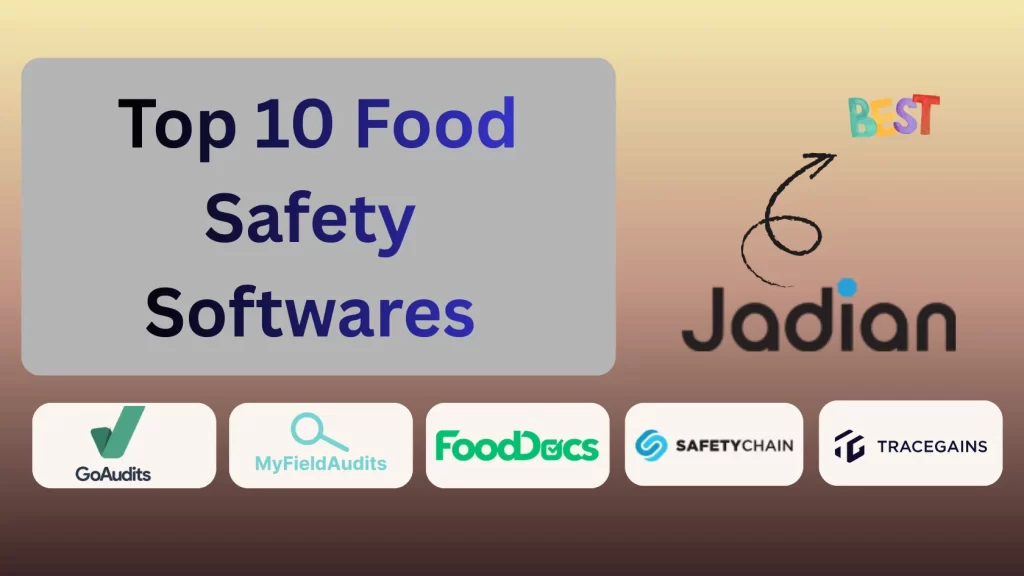
Read More >> Choosing Food Safety Software in 2026? Here’s Our Guide of the Top 10 Softwares
Want to get out of spreadsheets?
Get a free demo and see how Jadian will change the way you do compliance and field work.
Frequently Asked Questions (FAQs)
- Is compliance software necessary for all industries?
Every type of company is valuable, but it is particularly valuable to the industries that have to adhere to strict regulations, such as finance, healthcare, government, manufacturing, and SaaS, and any business that cooperates with data and has a security risk.
- Can compliance tools automate audits completely?
No, they can’t afford to rely only on software. The software of compliance assists in collecting and reporting the evidence, and still, it is necessary to examine certain areas. People have to be interviewed, and processes walked through by auditors, and policies, procedures, and risk decisions still require a manual process to write and sanction.
- How do you measure ROI from compliance software?
ROI is observed as quantifiable items, such as a reduction in evidence gathering time, decreased audit expenses, reduced risk of penalties, reduced manual error, accelerated certification of certification (such as SOC 2 and ISO 27001), and increased efficiency.
4. How long does it take to implement compliance software?
Installation of a tool normally occupies between two and eight weeks for most cloud solutions. More complicated Governance, Risk, and Compliance systems that require personal workflows and integrations may require more time.
5. What integrations should compliance software support?
An effective solution must be compatible with identity providers (Okta, Azure AD), cloud solutions (AWS, Azure, GCP), HR applications (BambooHR, Workday), ticketing systems (Jira, ServiceNow), and other security solutions.