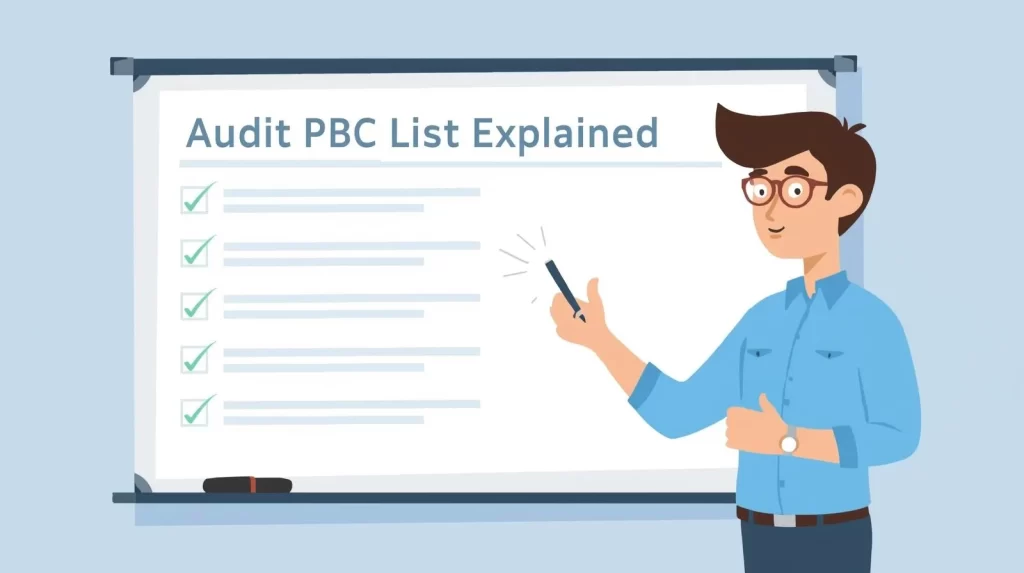
The Audit PBC List is an important document in the external audit process, acting as a broad checklist that the audit team requires from the client. This is the key to a smooth, efficient, and timely audit since it organizes the information and preparation required by the client’s team.
This updated guide covers its significance and best practices for management in 2026. An attempt to provide an in-depth understanding for both first-time auditees and seasoned financial professionals.
What Does PBC Stand For in Audit and What is Its Meaning?
The term PBC stands for “Prepared By Client” in the context of an audit. It entails schedules and data that the client’s staff must prepare and provide to the external auditors. Hence, the PBC audit’s meaning is based on the client’s responsibility to deliver specific evidence.
This is a must-have for the audit team to do their work and form their own opinion on the financial statements.
Why is the Client Responsible for PBC Items?
Management is responsible for the accurate and fair presentation of financial statements, which is a core principle of auditing. The auditor’s task is to provide independent assurance that these statements are not falsified, whether due to error or fraud.
Therefore, the auditor cannot prepare the working papers; these must be prepared by client management to establish their claim over the financial data.
What is the Audit PBC List (or Audit Request List)?
The Audit PBC List, also known as the Audit Request List or Information Request List (IRL), is a comprehensive checklist compiled by the external audit firm. It summarises everything needed from the client to perform the audit procedures effectively. This is a notable project plan that describes the format, requirements, and deadlines.
Why is the PBC List so Important for a Successful Audit?
A clear, and secure PBC list is the first line of defense against audit chaos and delays.
- Clarity and Transparency: Reducing biases and assuring client stakeholders understand what and when the information is needed, and who is responsible for providing it.
- Efficiency and Time Savings: With complete and organized documents, auditors can spend less time chasing files. Results show faster and simpler auditing with lower overall fees for the client.
- Completeness of Evidence: All material accounts and audit cycles should be complete and supported by the client’s proof of documentation. This is to check if there is a risk of a scope limitation or a wrong audit file.
- Shared Tracking: Modern PBC lists function as advanced dashboards for both the audit firm and the client which check the real-time status of audit requests (e.g., Pending, Received, Reviewed).
What is the Full Form of PBC in Accounting?
While the most common industry usage is “Prepared By Client” in the audit context, the PBC full form in accounting is fundamental to client-generated support.
When any external accountant or financial advisor asks the internal accounting team to produce a schedule or analysis, it falls under the PBC category. The document must be created or extracted actively by the internal team, not left dormant.
Key Components of the Audit PBC List (A Detailed Checklist)
The structure of the audit request list is dynamic, customized for each client based on their operations, industry, and risk profile. However, it is organized based on the financial statements. Developing these requires heavy effort and is the main reason clients need to start early.
1. General and Administrative Items
These items provide the auditors with a primary understanding of the company’s structure and governance.
- Organizational Documents: Updated organizational chart, list of important personnel, and contact information.
- Governance: Record of all meetings by the key committee members and the Board of Directors within the review period.
- Legal: A Legal Representation Letter draft to be sent to the company’s external legal counsel with descriptions of any current or pending litigation and contingent liabilities.
- Contracts: A detailed summary of all material contracts, which includes important leases for the year, financing arrangements, and any non-standard vendor/customer contracts.
- Internal Controls: A report or memo that contains all changes that are significant to the company’s internal controls, systems, or accounting policies since the last audit.
2. Financial Statements and General Ledger
These form the basis and core evidence for the entire audit.
- Trial Balance (TB): The final, frozen TB for the period, which is ideally provided in a searchable Excel format.
- General Ledger (GL): The detailed GL activity for all accounts, which the auditor uses for substantive testing.
- Draft Financial Statements: The complete draft of financial statements, which the client provided, includes footnotes and all schedules and disclosures.
- Journal Entries: A comprehensive list and support for every non-standard or important year-end journal entry.
3. Assets Section (Balance Sheet)
The PBC list requires exact schedules that tie out (reconcile) to the final general ledger balances.
- Cash and Bank: Month-long Bank Reconciliations for all accounts for the entire year, with copies of the final bank statements, and a list of authorized bank signers.
- Accounts Receivable (A/R): A detailed A/R Aging Report which lists outstanding customer balances, a reconciliation to the GL balance, and management’s analysis of the Allowance for Doubtful Accounts.
- Inventory: Final Inventory Count Sheets, proof of the physical count procedures, and the detailed Inventory Valuation Report (costing method, overhead allocation, and write-down calculations).
- Fixed Assets (PP&E): The Fixed Asset Roll-Forward Schedule, which records additions, disposals, depreciation expense, and accumulated depreciation for the year. This schedule must be aligned with the GL. Invoices for major asset acquisitions are also required.
4. Liabilities and Equity Section (Balance Sheet)
This section focuses on guaranteeing that all obligations are recorded and equity changes are properly documented.
- Accounts Payable (A/P): A detailed A/P Aging Report, aligned to the GL, and copies of vendor statements for the largest balances to help with the search for unrecorded liabilities.
- Accrued Liabilities: Complete supporting schedules for all material accruals, including every accrued payroll, accrued bonuses, accrued warranty expense, and accrued property taxes.
- Debt: A detailed debt schedule that shows the principal balance, interest rate, payments made, and any new borrowings or repayments made during the year. All loan agreements should have a copy on file.
- Equity: An elaborate schedule of all changes in equity during the period (e.g., stock issuances, dividends, or treasury stock activity), typically supported by Board approvals.
5. Income Statement (P&L) Items
The PBC for the P&L constantly focuses on cut-off and specific non-routine transactions.
- Revenue Cut-off: Records of the last five sales invoices before year-end and the first five after year-end to certify revenue is recorded in the correct period. To ensure all cut-off adjustments are properly reflected.
- Expense Cut-off: Records of invoices that were received and paid around year-end to test for proper expense recording. To ensure all liabilities are recorded in the correct time period.
- Payroll: The consolidated Payroll Register for the year, including a reconciliation of the register to the GL expense, along with copies of key tax filings (e.g., Form 941).
The Evolution of PBC Management in 2026
Scattered boxes of paper and unsecured emails that auditors receive are quickly declining. By 2026, PBC management will be efficient, heavily relying on practical processes and technology.
Centralized Digital Platforms
Audit firms nowadays use a more secure client portal (sometimes referred to as a dynamic request list) to oversee the PBC process.
- Request Hosting: The PBC list is loaded onto the portal, with a dedicated section for each item. This allows clients to upload supporting documents directly and connect with auditors securely.
- Secure Upload: By directly uploading to the corresponding request item, the client ensures that the data is secured and organized properly, enhancing audit efficiency.
- Real-Time Tracking: Every item status, including Requested, Submitted, In Review, Needs Clarification, or Finalized (OK), is shared both to the client and the audit team. This real-time visibility cuts down miscommunication notably.
The Role of Automation
Automation features, constantly integrated into these platforms, are becoming standard. They send automated follow-up reminders to the client for overdue items. Also includes progress tracking, generating status reports for efficiency and transparency.
Some AI-powered tools can even carry out basic document validation, ensuring, for example, that an uploaded bank reconciliation statement contains a date that matches the request. This reduces avoidable rejection of improperly formatted or incomplete files.
Best Practices for Managing the Audit PBC List
A client’s effectiveness in managing the PBC list is a key element of audit success. Management should treat the PBC list as a high-priority, interdepartmental project.
1. Plan Early and Assign Clear Ownership
- Set the Strategy: When the final PBC list is received, the client’s CFO or Controller should hold a kick-off meeting with internal teams. This includes HR, Payroll, IT, and Legal.
- Delegate Explicitly: Every single item should have a specific internal owner and a realistic due date. One person for every document is inefficient and prone to delays.
- Adopt a Standard Naming Convention: All internal owners must use a standardized naming convention before uploading. Maintaining organization is important in this aspect.
2. Prioritize “Tie-Outs” and Formatting
- Reconciliation is King: “Tie-Out” is the golden rule of PBC. Schedules like A/R Aging and Fixed Asset Roll-Forward you provide must reconcile precisely. If it doesn’t tie out to the final balance in the General Ledger and Trial Balance, the auditors will not use it and reject it, insisting on correcting it.
- Follow Format Instructions: If they request an Excel file, then do not submit a PDF. If they request a GL detail export with specific columns, ensure those are present. Requests from the auditor must be followed, as they can cause significant delays.
- Provide Searchable Documents: PDFs that are searchable, created directly from a file and not scanned images, are preferred. This allows the auditor to find specific transactions effectively and efficiently.
3. Proactive Communication and Flexibility
- Start with Key Items: Inputs like the Trial Balance, General Ledger, and, most complex, year-end schedules (like Fixed Assets and Accruals) should be prioritized. These are what the auditor needs the most to start with analytical procedures.
- Raise Concerns Immediately: Contact the audit manager immediately if something is impossible to produce in the requested format. Discuss other acceptable alternatives that can still satisfy their objective.
- Manage the Flow: Monitor the real-time status tracker actively. Address items that are marked “Needs Clarification” first. Focus on these since they can stop the audit process for that specific area.
FAQ: Audit PBC List
What is the full form of PBC?
The PBC full form is “Prepared By Client”. The client’s staff must prepare and submit all documents, schedules, and data to the external auditors.
What does PBC mean in accounting?
PBC in accounting means information that the client’s internal team must generate, analyze, and reconcile for an external party. This completes their engagement.
What is a PBC list?
A PBC list is a thorough checklist of everything, including documentation and supporting evidence. This acts as a mandatory audit roadmap that an audit client must provide to the external auditors.
When should the client receive the PBC list?
The full audit request list should be provided within 30 to 60 days, ideally before the expected start date of fieldwork. This can give the client sufficient time to prepare schedules.
What happens if a client doesn’t provide the PBC items on time?
If a client doesn’t provide the PBC audit items on time, it can cause massive audit delays and cost overruns. The audit team is forced to wait, which can lead to higher fees, missed reporting deadlines, and frustration from both parties.
What does “tie-out” mean on a PBC schedule?
A “tie-out” means an exact match on the ending total of the client’s submitted supporting schedule (e.g., Accounts Receivable balance) and the corresponding balance recorded in the General Ledger and Trial Balance. If they do not match, the schedule will be rejected.